Bonus Content: Playbill for The Insurrectionist’s Masquerade

Bonus Content: Playbill for The Insurrectionist’s Masquerade

If you’ve read Sung in the Shadows, then have I got a treat for you! (And if not, you can still read this and enjoy it, and it might even make your reading of Sung in the Shadows a little richer!)

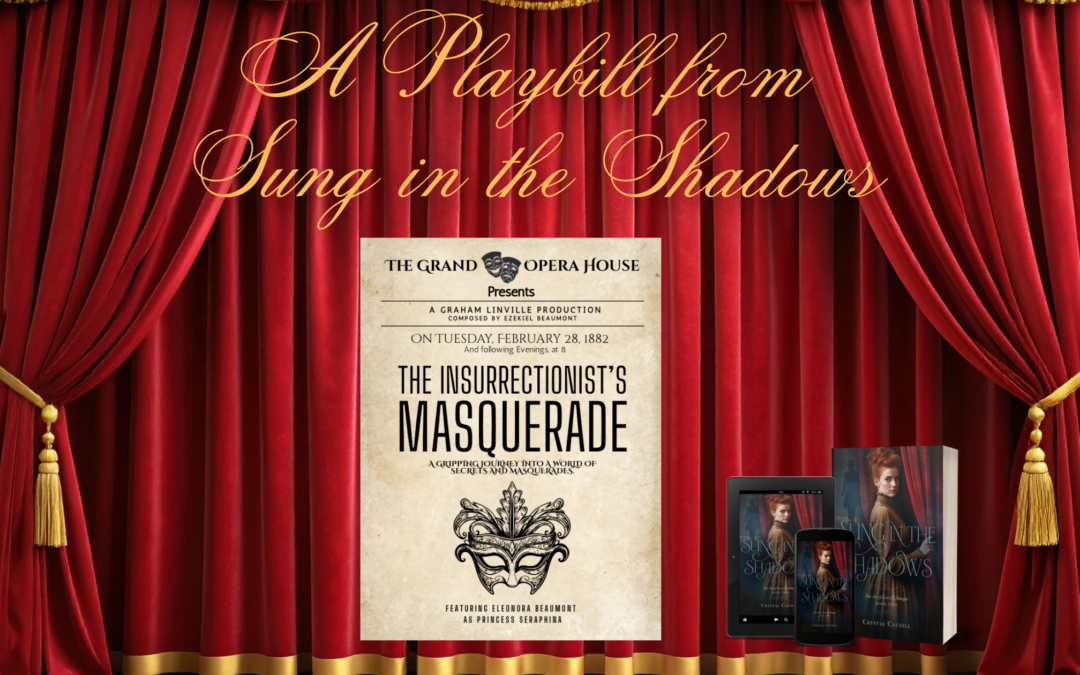
Remember how Ezekiel was commissioned to write the music for an opera? The storyline was vaguely referenced, and so I decided that what could be more fun than to have the actual playbill from the final production? So without further ado, settle in for a peek at Ezekiel’s opera. (Unfortunately, I have no music. How sad.)

*I do confess, I did use AI to help create the story, then I edited it to make it fit what I wanted it to be. There are only so many hours in a day and only so much creativity in the midst of life. Plus, writing an opera plot is WAY out of my wheelhouse. So I pray you will give me grace for using AI to help me create a bonus material item. The playbill is my design.*

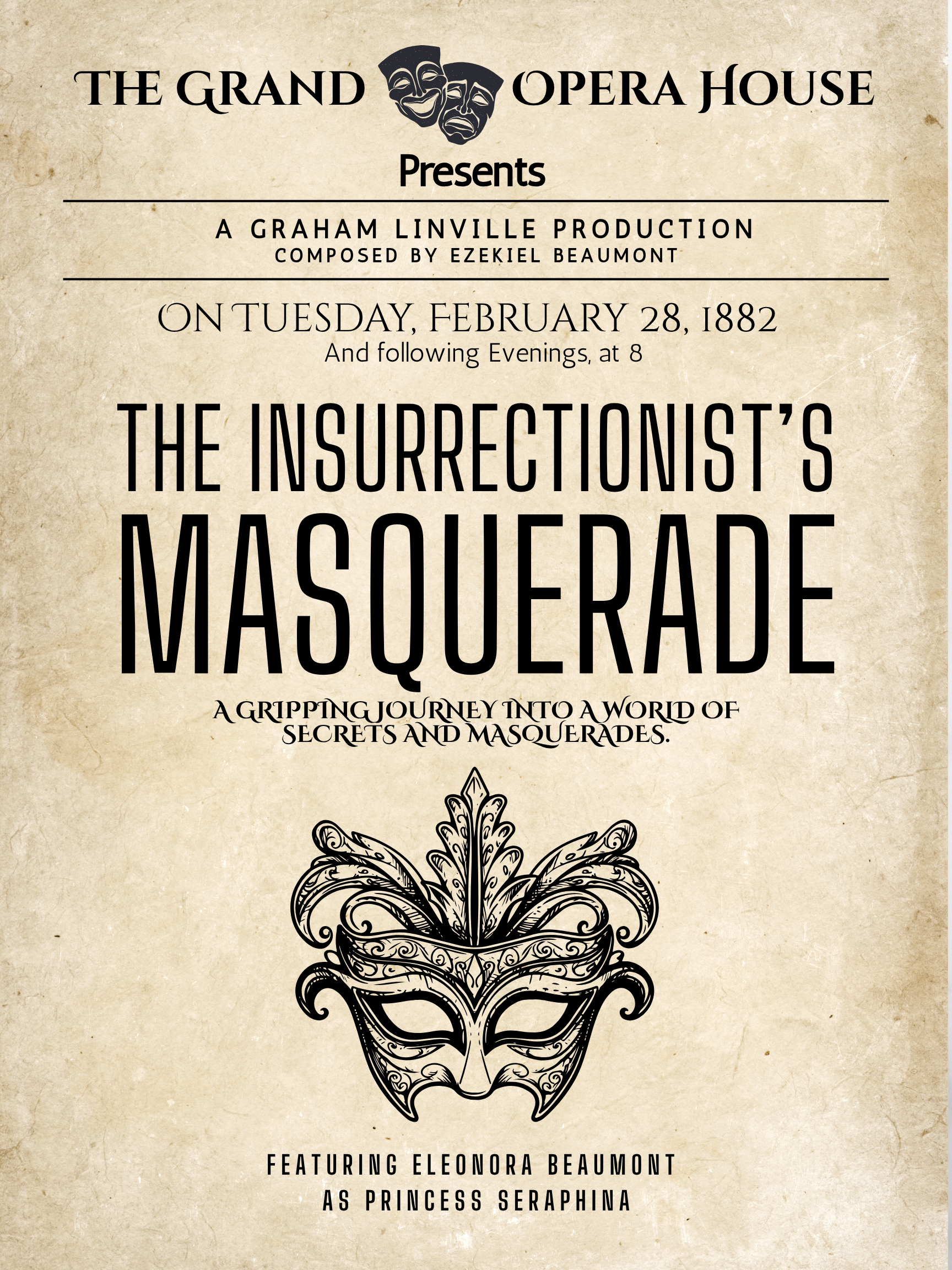
First page of the playbill for The Insurrectionist's Masquerade

The Grand Opera House 
Presents
A Graham Linville Production
Composed by Ezekiel Beaumont

On Tuesday, February 28, 1882
and following evenings at 8

The Insurrectionist’s Masquerade

A gripping journey into a world of secrets and masquerades

Featuring Eleonora Beaumont
as Princess Seraphina

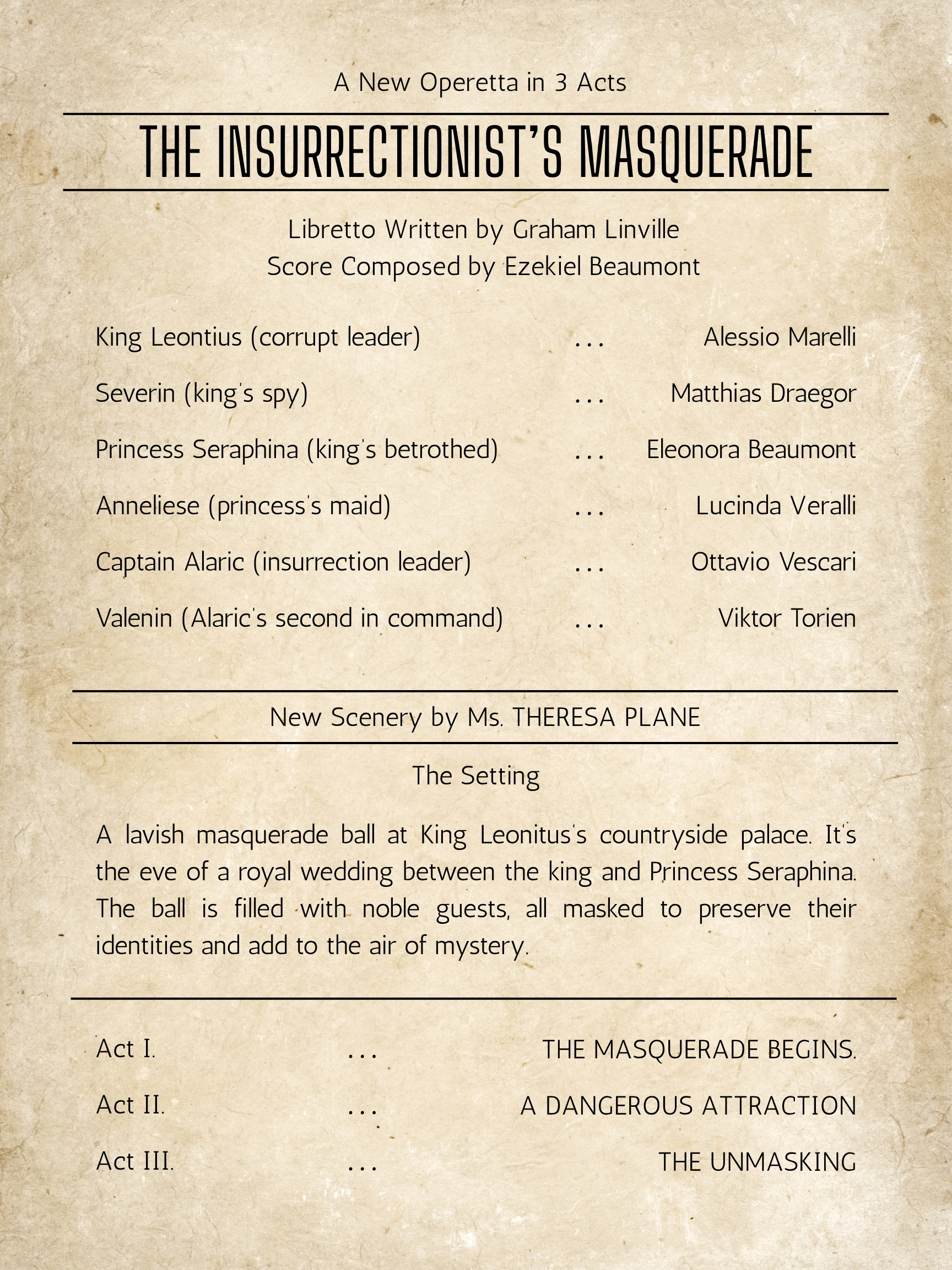
Page 2 of playbill

A New Operetta in 3 Acts

The Insurrectionist’s Masquerade

Libretto Written by Graham Linville
Score Composed by Ezekiel Beaumont

King Leontius (corrupt leader) . . .  Alessio Marelli
Severin (king’s spy) . . .  Matthias Draegor
Princess Seraphina (king’s betrothed) . . . Eleonora Beaumont
Anneliese (princess’s maid) . . . Lucinda Veralli
Captain Alaric (insurrection leader) . . . Ottavio Vescari
Valenin (Alaric’s second in command) . . . Vicktor Torien

New Scenery by Ms. Theresa Plane

The Setting
A lavish masquerade ball at King Leonitius’s countryside palace. It’s the eve of a royal wedding between the king and Princess Seraphina. The ball is filled with noble guests, all masked to preserve their identities and add to the air of mystery.

Act I . . . A Masquerade Begins

Act II . . . A Dangerous Attraction

Act III . . . The Unmasking

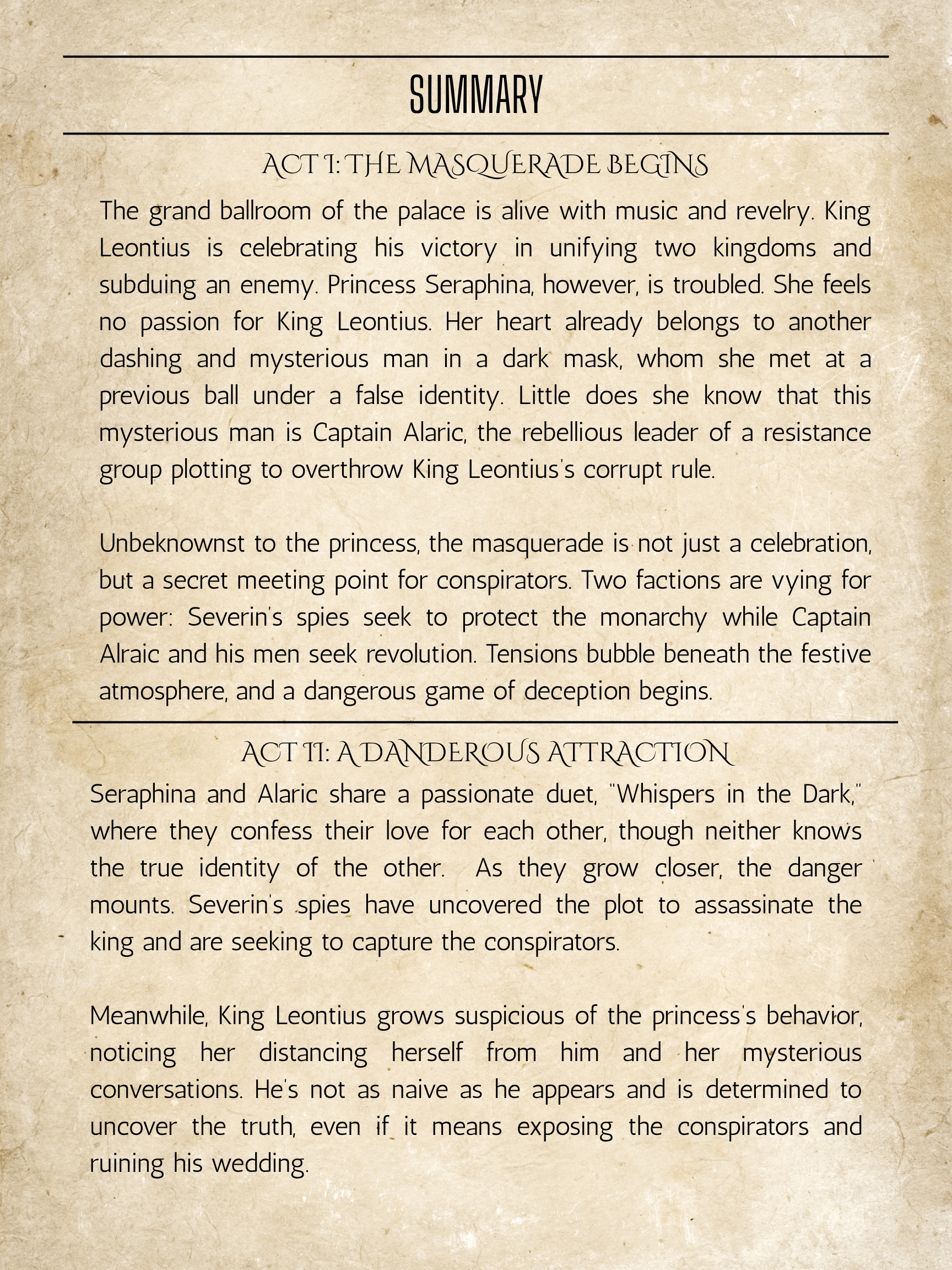
Page 3 of the playbill

Summary

ACT 1: THE MASQUERADE BEGINS

The grand ballroom of the palace is alive with music and revelry. King Leontius is celebrating his victory in unifying two kingdoms and subduing an enemy. Princess Seraphina, however, is troubled. She feels no passion for King Leontius. Her heart already belongs to another dashing and mysterious man in a dark mask, whom she met at a previous ball under a false identity. Little does she know that this mysterious man is Captain Alaric, the rebellious leader of a resistance group plotting to overthrow King Leontius’s corrupt rule.

Unbeknownst to the princess, the masquerade is not just a celebration, but a secret meeting point for conspirators. Two factions are vying for power: Severin’s spies seek to protect the monarchy while Captain Alraic and his men seek revolution. Tensions bubble beneath the festive atmosphere, and a dangerous game of deception begins.

ACT II: A DANGEROUS ATTRACTION

Seraphina and Alaric share a passionate duet, “Whispers in the Dark,” where they confess their love for each other, though neither knows the true identity of the other. As they grow closer, the danger mounts. Severin’s spies have uncovered the plot to assassinate the king and are seeking to capture the conspirators.

Meanwhile, King Leontius grows suspicious of the princess’s behavior, noticing her distancing herself from him and her mysterious conversations. He’s not as naive as he appears and is determined to uncover the truth, even if it means exposing the conspirators and ruining his wedding.

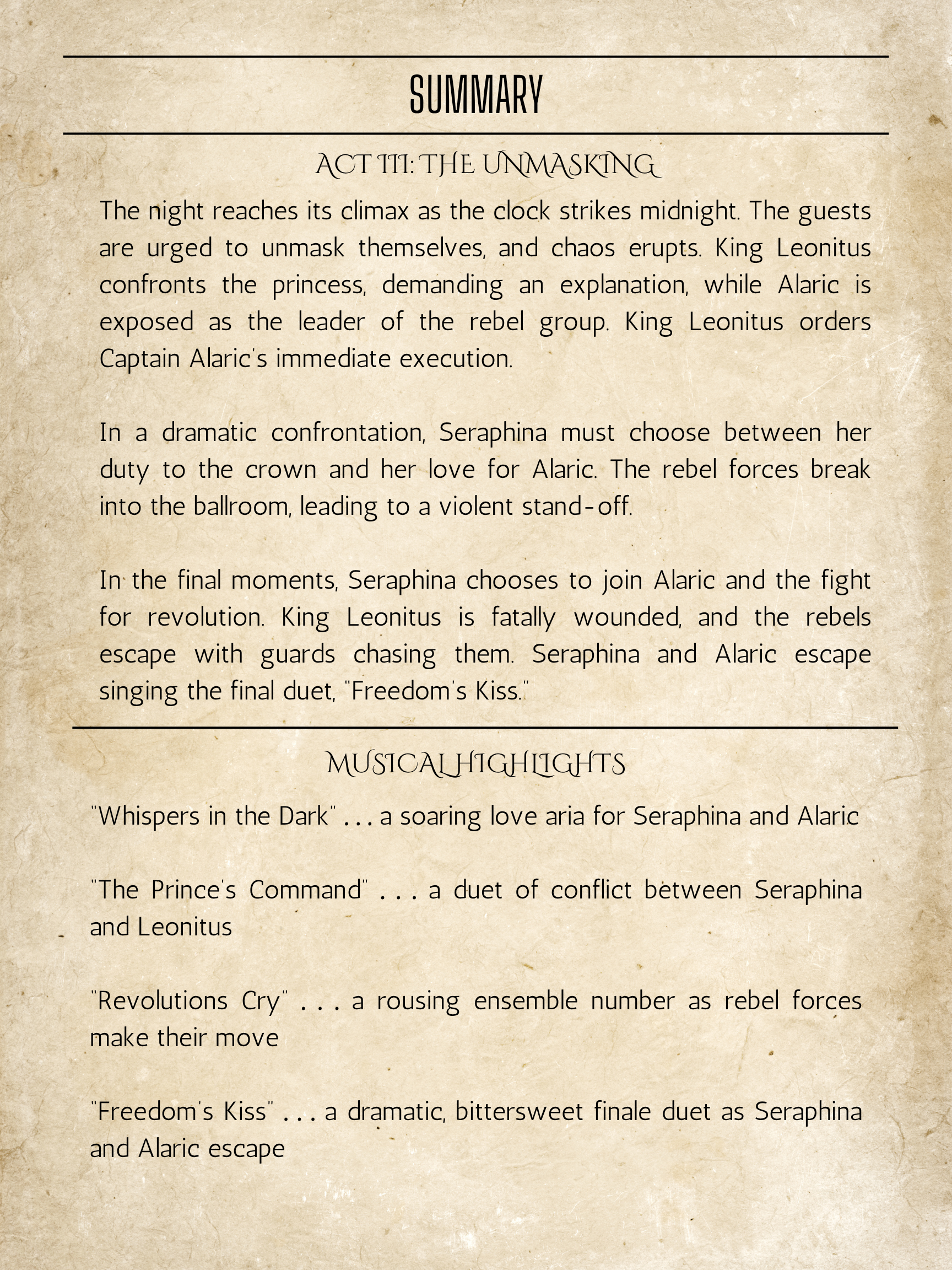
Page 4 of the Playbill<br />

Summary

ACT III: THE UNMASKING

The night reaches its climax as the clock strikes midnight. The guests are urged to unmask themselves, and chaos erupts. King Leonitus confronts the princess, demanding an explanation, while Alaric is exposed as the leader of the rebel group. King Leonitus orders Captain Alaric’s immediate execution.

In a dramatic confrontation, Seraphina must choose between her duty to the crown and her love for Alaric. The rebel forces break into the ballroom, leading to a violent stand-off.

In the final moments, Seraphina chooses to join Alaric and the fight for revolution. King Leonitus is fatally wounded, and the rebels escape with guards chasing them. Seraphina and Alaric escape singing the final duet, “Freedom’s Kiss.”

MUSICAL HIGHLIGHTS

“Whispers in the Dark” . . . a soaring love aria for Seraphina and Alaric

“The Prince’s Command” . . . a duet of conflict between Seraphina and Leonitus

“Revolutions Cry” . . . a rousing ensemble number as rebel forces make their move

“Freedom’s Kiss” . . . a dramatic, bittersweet finale duet as Seraphina and Alaric escape

If you haven’t read Sung in the Shadows yet, you can learn more about it here. 

My question for YOU:

What did you think of the operetta? 

I modeled the design after playbills of the time, so I hope it felt like a night at the theater for you. I loved how there were parallels to The Insurrectionist’s Masquerade and Sung in the Shadows. (Yes, I purposely built those in and tweaked AI’s story to do what I wanted for the operetta.)

ABOUT CRYSTAL CAUDILL

Crystal Caudill is the author of “dangerously good historical romance.” Her debut novel, Counterfeit Love, was a 2023 Carol Award finalist, and her novella, “Star of Wonder,” won the 2024 Christy Award for short form. She loves history, hot tea, all things bookish, and the Teenage Mutant Ninja Turtles. She is a stay-at-home mom, caregiver, and chaos organizer. When she isn’t writing, Crystal can be found hanging with her family and playing board games at her home outside Cincinnati, Ohio. Find out more at crystalcaudill.com.

Connect with the author:

Website  |  Newsletter  |  Facebook  |  Facebook Group  |  Instagram  |  Pinterest  |  Amazon  |  BookBub  |  GoodReads

Meet the Cast of Sung in the Shadows

Meet the Cast of Sung in the Shadows

Continuing in my series of post about Sung in the Shadows, I want to introduce the characters. If you’ve seen the social media posts, you’ll recongize some of the information, but blog posts allow for a little more space to add more information. For each character I’ve shared a bit about their creation, a favorite quote from them or scene in Tristan’s case, and the pictures I used for inspiration while writing. 

Image of the inspiration for Ezekiel Beaumont - a man with dark hair and a dark beard in a suit.

Ezekiel Beaumont

Inspiration: A bit of my husband shows up in every hero, but especially his steadiness when Nora’s sanity was in question. My husband and I have been through some serious family stuff where I thought I would lose my mind. He was the steady rock I needed to remind me of THE ROCK when I was drowning and fearful.

A bit about him:

  • composer & stage manager at Pike’s Opera House
  • Visits his mother at Longview Asylum every week
  • Determined to win Nora over with his wit and steadiness
  • Protective and faithful
  • Believes Nora’s mother is the famed opera singer who disappeared mid-performance


Favorite Quote from him:

“God never promised to remove the burdens of our lives, but to bear that burden with us and to help guide and direct us through it. Maybe Jesus has paired us under the same yoke so we can share each other’s burdens as He guides us through this mess of life.”


Nora (Brisbane) Davis

Inspiration: Each of the Guardians reflects one of my “Mayhemmer” friends. Nora best reflects Angela Carlisle (who is an amazing contemporary romantic suspense writer). Both are incredible knitters, absolutely terrifying in their ability to protect themselves, but are quiet and keep most of their thoughts to themselves. And if you don’t know her, Angela can sometimes be hard to read. But both women have incredible faith despite what they have walked through.

A bit about her:

  • Kidnapped as a child, but escaped
  • quiet, independent, a knitter, harbors secrets from her friends, The Guardians
  • trained by her opera-singing mother, but the music/theater world is forbidden
  • Afraid of trusting the man who’s taken an interest in her
  • sees her kidnappers everywhere and fears she is going mad like her mum


Favorite Quote from her:

“If there is one thing I’ve learned through Mum’s illness, it’s that her choices are hers alone. We can do everything in the world to protect our loved ones—put rules in place, hide them from the dangers posed, shield them from pain—but we were never meant to bear the burden of saving them from themselves. We cannot even save ourselves.”


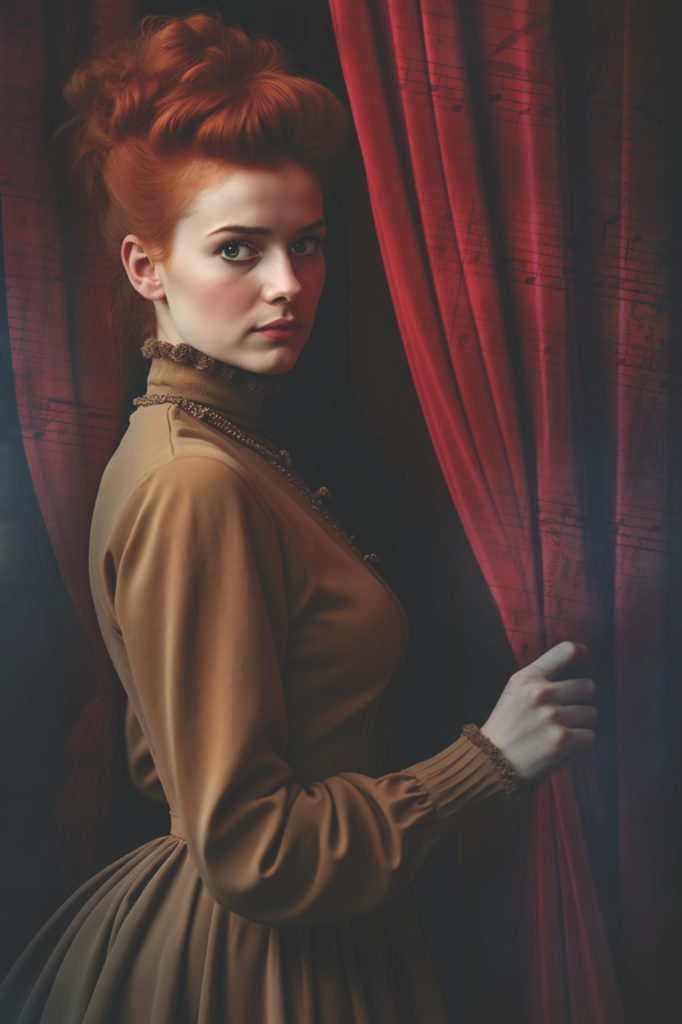
Cover character - Nora (Brisbane) Davis
Inspiration for Tristan, a gray cat with a missing eye and torn ear

Tristan Beaumont

Inspiration: Tristan was actually suggested by my friend’s daughters, and then I took inspiration from the ONE cat I had who lived to be 18. His thing was shrimp. You couldn’t say or spell the word without him attacking you until he got his piece. He was also an indoor/outdoor cat who would catch the mockingbirds that divebombed him and eat them until all that was left were their beaks and feet.

A bit about him:

  • Wrestled with a dog and lost his eye and had his ear torn
  • Cat with a bad attitude
  • Views Ezekiel as the enemy
  • loves F-I-S-H
  • Brings Nora and Ezekiel together
  • Causes LOTS of trouble and mayhem


Favorite Scene with Tristan:

Don’t believe the worst. That’s thinking too much like Mum. Tristan must have gotten away. Look around and think like a cat.

Nora widened her search. There were plenty of leafless trees and bushes scattered along the road. He could be hiding in the brush, or maybe he’d climbed a tree. She didn’t see any gray balls of fur, but everything about the day was gray and brown.

“Tristan! Here, kitty, kitty!”

“You’re much more likely to get his attention by calling out ‘fish,'” Mr. Beaumont said. “It’s even better if you spell it because then he thinks you’re trying to not share, and he’ll have none of that.”

“Do you have any fish to give him?”

“No, but he already hates me. If it brings him back, I’ll gladly face his displeasure.” He raised his voice. “I say, Miss Davis, would you care for a bite of f-i-s-h?”

Nora held her breath as they waited for any indication Tristan was coming. The only rustling came from the rain hitting the bushes.

Mr. Beaumont tried again. “This fish is so good. I’m glad Tristan isn’t here to have any.”

If she weren’t so worried about Tristan, she’d find it amusing that Mr. Beaumont spoke of and treated the cat more like an unruly toddler than an animal.

Constanza Brisbane

Inspiration: While researching the opera, I read the biography of Emily Soldene (The Improbably Adventures of Miss Emily Soldene). The details of her life and the commentary on other opera singers of the time largely shaped the life and personality of Constanza. While I don’t want to give too much away, in case you haven’t read the story, you can find bits and pieces of the life Constanza tried to keep secret within the pages of that biography.

A bit about her:

  • Refuses to keep hiding her past as a former famous opera singer, but no one at the asylum believes her
  • committed to an asylum for paranoia
  • fears her daughter being kidnapped again
  • has secrets that could destroy her family


Favorite Quote from Her:

Whack! “Speak as you write.”

An absolute must for this ridiculous exercise to work, because speaking and writing meant you had no space in your mind to argue with the words being committed to paper. She rolled her eyes, but did as commanded.

“I am Josephine Davis.” Not that I want to be. “Wife of Mark Davis.” Marcellus, not Mark. “Mother of Nora Davis.” Eleonora is prettier. “I am not an opera singer.” Not anymore. “I am not a thief.” Unless you count the extra biscuit I stole from the dessert tray at lunch. “There is nothing special about me or my past.” Except I have three lives and a past that will kill my daughter and me if it catches up to us.

There is just something about her defiance that I love. That and the real quote I wanted to use would give too much away if you haven’t read the book yet. 

Inspiration picture for Constanza Brisbane, red haired woman in a black dress.
Inspiration for Mrs. Beaumont, a dark haired woman in about her 60s

Mrs. Beaumont

Inspiration: Mrs. Beaumont’s faith and struggles largely came from Sara Turnquist, an author who graciously shared about her battle with depression. The battle of darkness and light, and not believing God’s promises for herself came from her experiences. 

A bit about her:

  • Suffers from depression and attempted suicide (off-page)
  • Is a Christian and did everything everyone told her, but she’s still not healed
  • Speaks truth to Constanza even when she struggles to believe them herself
  • Doesn’t want to be a burden to the son she loves


Favorite Quote from Her:

“It’s not about what you confess, but to whom you confess.”

Even in the midst of her own depression and struggles, Mrs. Beaumont spoke the truth of the Gospel to others. It was a beautiful thing to watch and know that two things can be true at once: 1) You can share about the Gospel and believe it’s true, 2) but you can wrestle with believing it applies to you. 

Bonus: Mrs. Jerden

I have no images for her, or even inspiration. She sort of developed as her own character that I absolutely adored. She was a wonderful neighbor and calculating chaperone. I couldn’t end this post without sharing this quote from her:

“Ah, young love. It is as wild as it is beautiful. I’m happy to be the chaperone who’s tardy enough to allow the kiss but timely enough to keep it short.”


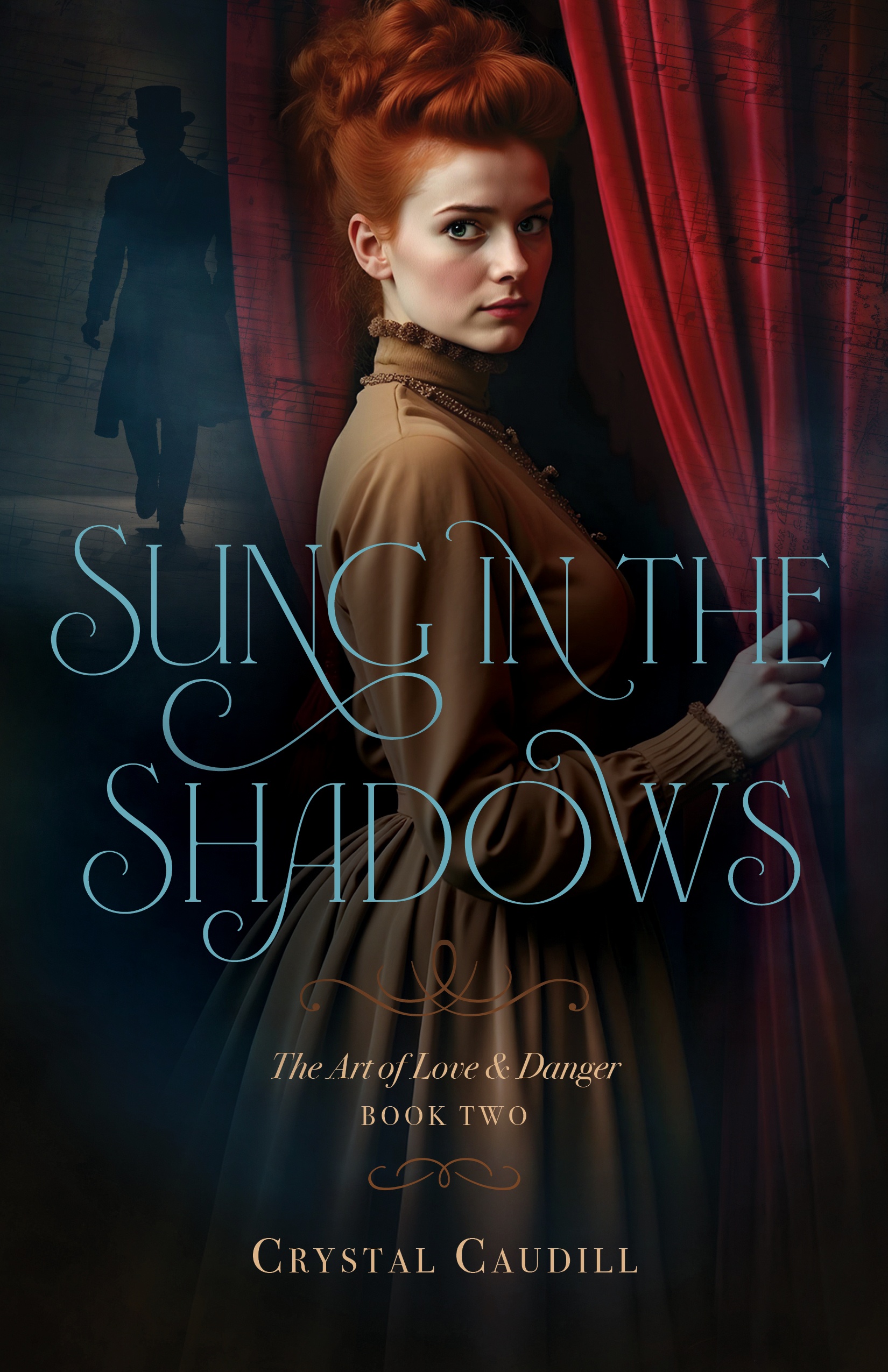
Cover image of Sung in the Shadows by Crystal Caudill, Red haired woman standing next to a theater curtain with a shadowy figure looming in the shadowsIf you haven’t checked out Sung in the Shadows yet, I encourage you to do so. This book didn’t start out as the book of my heart, but it has certainly ended up becoming one. 

When past darkness prowls, will stepping into the light lead to a brighter future?

~ Composer Hero
~ Opera Singer Heroine
~ Family Secrets
~ Secret Identity
~ Opera / Theater Life
~ Asylum
~ Mental Illness Representation
~ Suspense / Mystery
~ Love that Overcomes
~ Forbidden Love
~ Hope in the Darkness
~ Strong Female Friends

My question for YOU:

Which character is YOUR favorite? Or even, which character are you most glad makes an appearance in the story?

ABOUT CRYSTAL CAUDILL

Crystal Caudill is the author of “dangerously good historical romance.” Her debut novel, Counterfeit Love, was a 2023 Carol Award finalist, and her novella, “Star of Wonder,” won the 2024 Christy Award for short form. She loves history, hot tea, all things bookish, and the Teenage Mutant Ninja Turtles. She is a stay-at-home mom, caregiver, and chaos organizer. When she isn’t writing, Crystal can be found hanging with her family and playing board games at her home outside Cincinnati, Ohio. Find out more at crystalcaudill.com.

Connect with the author:

Website  |  Newsletter  |  Facebook  |  Facebook Group  |  Instagram  |  Pinterest  |  Amazon  |  BookBub  |  GoodReads

Longview Asylum

Longview Asylum

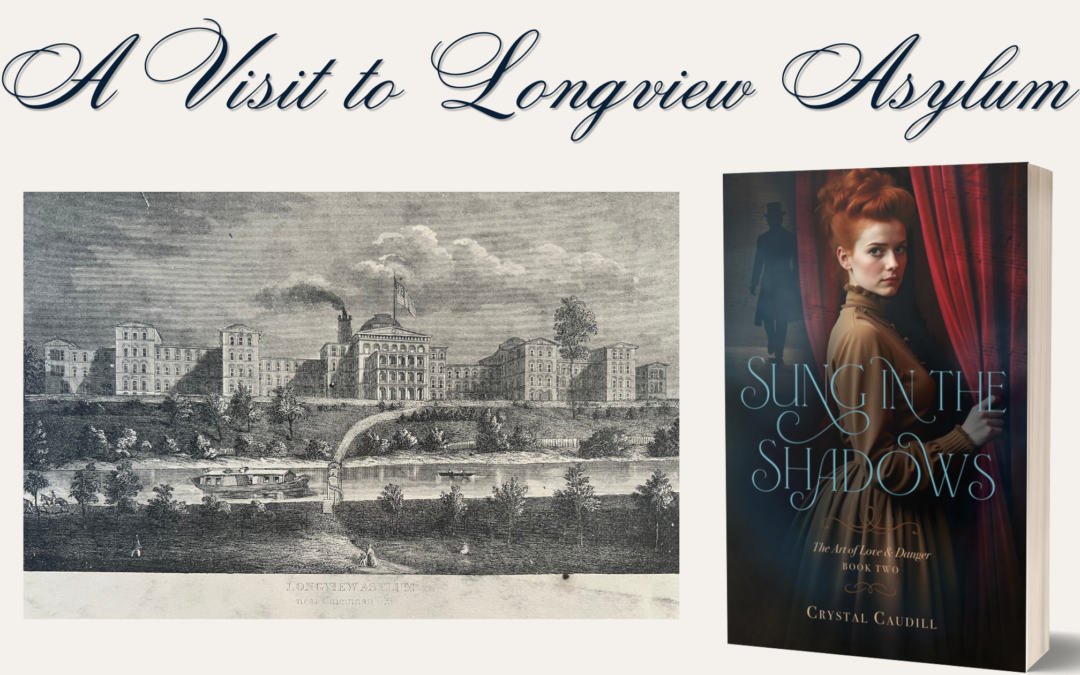
I totally missed my own release date for Sung in the Shadows, but I figure better late than never! I have a few posts I’m hoping to get together and tossed up over the next couple of weeks about the history of Longview Insane Asylum, my cast of characters, behind-the-scenes fun, and a fun playbill I created to go with the opera Ezekiel composes in the book.


So I’m a TOTAL history nerd–thus my writing HISTORICAL romantic suspense/mystery–and when I discovered Longview Asylum in some research for another book, I knew one day I would have to set a story there. I never knew how hard it would be to research. When I talked to the historical societies and local museums, the most they could provide was a few pictures and some old board of directors reports. I was able to find general history information online, but little to nothing about the actual building.


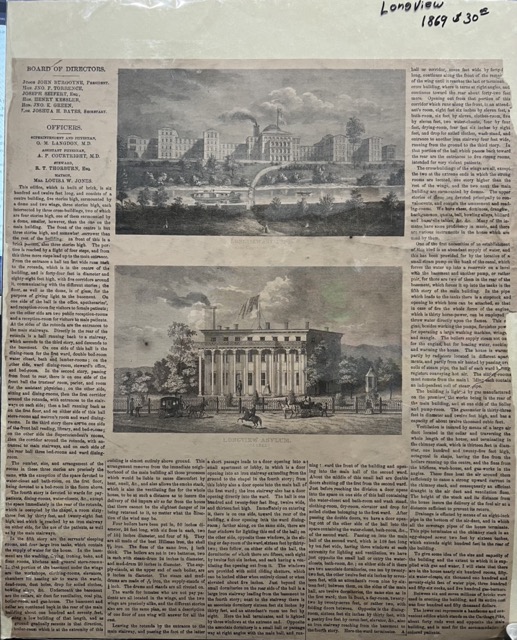
At least until I visited the Ohio Book Store, where the owner had a single page from a poster-sized atlas with a written walking tour of the asylum from around 1869. That beauty set me back $30, but it was worth every penny to have this rare piece of research. For posterity’s sake, I’ve included the entirety of the article at the end of this blog post. (I have since found a digitized copy here, so if you’re someone who needs to cite the article, here is the link to the digitized copy.)


For my dear readers, everything you read in Sung in the Shadows is as factual as I could make it–from the dome over the rotunda to the glass floors beneath it that provided light to the basement below. Of course, I have no way of knowing if the visitor’s room had a piano, but there could have been, given the other details of the building. And yes! Tours were given to the public once a week so they could observe the patients, much like they would observe animals in a zoo. The treatments in the story weren’t necessarily from Longview specifically. However, I read around 20 books and articles from doctors of the time for their treatments, descriptions of ailments, and descriptions of staff practices.


For those interested in learning more about the Longview Asylum for the Insane, I have the history of the asylum and that article typed up beneath the description of Sung in the Shadows—a story of family secrets, danger, mental illness, and a hope that shines bright in the darkness.

Cover image of Sung in the Shadows by Crystal Caudill, Red haired woman standing next to a theater curtain with a shadowy figure looming in the shadows

When past darkness prowls, will stepping into the light lead to a brighter future?

In nineteenth-century Cincinnati, fear keeps Nora Davis caged with secrets and lies. Her true identity as the daughter of a famous opera singer is too dangerous to reveal with her former captors still on the loose. But weekly singing lessons at Longview Asylum—her paranoid mother’s permanent residence—light a flame in Nora, and it’s one she can avoid fanning for only so long.

With his suicidal ma in the asylum, Ezekiel Beaumont’s soul is weary, but Nora’s presence at the asylum intrigues him. As a Pike’s Opera House employee, Ezekiel thinks Nora might be cut out for the stage. He also begins to wonder if Nora’s ma is really the famed Constanza Brisbane, who went missing mid-performance. He’s determined to find out.

Though Ezekiel brings the performance world a little too close for comfort, Nora is drawn to his warm personality all the same. The two of them steadily grow closer, but then Nora begins to fear she’s being watched, and her own paranoia blooms.

As the line between what’s real and false grows fainter, will Ezekiel’s and Nora’s faith and love overcome?

“From the haunting halls of Longview Asylum to the dangerous secrets of Nora’s past, Sung in the Shadows delivers a riveting blend of romance, mystery, and redemption.” —Misty M. BellerUSA TODAY best-selling author of the Sisters of the Rockies series

Purchase Links & Bonus Material

Longview Asylum for the Insane: A Brief History

In 1860, the Longview Asylum opened on Paddock Road in Carthage, OH, along the banks of the Miami & Erie Canal. It was established with a guiding philosophy of maintaining a humane institution that cared for its patients’ physical well-being as well as their mental state. For a time, Longview was much better at keeping with that philosophy than its predecessors. In a 1861 report, it was recorded that the hospital offered entertainment and amusements, including a bowling alley, dancing parties, singing birds, and other activities for patient enjoyment. It was also claimed that scourging and tormenting of patients was not as prevalent at Longview as at other institutions. I cringe at the phrase “as prevalent,” meaning abuse did occur, even in the beginning.

Over time, underfunding and understaffing led to more frequent occurrences of patient mistreatment. The Cincinnati Enquirer published several articles in 1879 describing incidents in the hospital laundry, where female patients who drew the wrath of an employee would either be repeatedly submerged in a tub of water or have a wet towel wrapped around their faces, preventing them from breathing. Beatings were often administered, then later reported by the former employees who witnessed them and resigned from the hospital.

Initially, the building housed 400 patients, but within three decades, the population had grown to 800. The facility was overpopulated. New wards were constructed in the 1890s, increasing the capacity to 955. In 1927, additional buildings were added to house another 500 patients. However, by 1953, there were 3,568 patients and only 1,831 beds. Add to that a massive staffing shortage, and you have the nightmares that have lived well into the minds of future generations.

With a change in treatment philosophies—including medication, outpatient treatment, community support strategies, etc—a vast state hospital complex was no longer required. The resident population dwindled and moved to a new building. In 1978, the original Longview building was razed after years of disuse. 

Longview Article from 1869 Atlas

(Text from Article – Typed up by Crystal Caudill from her physical copy. All spellings and phrasing orginial to article.)

BOARD OF DIRECTORS
_____________
Judge JOHN BURGOYNE, President.
Hon. JNO. F. TORRENCE
JOSEPH SEIFERT, Esq.,
Hon. HENRY KESSLER,
Hon. JNO. K. GREEN
Hon. JOSHUA H. BATES, Secretary.
_____________

OFFICERS
______
SUPERINTENDENT AND PHYSICIAN,
O.M. LANGDON, M.D.
ASSISTANT PHYSICIAN,
A.P. COURTRIGHT, M.D.
STEWARD,
R.T. THOURBURN, Esq.
MATRON,
MRS. LOUISA W. JONES.

This edifice, which is built of brick, is six hundred and twelve feet long, and consists of a centre building, five stories high, surmounted by a dome and two wings, three stories high, each intersected by three cross-buildings, two of which are four stories high, one of them surmounted by a dome, smaller, however, than the one on the main building. The front of the centre is but three stories high, and somewhat narrower than the rest of the building. The front of the centre is but three stories high, and somewhat narrower than the rest of the building. In front of this is a brick portico, also three stories high. The portico is reached by a flight of four steps, and from this, three more steps lead up to the main entrance. From the entrance, a hall ten feet wide runs back to the rotunda, which is in the centre of the building, and is forty-four feet in diameter and eighty-eight feet high, with five corridors around it, communicating with the different stories; the floor, as well as the dome, is of glass, for the purpose of giving light to the basement. On one side of the hall is the office, apothecaries’, and reception-room for visitors to female patients; on the other side are two public reception-rooms and reception-room for visitors to male patients. At the sides of the rotunda are the entrances to the main stairways. Directly in the rear of the rotunda is a hall running back to a stairway, which ascends to the third story, and descends to the basement. On one side of this hall is the dining-room for the first ward, double bed-room water closet, bath and lumber-rooms; on the other side, ward dining-room, steward’s office, and bed-room. In the second story, passing from front to rear, there is one side of the front hall the trustees’ room, parlor, and room for the assistant physician; on the other side, sitting and dining-rooms, then the first corridor around the rotunda, with entrances to the stairways on each side; then a hall running back as on the first floor, and on either side of this hall store-rooms and matron’s room and ward dining-rooms. In the third story, there are on one side of the front hall reading, library, and bed-rooms; on the other side the Superintendent’s rooms, then the corridor around the rotunda, with entrances to main stairways, and on each side of the rear hall three bed-rooms and ward dining-room. 

The number, size, and arrangement of the rooms in these three stories are precisely the same, with the exception of the space devoted to water-closet and bath-room, on the first floor, being devoted to a bed-room in the floors above. 

The fourth story is devoted to wards for pay-patients, dining-rooms, water-closets, &c, except the space immediately in the rear or the rotunda, which is occupied by the chapel, a room sixty-three feet by thirty feet, and twenty-eight feet high, and which is reached by an iron starqay on either side, for the use of the patients, as well as by the main stairways.

In the fifth story are the servants’ sleeping rooms, and four large iron tanks, which contain the supply of water for the house. In the basement are the washing, drying, ironing, bake, and flour rooms, kitchens and general store-rooms. In that portion of the basement under the wings are the workshops, clothing-rooms, elevators, chamgers for heating air to warm the wards, dead-room, dust holes, drop for soiled clothes, bowling alleys, &c. Underneath the basement are the cellars, air duct for ventilation, coal pits, boiler-room, an d gas-house. The basement and cellar are continued back in the rear of the main building about one hundred and seventy feet, forming a low building of that length, and as the ground gradually recedes in that direction, the boiler-room which is at the extremity of this building is almost entirely above ground. This arrangement removes from the immediate neighborhood of the main building all those processes which wuld be liable to cause discomfort by heat, smell, &c, and also allows the smoke stack, which is also the ventilating flue for the whole house, to be at such a distance as to insure the delivery of the impure air so far from the house that there cannot be the slightest danger of its being returned to it, no matter what the direction of the wind may be.

Four boilers have been put in, 50 inches diameter, 26 feet long, with six flues in each, two of 10 1/2 diameter, and four of 8 1/2. They are all made of the best Hillman iron, the shell 15/16 iron. The flues of the same iron, 1/4 inch thick. The boilers are set in two batteries, two in each with steam-drum 24 inches in diameter, and mud-drum 20 inches in diameter. The steam and mud-drums are made of 5/16 iron, the supply-stands of 1/4 inch. The drums and stands are all riveted on. 

The wards for inmates who are not pay patientes are all located in the wings, and the two wings are precisely alike, and the different stories are also on the same plan, so that a description of one floor of one wing will answer for all the rest. 

Leaving the rotunda by the entrance to the main stairway, and passing the foot of the latter a short passage leads to a door opening into a small apratment or lobby, in which is a door opening into an iron stairway etending fromf the ground to the chapel in the fourth story; from this lobby also a door opens into the main hall of the first ward; the iron stairway also has a door opening directly into the ward. The hall is one hundred and twenty-four feet long, twelve wide, and thirteen feet high. Immediately on entering it, threre is on one side, toward the rear of the building, a door opening into the ward dining-room; farther along, on the same side, there are four windows for lighting this end of the hall; on the otherside, opposite these windows, is the sitting or day-room of the ward, sixteen feet by thirty-two; then follow, on either side of the hall, teh dormitories of which there are fifteen, each eight by twelve feet six inches, and each having a ventilating flue opening out from it. The windows are provided with solid sliding shutters, which can be locked either when entirely closed or when elevated about five inches. Just beyond the small dormitories on the rear side of the hall is a large iron stairway leading from the basement to the fourth story; next to the stairway where is an associate dormitory sixteen feet six inches by thirty feet, and an attendant’s room ten feet by eight. Here the hall terminates, and is lighted by three windows at the extreme end. Opposite the associate dormitory is a small hall or passage way at right angles with the main hall, and running toward the front of the building and opening into the main hall of the second ward. About the middle of this small hall are double doors shutting off the first from the second ward. Just before reaching the division a door opens into the space on one side of this hall containing the water-closet, and bath-room and wash stand, clothing-room, dry-room, elevator and drop for soiled clothes belonging to the first ward. After passing the double doors, we have a door opening out of the other side of the hall into the space containing the water-closet, bath-room, &c., of the second ward. Passing on into the main hall of the second ward, which is 108 feet long by ten feet wide, haivng three windows at each extremity for lighting and centilation, we have just opposite the small hall or entry the water-closets, bath-rooms, &c.; on either side of it there are two associate dormitories, one ten by twenty-two feet, the other twelve feet six inches by seventeen feet, with an attendant’s room nine by sixteen feet; between them, on the sides of the main hall are twelve dormitories, the same size as in teh first ward; then in front, a day-room, twenty-two by twenty-seven feet, or rahter two, with folding doors bewteen them. Opposite is the dining-room, sixteen feet six inches by thirty feet, with a pantry five feet by seven feet, elevator, &c., also an iron stairway reaching from the basement to the fourth story. Here the ward terminates. A hall or corridor, seven feet wide by forty-four long continues along the front of the remainder of the wing until it reaches the last or terminating cross building, where it turns at right angles and continues toward the rear about forty-two feet more. Opening out from that portion of this corridor which runs along the front, is an attendant’s room, eight feet six inches by eleven feet, a bath-room, six feet by eleven, clothe-sroom, five by eleven feet, two water-closets, four by four feet, drying-room, four feet six inches by eight feet, and drop for soiled clothes, wash-stand, and entrance to another iron stairway four feet wide, running from teh ground to the third story. In that portion of the hall which passes back toward the rear are the entrances to five strong rooms, intended for very violent patients.

The cross buildings of the wings are all, except the two at the extreme ends in which the strong rooms are located, one story higher than the rest of the wings, and the two next the main building are surmounted by domes. The upper stories of these are devoted principally to convalescents, and contain the amusement and reading-rooms. We have chess, dominoes, draughts, backgammon, quoits, ball, bowling alleys, billiards and bagatelle tables, &c., &c. Many of the inmates have some proficiency in music, and there are various instruments in the house which are used by them. 

One of the first necessities of an establishment of this kind is an abudant supply of water, and this has been provided for by the location of a scmall steam pump on the bank of the canal, which forces the water up into a reservoir on a level with the basement and anotehr pump, or rather pari, for there are two of them in the rear of the basement, which forces it up into the tanks in the fifth story of the mian building. In the pipe which leads to the tanks there is a stopcock and opening to which hose can be attached, so that in case of fire the whole force of the engine, which is thrity horse-power, can be employed to throw water directly upon the flames. This engine, besides working the pumps, furnishes power for operating a large pashing machine, wringer, and mangle. The boilers supply steam not only for the engine, but for heating water, cooking, and warming the house. The house is warmed partly by radiators located in different apartments, and partly from air heated by passing over coils of steam pipe, the hall of each ward having registers conveying hot air. The sitting-rooms most remote from the bain building each contain an independent coil of steam pipe. 

The building is lighted by gas manufactured on the premises, the words being in the rear of the main building, and at one side of the boiler and pump-room. The gasometer is thirty-three feet in diameter and twelve feet high, and has a capacity of about twelve thousand cubic feet.

Ventilation is insured by means of a large air duct located in the cellar and traversing the whole length of the house, and terminating in the chimney stack, which is thirteen feet in diameter, on hundred and twenty0five feet high, octagonal in shape, having the flue from the boilers running up the centre, and the flues from the kitchens, wash-house, and gas-works in the angles. These flues heat the air around them sufficiently to cause a strong upward current in the chimney stack, and consequently an efficient draught in the air duct and ventilation flues. The height of the stack and its distance from the ouse insure the delivery of the foul air at a distance sufficient to prevent its return.

Drainage is effected by means of an eight-inch pipe in the bottom of the air-duct, and in which all the sewerage pipes of the house terminate. This pipe terminates at the chimney stack in an egg-shaped sewer two feet by sixteen inches, which extends eight hundred feet in the rear of the building. 

To give some idea of the size and capacity of the building and the extent to which it is supplied with gas and water, I will state that there are in the house nearly six hundred rooms, fifty-six water-closets, six thousand one hundred and seventy-eight feet of water pipe, three hundred and fifty-six cocks, and five hundred gas-burners.

Between six and seven millions of bricks were used in erecting the building, and its entire cost was four hundred and fifty thousand dollars.

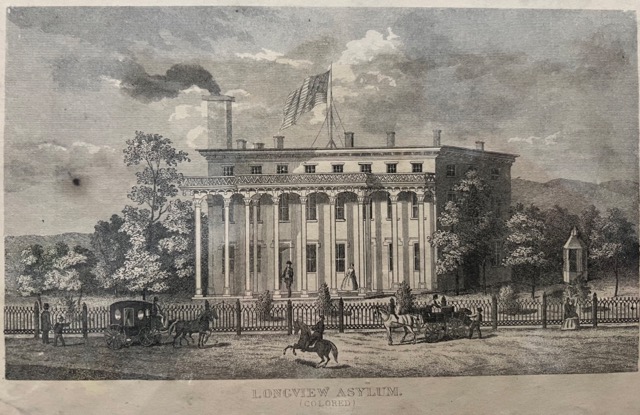
The lower cut represents a handsome and convenient edifice which stands on the Carthage Pike, about forty rods west and opposite the main building, and is used for teh accomodations of colored patients.

My question for YOU:

Wow, thanks for making it this far! What was the most interesting thing you learned from all this?

ABOUT CRYSTAL CAUDILL

Crystal Caudill is the author of “dangerously good historical romance.” Her debut novel, Counterfeit Love, was a 2023 Carol Award finalist, and her novella, “Star of Wonder,” won the 2024 Christy Award for short form. She loves history, hot tea, all things bookish, and the Teenage Mutant Ninja Turtles. She is a stay-at-home mom, caregiver, and chaos organizer. When she isn’t writing, Crystal can be found hanging with her family and playing board games at her home outside Cincinnati, Ohio. Find out more at crystalcaudill.com.

Connect with the author:

Website  |  Newsletter  |  Facebook  |  Facebook Group  |  Instagram  |  Pinterest  |  Amazon  |  BookBub  |  GoodReads

12 Historical Christian Fiction Books that Feature Mental Health/Illness

12 Historical Christian Fiction Books that Feature Mental Health/Illness

Mental Health has become a common topic of conversation in society, while mental illness still lives in the shadows of the taboo. However, Christian Fiction has long been wrestling with how faith, mental health/illness, and the Christian community should interact. Sung in the Shadows is my wrestle with the topic, but it’s not the only book out there you can read. Below are twelve titles that I have personally read or plan to read with story threads that deal with mental illness and mental health in general. I can guarantee that these stories interweave faith and mental illness into their stories in such a way as to give readers hope and to God all glory.

There are SOOOO many more books out there you can choose. The Inspirational Historical Fiction Index will allow you to choose by topic. If you’re looking for more reader recommendations, including contemporary stories, check out this post I made in Avid Readers to help find titles.

12 Christian Fiction Books that Feature Mental Health / Mental Illness CrystalCaudill.com

My Top Personal Reads

(In No Particular Order)

Cover image of Sung in the Shadows by Crystal Caudill, Red haired woman standing next to a theater curtain with a shadowy figure looming in the shadows

Sung in the Shadows by Crystal Caudill

In nineteenth-century Cincinnati, fear keeps Nora Davis caged with secrets and lies. Her true identity as the daughter of a famous opera singer is too dangerous to reveal with her former captors still on the loose. But weekly singing lessons at Longview Asylum—her paranoid mother’s permanent residence—light a flame in Nora, and it’s one she can avoid fanning for only so long.

With his suicidal ma in the asylum, Ezekiel Beaumont’s soul is weary, but Nora’s presence at the asylum intrigues him. As a Pike’s Opera House employee, Ezekiel thinks Nora might be cut out for the stage. He also begins to wonder if Nora’s ma is really the famed Constanza Brisbane, who went missing mid-performance. He’s determined to find out.

Though Ezekiel brings the performance world a little too close for comfort, Nora is drawn to his warm personality all the same. The two of them steadily grow closer, but then Nora begins to fear she’s being watched, and her own paranoia blooms.

Amazon  |  Baker Book House  |  Barnes and Noble  |  Books-A-Million  |  Bookshop.org  |  Christianbook.com  |  Kregel Parable Christian Bookstore

Cover for Shadows in the Mind's Eye by Janyre Trop, a burning building with a dusky background

Shadows in the Mind’s Eye by Janyre Tromp

Charlotte Anne Mattas longs to turn back the clock. Before her husband, Sam, went to serve his country in the war, he was the man everyone could rely on—responsible, intelligent, and loving. But the person who’s come back to their family farm is very different from the protector Annie remembers. Sam’s experience in the Pacific theater has left him broken in ways no one can understand—but that everyone is learning to fear.

Tongues start wagging after Sam nearly kills his own brother. Now when he claims to have seen men on the mountain when no one else has seen them, Annie isn’t the only one questioning his sanity and her safety. If there were criminals haunting the hills, there should be evidence beyond his claims. Is he really seeing what he says, or is his war-tortured mind conjuring ghosts?

Annie desperately wants to believe her husband. But between his irrational choices and his nightmares leaking into the daytime, she’s terrified he’s going mad. Can she trust God to heal Sam’s mental wounds—or will sticking by him mean keeping her marriage at the cost of her own life?

Amazon

Cover for The Lost Melody by Joanna Davidson Politanto with a read haired lady sitting at a piano with flowers around the title

The Lost Melody by Joanna Davidson Politano

When concert pianist Vivienne Mourdant’s father dies, he leaves to her the care of a patient at Hurstwell Asylum. Vivienne had no idea the woman existed, and yet her portrait is shockingly familiar. When the asylum claims she was never a patient there, Vivienne is compelled to discover what happened to the figure she remembers from childhood dreams.

The longer she lingers in the deep shadows and forgotten towers at Hurstwell, the fuzzier the line between sanity and madness becomes. She hears music no one else does, receives strange missives with rose petals between the pages, and untangles far more than is safe for her to know.

But can she uncover the truth about the mysterious woman she seeks? And is there anyone at Hurstwell she can trust with her suspicions?

Amazon

Cover for Their Burden to Bear by Heather Tabers, soldier and woman facing each other with the Tomb of the Unknown Soldier in the background

Washington, D.C., 1921. As America prepares to honor the first Unknown Soldier, Elsie St. Clair longs for freedom from her father’s cruel control and the chance to build a life of her own. Instead, she is forced into the spotlight of the upcoming ceremonies when she’s chosen to serve as companion to Gunnery Sergeant Phillip Pierce—a decorated Marine tasked with bearing the Unknown Soldier to his final rest.

Phillip is a war hero, but the medals pinned to his chest weigh heavy with loss and unspoken pain. To Elsie, his quiet strength and battle-hardened scars stir a hope she thought long dead: the hope of being truly seen and loved. Yet danger shadows their every step—from subtle whispers in the capital to the schemes of a jealous rival determined to come between them.

When Phillip offers Elsie a marriage of convenience, it seems a practical way to shield her from harm and keep his own heart untouched. But as they raise her orphaned nephew together, friendship blossoms into a tender bond neither can deny. Still, secrets from the past threaten to shatter the fragile peace they’ve found, forcing them to decide if they will cling to silence—or risk everything for the kind of love that bears all things.

Amazon

Cover of Midnight's Budding Morrow by Carolyn Miller, woman on an English countryside cliff and with a shadowed manor in the background

Midnight’s Budding Morrow by Carolyn Miller

Sarah Drayton is eager to spend a holiday at her best friend’s crumbling Northumberland castle estate. Alas, rather than easy companionship with her dear friend, she finds herself being inveigled into a marriage of convenience with her friend’s rakish brother.

When James Langley returns to his family’s estate, war is raging and he wants only distraction, not serious tethers. But his roguish ways have backed him into a corner, and he has little choice but to obey his father’s shocking decree: marry before returning to war…or else. Suddenly he finds himself wedded to a clever and capable woman he barely knows.

Sarah craves love and a place to belong, neither of which James offered before returning to the battlefront. Now everyone around her thinks she married above her station, and they have no intention of rewarding her for such impertinence. Only when her husband returns from war does she begins to hope they may find real happiness.

When tragedy strikes, this pair must learn to trust God and cling to the belief that even in the darkest depths of night, the morning still holds hope.

Amazon

Cover of Lost in Darkness by Michelle Griep, man and woman standing on a cliff surrounded in green tones

Lost in Darkness by Michelle Griep

Travel writer Amelia Balfour’s dream of touring Egypt is halted when she receives news of a revolutionary new surgery for her grotesquely disfigured brother. This could change everything, and it does. . .in the worst possible way.

Surgeon Graham Lambert has suspicions about the doctor he’s gone into practice with, but he can’t stop him from operating on Amelia’s brother. Will he be too late to prevent the man’s death? Or to reveal his true feelings for Amelia before she sails to Cairo?

Amazon

Cover of Veiled in Smoke by Jocelyn Green, woman in pink facing toward a burned down Chicago

Veiled in Smoke by Jocelyn Green

Meg and Sylvie Townsend manage the family bookshop and care for their father, Stephen, a veteran still suffering in mind and spirit from his time as a POW during the Civil War. But when the Great Fire sweeps through Chicago’s business district, they lose much more than just their store.

The sisters become separated from their father and make a harrowing escape from the flames with the help of Chicago Tribune reporter Nate Pierce. Once the smoke clears away, they reunite with Stephen, only to learn soon after that their family friend was murdered on the night of the fire. Even more shocking, Stephen is charged with the crime and committed to the Cook County Insane Asylum.

Though homeless and suddenly unemployed, Meg must not only gather the pieces of her shattered life, but prove her father’s innocence before the asylum truly drives him mad.

Amazon

Recommended Reads on the Top of My TBR Pile

(In No Particular Order)

Cover for A Heart Deceived by Michelle Griep, a white two-story building set in a dark and ominous color palette

A Heart Deceived by Michelle Griep

Miri Brayden teeters on a razor’s edge between placating and enraging her brother, whom she depends upon for support. Yet if his anger is unleashed, so is his madness. Miri must keep his descent into lunacy a secret, or he’ll be committed to an asylum—and she’ll be sent to the poorhouse.

Ethan Goodwin has been on the run all of his life—from family, from the law … from God. After a heart-changing encounter with the gritty Reverend John Newton, Ethan would like nothing more than to become a man of integrity—an impossible feat for an opium addict charged with murder.

When Ethan shows up on Miri’s doorstep, her balancing act falls to pieces. Both Ethan and Miri are caught in a web of lies and deceit—fallacies that land Ethan in prison and Miri in the asylum with her brother. Only the truth will set them free.

Amazon

Cover for Specters in the Glass House by Jaime Jo Wright, rundown glass conservatory

Specters in the Glass House by Jaime Jo Wright

In 1921, Marian Arnold, the heiress to a brewing baron’s empire, seeks solace in the glass butterfly house on her family’s Wisconsin estate as Prohibition and the deaths of her parents cast a long shadow over her shrinking world. When Marian’s sanctuary is invaded by nightmarish visions, she grapples with the line between hallucinations of things to come and malevolent forces at play in the present. With dead butterflies as the killer’s ominous signature, murders unfold at a steady pace. Marian, fearful she might be next, enlists the help of her childhood friend Felix, a war veteran with his own haunted past.

In the present day, researcher Remy Shaw becomes entangled in an elderly biographer’s quest to uncover the truth behind Marian Arnold’s mysterious life and the unsolved murders linked to an infamous serial killer. Joined by Marian’s great-great-grandson, can Remy expose the evil that lurks beneath broken wings? Or will the dark legacy surrounding the manor and its glass house destroy yet another generation?

Amazon

Cover of Miss Blaire in Blackwell's Island by Grace Hitchcock, a woman standing on dark asylum stairs

Miss Blaire in Blackwell’s Island (The Gray Chamber) by Grace Hitchcock

Will Edyth prove her sanity before it is too late?

On Blackwell’s Island, New York, a hospital was built to keep its patients from ever leaving.

With her late parents’ fortune under her uncle’s care until her twenty-fifth birthday in the year 1887, Edyth Blaire does not feel pressured to marry or to bow to society’s demands. She freely indulges in eccentric hobbies like fencing and riding her velocipede in her cycling costume about the city for all to see. Finding a loophole in the will, though, her uncle whisks Edyth off to the women’s lunatic asylum just weeks before her birthday. And Edyth fears she will never be found.

At the asylum she meets another inmate, who upon discovering Edyth’s plight, confesses that she is Nellie Bly, an undercover journalist for The World. Will either woman find a way to leave the terrifying island and reclaim her true self?

Amazon

Cover of Until the Dawn by Elizabeth Camden, woman in pink facing away with gates to a garden at the bottom

Until the Dawn by Elizabeth Camden

A volunteer for the newly established Weather Bureau, Sophie van Riijn needs access to the highest spot in her village to report the most accurate readings. Fascinated by Dierenpark, an abandoned mansion high atop a windswept cliff in the Hudson River Valley, Sophie knows no better option despite a lack of permission from the absent owners.

The first Vandermark to return to the area in sixty years, Quentin intends to put an end to the shadowy rumors about the property that has brought nothing but trouble upon his family. Ready to tear down the mansion, he is furious to discover a local woman has been trespassing on his land.

Instantly at odds, Quentin and Sophie find common ground when she is the only one who can reach his troubled son. There’s a light within Sophie that Quentin has never known, and a small spark of the hope that left him years ago begins to grow. But when the secrets of Dierenpark and the Vandermark family history are no longer content to stay in the past, will tragedy triumph or can their tenuous hope prevail?

Amazon

Cover of the Curse of Misty Wayfair with a chair sitting in a corner with a cracked overlay

The Curse of Misty Wayfair by Jaime Jo Wright

Left at an orphanage as a child, Thea Reed vowed to find her mother someday. Now grown, her search takes her to Pleasant Valley, Wisconsin, in 1908. When clues lead her to a mental asylum, Thea uses her experience as a post-mortem photographer to gain access and assist groundskeeper Simeon Coyle in photographing the patients and uncovering the secrets within. However, she never expected her personal quest would reawaken the legend of Misty Wayfair, a murdered woman who allegedly haunts the area and whose appearance portends death.

A century later, Heidi Lane receives a troubling letter from her mother–who is battling dementia–compelling her to travel to Pleasant Valley for answers to her own questions of identity. When she catches sight of a ghostly woman who haunts the asylum ruins in the woods, the long-standing story of Misty Wayfair returns–and with it, Heidi’s fear for her own life.

As two women across time seek answers about their identities and heritage, can they overcome the threat of the mysterious curse that has them inextricably intertwined?

Amazon

My question for YOU:

What books would YOU recommend that deal with mental illness?

ABOUT CRYSTAL CAUDILL

Crystal Caudill is the author of “dangerously good historical romance.” Her debut novel, Counterfeit Love, was a 2023 Carol Award finalist, and her novella, “Star of Wonder,” won the 2024 Christy Award for short form. She loves history, hot tea, all things bookish, and the Teenage Mutant Ninja Turtles. She is a stay-at-home mom, caregiver, and chaos organizer. When she isn’t writing, Crystal can be found hanging with her family and playing board games at her home outside Cincinnati, Ohio. Find out more at crystalcaudill.com.

Connect with the author:

Website  |  Newsletter  |  Facebook  |  Facebook Group  |  Instagram  |  Pinterest  |  Amazon  |  BookBub  |  GoodReads

The Book that Broke Me & The Songs that Encouraged Me

The Book that Broke Me & The Songs that Encouraged Me

Have you ever had a book just absolutely wreck you? Me too . . . only it was the book I was writing. However, it didn’t just wreck me. It broke me–and God used the writing of it to restore me.

The theme of Sung in Shadows, the book that broke me, is mental illness and the struggle of those who support others with mental illness. Why that topic? It’s actually a topic near and dear to my heart. While mental health has become less of a taboo topic, there is still a huge gap in support and understanding of those who struggle with mental illness and the people who support them. I’ve been on both sides of the aisle now, and my wrestle with mental illness actually came to a head during the writing of Sung in the Shadows.

Don’t Be Like Jonah . . . or Me

You see, even though I knew God wanted me to write a book with a mental health thread, I wanted to make it as small as I possibly could. But God wasn’t satisfied with a “side-note” of what He called me to write. With only three months before my book was due, God orchestrated events so that my editor read the first chapter of my draft-in-progress. With firm, but loving kindness, she told me what I turned in was not the story that needed to be told. That mental health thread I was trying to hide under many other layers of plot? That was were the real story was. That was the one that needed to be told.

I should have known that fighting God wasn’t going to end with me winning.

So everything got tossed out and rewritten in 1/3 of the time that I usually write a book–and it wasn’t because it came easy. Every word was a fight, every page a wrestle with the struggles I’d endured as a supporter of those with mental illnesses and the realization that I myself had reached a mental breakdown. I needed help, but those I supported still needed me. I should have gotten professional help, and I regret that I didn’t. However, God was good enough to minister to me through the writing of the story, those who ended up being my support, and the soundtrack to Sung in the Shadows below.

A release is coming, but it’s so much more . . .

Between now and release, I plan to create several blog posts, not just about the history like I usually do, but also about mental health, my journey to write this story, and some things God taught me about Christians and mental health. Unfortunately, the Church has, by-and-large (but not everyone), ignored mental illness, shamed those who struggled, and/or failed to support those with mental illness and the loved ones who support them.


Sung in the Shadows
is specifically written for anyone who has ever struggled to support someone with mental illness or has ever struggled themselves. As hard as this book was for me, it’s become as much a book of my heart as Counterfeit Hope is. It’s so important to me that both groups feel seen, understood, supported, and loved by God despite the struggles.

Today, I’m sharing with you what I’m calling the “Sung in the Shadows Soundtrack.” These are the songs I listened to over and over and over and over (and still listen to on hard days) as I wrote Sung in the Shadows. May it encourage you and help you as you walk through your own struggles.


READER QUESTION: What songs would you add to a list for encouragement and hard days?


When past darkness prowls, will stepping into the light lead to a brighter future?

In nineteenth-century Cincinnati, fear keeps Nora Davis caged with secrets and lies. Her true identity as the daughter of a famous opera singer is too dangerous to reveal with her former captors still on the loose. But weekly singing lessons at Longview Asylum—her paranoid mother’s permanent residence—light a flame in Nora, and it’s one she can avoid fanning for only so long.

With his suicidal ma in the asylum, Ezekiel Beaumont’s soul is weary, but Nora’s presence at the asylum intrigues him. As a Pike’s Opera House employee, Ezekiel thinks Nora might be cut out for the stage. He also begins to wonder if Nora’s ma is really the famed Constanza Brisbane, who went missing mid-performance. He’s determined to find out.

Though Ezekiel brings the performance world a little too close for comfort, Nora is drawn to his warm personality all the same. The two of them steadily grow closer, but then Nora begins to fear she’s being watched, and her own paranoia blooms.

As the line between what’s real and false grows fainter, will Ezekiel’s and Nora’s faith and love overcome?

“From the haunting halls of Longview Asylum to the dangerous secrets of Nora’s past, Sung in the Shadows delivers a riveting blend of romance, mystery, and redemption.”

—Misty M. Beller, USA TODAY best-selling author of the Sisters of the Rockies series

Learn More Here

Pin It on Pinterest