


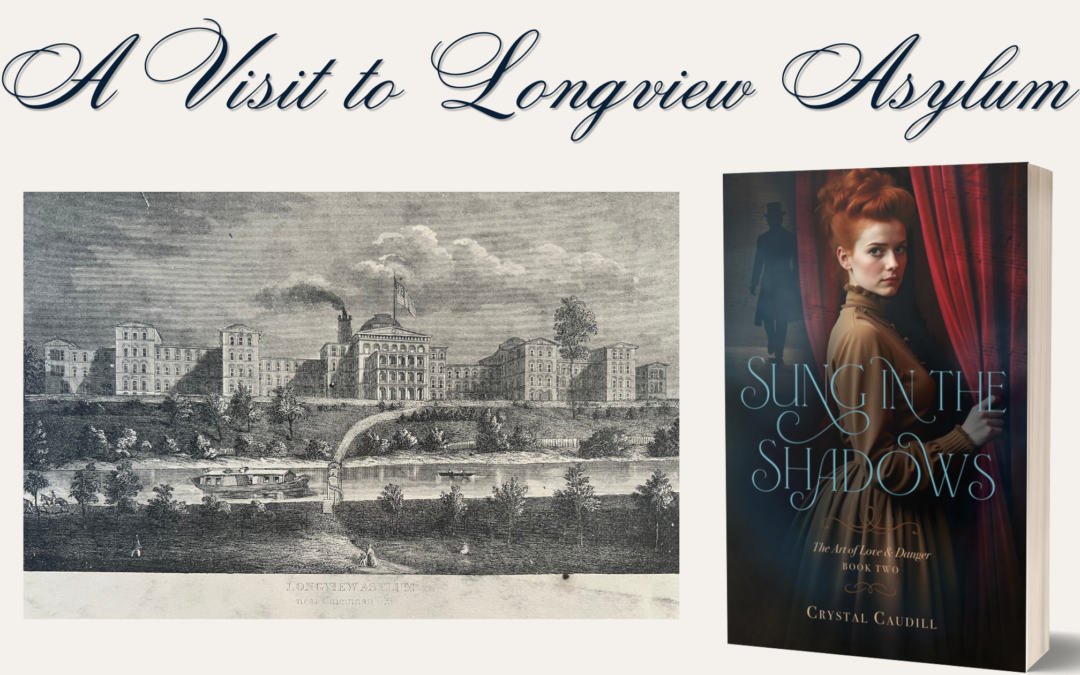
I totally missed my own release date for Sung in the Shadows, but I figure better late than never! I have a few posts I’m hoping to get together and tossed up over the next couple of weeks about the history of Longview Insane Asylum, my cast of characters, behind-the-scenes fun, and a fun playbill I created to go with the opera Ezekiel composes in the book.
So I’m a TOTAL history nerd–thus my writing HISTORICAL romantic suspense/mystery–and when I discovered Longview Asylum in some research for another book, I knew one day I would have to set a story there. I never knew how hard it would be to research. When I talked to the historical societies and local museums, the most they could provide was a few pictures and some old board of directors reports. I was able to find general history information online, but little to nothing about the actual building.
At least until I visited the Ohio Book Store, where the owner had a single page from a poster-sized atlas with a written walking tour of the asylum from around 1869. That beauty set me back $30, but it was worth every penny to have this rare piece of research. For posterity’s sake, I’ve included the entirety of the article at the end of this blog post. (I have since found a digitized copy here, so if you’re someone who needs to cite the article, here is the link to the digitized copy.)
For my dear readers, everything you read in Sung in the Shadows is as factual as I could make it–from the dome over the rotunda to the glass floors beneath it that provided light to the basement below. Of course, I have no way of knowing if the visitor’s room had a piano, but there could have been, given the other details of the building. And yes! Tours were given to the public once a week so they could observe the patients, much like they would observe animals in a zoo. The treatments in the story weren’t necessarily from Longview specifically. However, I read around 20 books and articles from doctors of the time for their treatments, descriptions of ailments, and descriptions of staff practices.
For those interested in learning more about the Longview Asylum for the Insane, I have the history of the asylum and that article typed up beneath the description of Sung in the Shadows—a story of family secrets, danger, mental illness, and a hope that shines bright in the darkness.

When past darkness prowls, will stepping into the light lead to a brighter future?
In nineteenth-century Cincinnati, fear keeps Nora Davis caged with secrets and lies. Her true identity as the daughter of a famous opera singer is too dangerous to reveal with her former captors still on the loose. But weekly singing lessons at Longview Asylum—her paranoid mother’s permanent residence—light a flame in Nora, and it’s one she can avoid fanning for only so long.
With his suicidal ma in the asylum, Ezekiel Beaumont’s soul is weary, but Nora’s presence at the asylum intrigues him. As a Pike’s Opera House employee, Ezekiel thinks Nora might be cut out for the stage. He also begins to wonder if Nora’s ma is really the famed Constanza Brisbane, who went missing mid-performance. He’s determined to find out.
Though Ezekiel brings the performance world a little too close for comfort, Nora is drawn to his warm personality all the same. The two of them steadily grow closer, but then Nora begins to fear she’s being watched, and her own paranoia blooms.
As the line between what’s real and false grows fainter, will Ezekiel’s and Nora’s faith and love overcome?
“From the haunting halls of Longview Asylum to the dangerous secrets of Nora’s past, Sung in the Shadows delivers a riveting blend of romance, mystery, and redemption.” —Misty M. Beller, USA TODAY best-selling author of the Sisters of the Rockies series
Longview Asylum for the Insane: A Brief History
In 1860, the Longview Asylum opened on Paddock Road in Carthage, OH, along the banks of the Miami & Erie Canal. It was established with a guiding philosophy of maintaining a humane institution that cared for its patients’ physical well-being as well as their mental state. For a time, Longview was much better at keeping with that philosophy than its predecessors. In a 1861 report, it was recorded that the hospital offered entertainment and amusements, including a bowling alley, dancing parties, singing birds, and other activities for patient enjoyment. It was also claimed that scourging and tormenting of patients was not as prevalent at Longview as at other institutions. I cringe at the phrase “as prevalent,” meaning abuse did occur, even in the beginning.
Over time, underfunding and understaffing led to more frequent occurrences of patient mistreatment. The Cincinnati Enquirer published several articles in 1879 describing incidents in the hospital laundry, where female patients who drew the wrath of an employee would either be repeatedly submerged in a tub of water or have a wet towel wrapped around their faces, preventing them from breathing. Beatings were often administered, then later reported by the former employees who witnessed them and resigned from the hospital.
Initially, the building housed 400 patients, but within three decades, the population had grown to 800. The facility was overpopulated. New wards were constructed in the 1890s, increasing the capacity to 955. In 1927, additional buildings were added to house another 500 patients. However, by 1953, there were 3,568 patients and only 1,831 beds. Add to that a massive staffing shortage, and you have the nightmares that have lived well into the minds of future generations.
With a change in treatment philosophies—including medication, outpatient treatment, community support strategies, etc—a vast state hospital complex was no longer required. The resident population dwindled and moved to a new building. In 1978, the original Longview building was razed after years of disuse.
Longview Article from 1869 Atlas
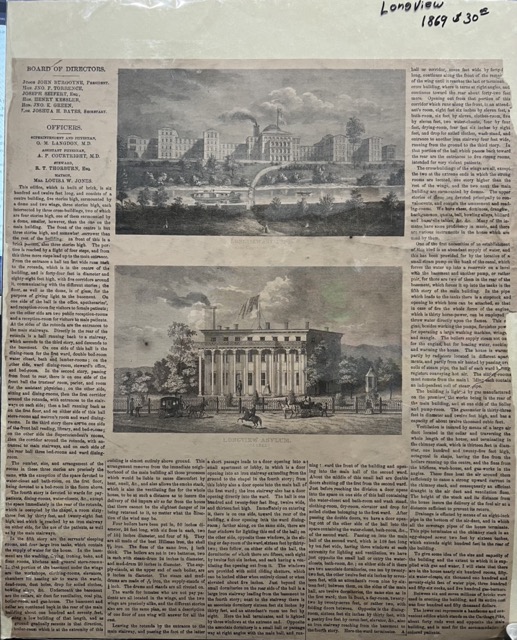
Longview Article
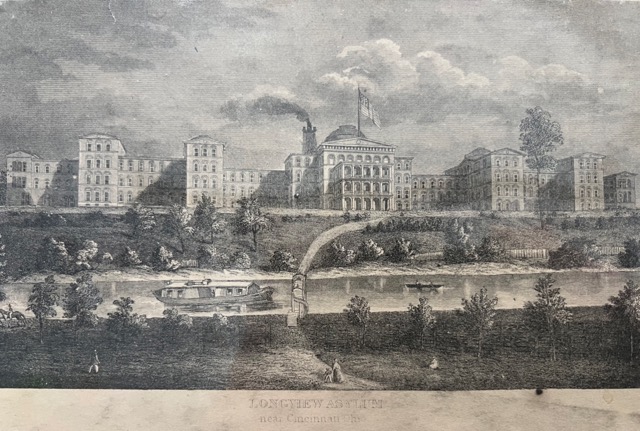
Longview
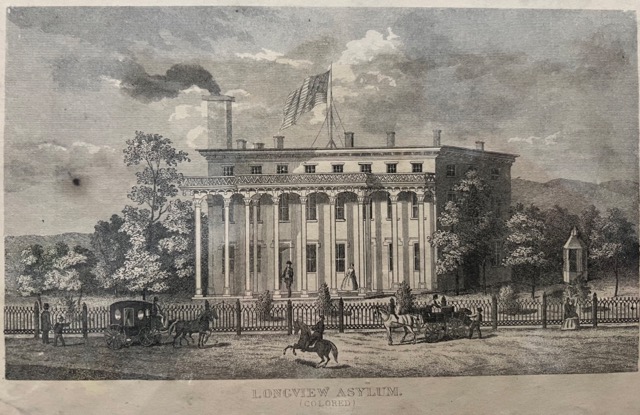
Longview Colored
(Text from Article – Typed up by Crystal Caudill from her physical copy. All spellings and phrasing orginial to article.)
BOARD OF DIRECTORS
_____________
Judge JOHN BURGOYNE, President.
Hon. JNO. F. TORRENCE
JOSEPH SEIFERT, Esq.,
Hon. HENRY KESSLER,
Hon. JNO. K. GREEN
Hon. JOSHUA H. BATES, Secretary.
_____________
OFFICERS
______
SUPERINTENDENT AND PHYSICIAN,
O.M. LANGDON, M.D.
ASSISTANT PHYSICIAN,
A.P. COURTRIGHT, M.D.
STEWARD,
R.T. THOURBURN, Esq.
MATRON,
MRS. LOUISA W. JONES.
This edifice, which is built of brick, is six hundred and twelve feet long, and consists of a centre building, five stories high, surmounted by a dome and two wings, three stories high, each intersected by three cross-buildings, two of which are four stories high, one of them surmounted by a dome, smaller, however, than the one on the main building. The front of the centre is but three stories high, and somewhat narrower than the rest of the building. The front of the centre is but three stories high, and somewhat narrower than the rest of the building. In front of this is a brick portico, also three stories high. The portico is reached by a flight of four steps, and from this, three more steps lead up to the main entrance. From the entrance, a hall ten feet wide runs back to the rotunda, which is in the centre of the building, and is forty-four feet in diameter and eighty-eight feet high, with five corridors around it, communicating with the different stories; the floor, as well as the dome, is of glass, for the purpose of giving light to the basement. On one side of the hall is the office, apothecaries’, and reception-room for visitors to female patients; on the other side are two public reception-rooms and reception-room for visitors to male patients. At the sides of the rotunda are the entrances to the main stairways. Directly in the rear of the rotunda is a hall running back to a stairway, which ascends to the third story, and descends to the basement. On one side of this hall is the dining-room for the first ward, double bed-room water closet, bath and lumber-rooms; on the other side, ward dining-room, steward’s office, and bed-room. In the second story, passing from front to rear, there is one side of the front hall the trustees’ room, parlor, and room for the assistant physician; on the other side, sitting and dining-rooms, then the first corridor around the rotunda, with entrances to the stairways on each side; then a hall running back as on the first floor, and on either side of this hall store-rooms and matron’s room and ward dining-rooms. In the third story, there are on one side of the front hall reading, library, and bed-rooms; on the other side the Superintendent’s rooms, then the corridor around the rotunda, with entrances to main stairways, and on each side of the rear hall three bed-rooms and ward dining-room.
The number, size, and arrangement of the rooms in these three stories are precisely the same, with the exception of the space devoted to water-closet and bath-room, on the first floor, being devoted to a bed-room in the floors above.
The fourth story is devoted to wards for pay-patients, dining-rooms, water-closets, &c, except the space immediately in the rear or the rotunda, which is occupied by the chapel, a room sixty-three feet by thirty feet, and twenty-eight feet high, and which is reached by an iron starqay on either side, for the use of the patients, as well as by the main stairways.
In the fifth story are the servants’ sleeping rooms, and four large iron tanks, which contain the supply of water for the house. In the basement are the washing, drying, ironing, bake, and flour rooms, kitchens and general store-rooms. In that portion of the basement under the wings are the workshops, clothing-rooms, elevators, chamgers for heating air to warm the wards, dead-room, dust holes, drop for soiled clothes, bowling alleys, &c. Underneath the basement are the cellars, air duct for ventilation, coal pits, boiler-room, an d gas-house. The basement and cellar are continued back in the rear of the main building about one hundred and seventy feet, forming a low building of that length, and as the ground gradually recedes in that direction, the boiler-room which is at the extremity of this building is almost entirely above ground. This arrangement removes from the immediate neighborhood of the main building all those processes which wuld be liable to cause discomfort by heat, smell, &c, and also allows the smoke stack, which is also the ventilating flue for the whole house, to be at such a distance as to insure the delivery of the impure air so far from the house that there cannot be the slightest danger of its being returned to it, no matter what the direction of the wind may be.
Four boilers have been put in, 50 inches diameter, 26 feet long, with six flues in each, two of 10 1/2 diameter, and four of 8 1/2. They are all made of the best Hillman iron, the shell 15/16 iron. The flues of the same iron, 1/4 inch thick. The boilers are set in two batteries, two in each with steam-drum 24 inches in diameter, and mud-drum 20 inches in diameter. The steam and mud-drums are made of 5/16 iron, the supply-stands of 1/4 inch. The drums and stands are all riveted on.
The wards for inmates who are not pay patientes are all located in the wings, and the two wings are precisely alike, and the different stories are also on the same plan, so that a description of one floor of one wing will answer for all the rest.
Leaving the rotunda by the entrance to the main stairway, and passing the foot of the latter a short passage leads to a door opening into a small apratment or lobby, in which is a door opening into an iron stairway etending fromf the ground to the chapel in the fourth story; from this lobby also a door opens into the main hall of the first ward; the iron stairway also has a door opening directly into the ward. The hall is one hundred and twenty-four feet long, twelve wide, and thirteen feet high. Immediately on entering it, threre is on one side, toward the rear of the building, a door opening into the ward dining-room; farther along, on the same side, there are four windows for lighting this end of the hall; on the otherside, opposite these windows, is the sitting or day-room of the ward, sixteen feet by thirty-two; then follow, on either side of the hall, teh dormitories of which there are fifteen, each eight by twelve feet six inches, and each having a ventilating flue opening out from it. The windows are provided with solid sliding shutters, which can be locked either when entirely closed or when elevated about five inches. Just beyond the small dormitories on the rear side of the hall is a large iron stairway leading from the basement to the fourth story; next to the stairway where is an associate dormitory sixteen feet six inches by thirty feet, and an attendant’s room ten feet by eight. Here the hall terminates, and is lighted by three windows at the extreme end. Opposite the associate dormitory is a small hall or passage way at right angles with the main hall, and running toward the front of the building and opening into the main hall of the second ward. About the middle of this small hall are double doors shutting off the first from the second ward. Just before reaching the division a door opens into the space on one side of this hall containing the water-closet, and bath-room and wash stand, clothing-room, dry-room, elevator and drop for soiled clothes belonging to the first ward. After passing the double doors, we have a door opening out of the other side of the hall into the space containing the water-closet, bath-room, &c., of the second ward. Passing on into the main hall of the second ward, which is 108 feet long by ten feet wide, haivng three windows at each extremity for lighting and centilation, we have just opposite the small hall or entry the water-closets, bath-rooms, &c.; on either side of it there are two associate dormitories, one ten by twenty-two feet, the other twelve feet six inches by seventeen feet, with an attendant’s room nine by sixteen feet; between them, on the sides of the main hall are twelve dormitories, the same size as in teh first ward; then in front, a day-room, twenty-two by twenty-seven feet, or rahter two, with folding doors bewteen them. Opposite is the dining-room, sixteen feet six inches by thirty feet, with a pantry five feet by seven feet, elevator, &c., also an iron stairway reaching from the basement to the fourth story. Here the ward terminates. A hall or corridor, seven feet wide by forty-four long continues along the front of the remainder of the wing until it reaches the last or terminating cross building, where it turns at right angles and continues toward the rear about forty-two feet more. Opening out from that portion of this corridor which runs along the front, is an attendant’s room, eight feet six inches by eleven feet, a bath-room, six feet by eleven, clothe-sroom, five by eleven feet, two water-closets, four by four feet, drying-room, four feet six inches by eight feet, and drop for soiled clothes, wash-stand, and entrance to another iron stairway four feet wide, running from teh ground to the third story. In that portion of the hall which passes back toward the rear are the entrances to five strong rooms, intended for very violent patients.
The cross buildings of the wings are all, except the two at the extreme ends in which the strong rooms are located, one story higher than the rest of the wings, and the two next the main building are surmounted by domes. The upper stories of these are devoted principally to convalescents, and contain the amusement and reading-rooms. We have chess, dominoes, draughts, backgammon, quoits, ball, bowling alleys, billiards and bagatelle tables, &c., &c. Many of the inmates have some proficiency in music, and there are various instruments in the house which are used by them.
One of the first necessities of an establishment of this kind is an abudant supply of water, and this has been provided for by the location of a scmall steam pump on the bank of the canal, which forces the water up into a reservoir on a level with the basement and anotehr pump, or rather pari, for there are two of them in the rear of the basement, which forces it up into the tanks in the fifth story of the mian building. In the pipe which leads to the tanks there is a stopcock and opening to which hose can be attached, so that in case of fire the whole force of the engine, which is thrity horse-power, can be employed to throw water directly upon the flames. This engine, besides working the pumps, furnishes power for operating a large pashing machine, wringer, and mangle. The boilers supply steam not only for the engine, but for heating water, cooking, and warming the house. The house is warmed partly by radiators located in different apartments, and partly from air heated by passing over coils of steam pipe, the hall of each ward having registers conveying hot air. The sitting-rooms most remote from the bain building each contain an independent coil of steam pipe.
The building is lighted by gas manufactured on the premises, the words being in the rear of the main building, and at one side of the boiler and pump-room. The gasometer is thirty-three feet in diameter and twelve feet high, and has a capacity of about twelve thousand cubic feet.
Ventilation is insured by means of a large air duct located in the cellar and traversing the whole length of the house, and terminating in the chimney stack, which is thirteen feet in diameter, on hundred and twenty0five feet high, octagonal in shape, having the flue from the boilers running up the centre, and the flues from the kitchens, wash-house, and gas-works in the angles. These flues heat the air around them sufficiently to cause a strong upward current in the chimney stack, and consequently an efficient draught in the air duct and ventilation flues. The height of the stack and its distance from the ouse insure the delivery of the foul air at a distance sufficient to prevent its return.
Drainage is effected by means of an eight-inch pipe in the bottom of the air-duct, and in which all the sewerage pipes of the house terminate. This pipe terminates at the chimney stack in an egg-shaped sewer two feet by sixteen inches, which extends eight hundred feet in the rear of the building.
To give some idea of the size and capacity of the building and the extent to which it is supplied with gas and water, I will state that there are in the house nearly six hundred rooms, fifty-six water-closets, six thousand one hundred and seventy-eight feet of water pipe, three hundred and fifty-six cocks, and five hundred gas-burners.
Between six and seven millions of bricks were used in erecting the building, and its entire cost was four hundred and fifty thousand dollars.
The lower cut represents a handsome and convenient edifice which stands on the Carthage Pike, about forty rods west and opposite the main building, and is used for teh accomodations of colored patients.
My question for YOU:
Wow, thanks for making it this far! What was the most interesting thing you learned from all this?

ABOUT CRYSTAL CAUDILL
Crystal Caudill is the author of “dangerously good historical romance.” Her debut novel, Counterfeit Love, was a 2023 Carol Award finalist, and her novella, “Star of Wonder,” won the 2024 Christy Award for short form. She loves history, hot tea, all things bookish, and the Teenage Mutant Ninja Turtles. She is a stay-at-home mom, caregiver, and chaos organizer. When she isn’t writing, Crystal can be found hanging with her family and playing board games at her home outside Cincinnati, Ohio. Find out more at crystalcaudill.com.
Connect with the author:
Website | Newsletter | Facebook | Facebook Group | Instagram | Pinterest | Amazon | BookBub | GoodReads

book looks like great read would love to read in print format so I can review book
Many libraries will purchase copies for their patrons. If you call your library, they can walk you through the process. This information might be helpful for them in considering the request:
Title: Sung in the Shadows
Author: Crystal Caudill
Publisher: Kregel Publishing
ISBN-10: 0825449103
ISBN-13: 978-0825449109
Release Date: March 17, 2026