by Crystal Caudill | Jun 9, 2016 | Counterfeit Love, History Facts

Image from SpringGrove.org
Have you ever been to a wedding in a cemetery? Well, that is a fairly normal occurrence at the Spring Grove Cemetery. Why? Because the Norman Chapel is a magnificent piece of architecture set in the picturesque beauty of a cemetery meant to look like a park.
Last Throwback Thursday I talked about the Spring Grove Cemetery where my main character’s grandfather is interned. This week I want to explore the gorgeous Norman Chapel.
The History & Design
The magnificent Romanesque-style chapel was designed by famous Cincinnatian architect, Samuel Hannaford, in 1879. The chapel itself was constructed in 1880 and the first service, a funeral, was held on February 7, 1881.
The Exterior
The exterior is made of rough-hewn limestone and has areas of intricately carved stonework. Beautiful archways and a covered drive are something to be admired. If you do a search of “Wedding Photos at Norman Chapel”, you will find several pictures where the arches are clearly seen. As of this moment, I have not made it back to the Spring Grove Cemetery for pictures, and I do not have permission to share the ones I have saved for research purposes.
The Interior
The interior of Norman Chapel is breath-taking.

Pictures and Collage created by SpringGrove.org.
The arches of the exterior are mirrored on the interior. Carved wooden beams support the chapel’s ceiling and marble graces the floor. The focal point is a magnificent stained glass window at the front of the sanctuary that depicts the Ascension of Christ, although at the time of my story the stained glass had not yet arrived from Europe.
Black Belgium marble floor paves the chapel floor and Bedford limestone is prominent in the vestibule. There are bronze doors on each side of the altar with bas-relief panels of Biblical scenes of the resurrection of Lazarus and of Jesus Christ, the Ascension, the revival of the widow’s son and Jabirus’ daughter, and the healing of the paralytic man.
The stained glass window shows not only the Ascension of Christ but also Jesus healing the paralytic man. The window is inscribed with Luke 51:24, “And it came to pass while He blessed them, He was parted from them and carried up into heaven.”
The chapel is in use today, although more for weddings than funerals now. Its beauty is lost to the dead, and often to the grieving as well. Norman Chapel is definitely one better suited for the rose colored lens of new love, eager to soak in every detail of the day.
So if you are looking for a unique venue you may want to consider the Norman Chapel. Just be aware, your guest list may be well over several thousand… but no worries, most of them are permanent residents.
by Crystal Caudill | May 26, 2016 | Counterfeit Love, History Facts

Spring Grove Cemetery is one of Cincinnati’s beautiful attractions, which has drawn visitors for over 150 years. The inciting incident of my current work in progress is the death of the heroine’s grandfather, and what better location for his funeral and burial than this park like cemetery.
Should you ever get the chance to come to Cincinnati, I highly recommend walking through this beautiful cemetery. In fact it is so beautiful, wedding are often held at the Norman Chapel, which will be discussed in next week’s Throwback Thursday.
The Birth of a Cemetery
Cholera epidemics swept through Cicinnati throughout the 1830s and 1840s, filling small church cemeteries to the brim. Little comfort could be found in these places of crowded interment for the bereaved families and leaders of the Cincinnati community voiced their concerns.
Members of the Cincinnati Horticultural Society formed a cemetery association in 1844 and endeavored to find a suitable location for a cemetery they envisioned as being a picturesque park undisturbed by expansion.

They sought to acquire a large enough area to support funerals for an indefinite future, along with the embellishments of shrubbery, flowers, trees, walks, and rural ornaments. It was so important to them that they create not just a a funeral location, but also an area of great beauty, respite, and leisure, members of the cemetery association traveled the United States and Europe for examples of superior design.
When a farm of 160 acres was secured (and later added 434 acres), a consecration ceremony was provided for the community. These founders publicly proclaimed their hope that the natural setting would be a contemplative atmosphere conductive to consolation, commemoration, and education.
A Tourist Attraction
Given its popularity, today as much as then, I believe the founders achieved their goal. The
1875 issue of Cincinnati Illustrated described it as “a peaceful resting place for the dead and a beautiful park for the living.” Indeed, more than 150,000 people visited the cemetery in 1874 alone, not including those who were attending actual funerals!
Those who had family members interred in Spring Grove had tickets and were able to introduce strangers and come and go as they pleased. However, those who did not have family members interred there, were required to obtain tickets from the Secretary’s office in Pike’s Opera House.
Can you imagine walking through the Spring Grove entrance and someone saying, “Ticket, please?”
The broad and beautiful Avenue, with its magnificent trees, brings the living and the dead alike to the final abode of rest and release from strife and contention where there are laurels and roses for the blue, lilies and myrtles for the gray. After generations have passed away, the massy granite, embedded in green turf, shaded by trees then venerable with age, and embosomed in flowers may look down upon the graves of many whose lives have been as romantic, if not so sad, as Eloise’s – as deeply loved as Fatima’s. Then some poet like Pope or some noble romancer like Scott will arise and in another Epistle or another “Old Mortality” tell the tale of those who are gone.
– Cincinnati Illustrated, 1875, p 319
As a kid I would walk through our local cemetery. It was always so peaceful and quiet. As an adult, I attended a funeral at Spring Grove Cemetery and it was beyond beautiful. Almost two centuries later, it is still the contemplative atmosphere the founders hoped for.
What about you? Do you enjoy walking through cemeteries or do they give you the heeby geebies? Would you purchase a ticket to walk through one? Have you actually done it?
Resources:
http://www.springgrove.org/history.aspx
Kenny, Daniel J. Illustrated Cincinnati; a Pictorial Hand-book of the Queen City, Comprising Its Architecture, Manufacture, Trade. Cincinnati: R. Clarke, 1875. Print.
Want to see more pictures? Visit Spring Groves Photo Gallery.
by Crystal Caudill | May 18, 2016 | Writing Craft
Do you remember those days in school where your teacher made you come up with all these ridiculous synonyms for said? As a fifth grade teacher, I taught my students that said was a boring word. We even had a funeral for said.

“Said is dead!” he cried.
“He is no more,” she whispered.
We had a whole funeral script written, and we did this for all the overused words, like asked, went, good, and nice. Our classroom ceiling was littered with the tombstones of forbidden words.
When I first began writing my novels, I was the queen of synonyms. Never could you claim to find one of those dead words in my books! No way! No, sir! My characters screamed, interrogated, and cheered. I was proud of my vast use of dialogue tags.
Imagine my surprise and shock when I discovered this was the mark of an amateur. Let me tell you, friends, everything we have been taught and graded on in elementary through high school is wrong! (And it isn’t your teachers’ fault, they were taught this is correct, too!)
 Said is a Zombie
Writing fiction- whether a short story, novella, or novel – is a completely different beast than the works we were forced to draft in school. The truth for authors is this. Dialogue tags should be kept to a minimum, and when they must be used, simple words like said and asked are best. Why? Because they create the least amount of author intrusion.
Therefore, it is time to resurrect said and asked from the dead. But beware! You want as few of these zombies as possible roaming through your stories.
Controlling Your New Zombie Friends 
The more zombies you have in your story, the more danger you are in. So how do you keep their numbers to a minimum?
Use descriptive beats. You know? Those statements around the dialogue which let you know what the speaker is doing?
Examine the two examples below. Which one draws you in and helps you understand the characters emotions?
“I understand, Father. I will abide by your wishes,” Amelia said.
or
Amelia twisted the napkin in her lap as she stared at the tablecloth. “I understand, Father. I will abide by your wishes.”
In both examples, Amelia is saying the exact same thing. Not a word of the dialogue has changed, but notice how the depth of understanding changes with the dialogue beat. I don’t know about you, but I for one can hear Amelia’s tone of voice and see her reserved submission.
Check out your favorite contemporary author, I bet you will find even more examples of how the author pulled you deeper into the story with the simple use of dialogue beats.
Now It’s Your Turn
Are you up for a little zombie slaying? Here is a conversation below where the zombies have taken over. Use your imagination and change the dialogue tags into dialogue beats. Share your results in the comments section.
“I don’t think this is a good idea, Jamie,” Henry said.
“Why not? What could go wrong?” Jamie asked.
“I can think of about a dozen things,” he said.
“If you are chicken, you can always head back to the car. I can do this by myself and probably quieter, too,” she said.
“But what if you get caught?” he asked.
“Me? Get caught? I don’t think you have to worry about that. Old Man Pinkerton is deaf as a bat,” she said.
“Bats aren’t deaf. They actually have amazing hearing,” he said.
“Whatever,” she said.
Happy writing! I look forward to reading your zombie slaying skills,

by Crystal Caudill | May 4, 2016 | Writing Craft
I took a couple weeks off doing only writing prompts while I figured out my new schedule for my blog. My new goal is to alternate between Writing Prompt Wednesday with Writing Craft Wednesday. So today marks the first Writing Craft Wednesday!
Today I am going to finish up our look at GMC: Goal, Motivation, and Conflict. Here is a list of the previous GMC posts:
Conflict: The Heat of the Story
So what is conflict? If goal is the “what” and motivation is the “why,” then conflict is the “why not.” Conflict is what your character must face in order to achieve their goal.
External conflict often comes in the form of a physical being, usually the villain. The villain causes problem after problem for the hero or heroine. All five senses are engaged when dealing with this maniacal menace. You can smell them, see them, feel them, hear them, and depending one what is going on… taste the blood they draw.
Internal conflict is more subtle. Whatever keeps the hero or heroine from learning their life lesson, that is your internal conflict. Just like anything else internal, it is emotional. Perhaps it is the self-conscious voice which keeps them from seeing their worth. Perhaps it is the guilt of not being there for a loved one when they were needed most. Whatever it is, it evades the five senses.
Why include conflict?
Readers like to see characters tested, run through the wringer, and facing their worst fears. Anticipating an explosion of conflict is what keeps the reader turning the pages.
Besides the excitement conflict brings to a story, it also brings depth and complexity to the characters. It is through conflict characters learn to dig withing themselves, grow and rise to the challenge. Through conflict they become a hero.
Think something is bad? Make it worse.
So how do you make the conflict engaging and page turning? Strife, tension, dissension, and opposition are key elements in creating conflict. Start with making a list of bad things which could stand in your character’s way.
Found one? Good. Now make it worse. Worse? YES! WORSE!
For one of my characters she is potentially losing her house. Initially, I started with the loan belonging to the bank, but then I applied the above principle. How did I make it worse? The loan belonged to a vicious loan shark who will get his money one way or another. Does that create more problems and stronger conflict? You betcha!
The stronger your conflict, the stronger your book.
Think your character has it bad?
Make it worse.
by Crystal Caudill | Apr 21, 2016 | Counterfeit Love, History Facts
Welcome to my first ever Throwback Thursday, where I share gems from my research for my novel.
The setting of my current Work In Progress (WIP) is a city with a wealth of history to pull from, Cincinnati, Ohio. Cincinnati is known as the Queen City and more important to today’s post, the City of Seven Hills.
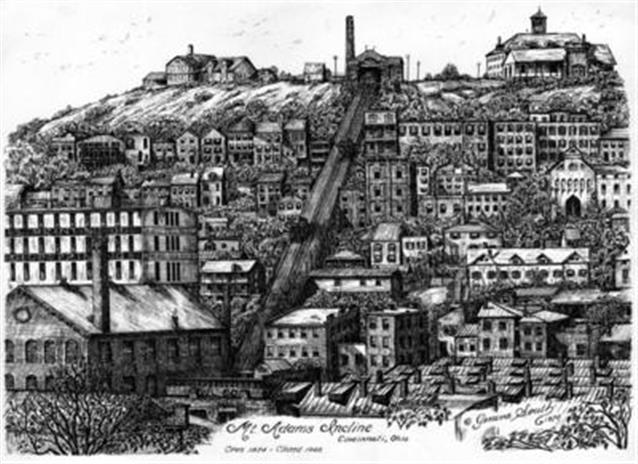
Drawing by Geneva South, 1972
The terrain for Cincinnati is very hilly as you can guess by the name, but not the gentle rolling hill kind where kids spend all summer rolling down until they become too dizzy to stand. Cincinnati’s hills are of the variety where trees and ravines impede your progress, where semis turn their hazard lights on because the climb to the top reduces them to a crawl.
Now step back to the Industrial Revolution, about one hundred-fifty years ago. Factories clogged the air with soot and smoke. Tuberculosis was rampant. The stench of the Erie Canal was far from pleasant. People looked to the hills for relief.
Omnibuses drawn by horses were the first transit system devised to struggle up the hills. However, drivers often had to hop out, block the wheels, and allow the horses to stop and rest before proceeding to the pristine air above. An alternative was desperately needed.
Responding to the need, business partners, Joseph Stacy Hill and George Smith, opened Cincinnati’s first incline plane on May 12, 1872. Hill top resorts, like the Lookout House and Highland House, opened and regularly drew in crowds of up to 10,000. (An upcoming post will describe the Highland House.)

Mt. Adams Incline
By the time my novel opens in 1883, Cincinnati had 4 operating inclines: The Mt. Auburn Incline (leading to the Lookout House), the Mt. Adams Incline (leading to the Highland House), the Price Hill Incline (the only double incline – one for freight and one for passengers), and the Bellevue Incline.
Interesting Tidbits and Stories
- In 1884, the price of a ride was 5¢.
- A one-way trip took 2 minutes and 20 seconds. This was repeated six times every hour, 19 hours a day.
- The Mt. Adams Incline made the trip in about 90 seconds.
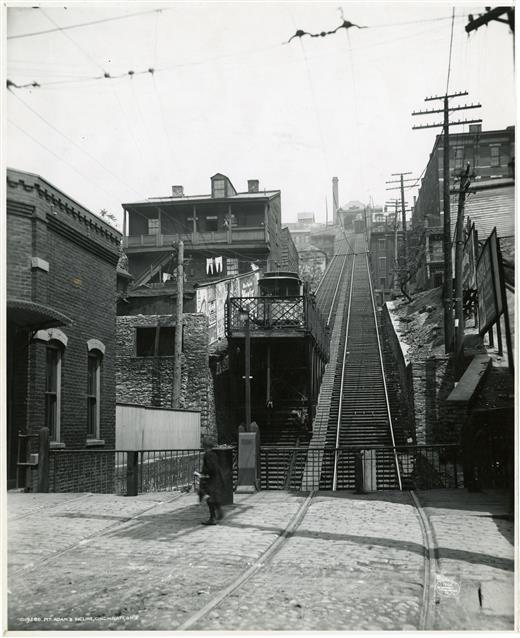
Mt. Adams Incline (1906): A car is lowering down the track and will eventually become flush with the ground.
- All full crew consisted of an operator, an engineer, a fireman, two gatemen, and two carpenters. The gateman’s job was to take the tickets from the passengers in the waiting room and then escort them onto the lift.
- A telegraphic system of signal bells between the operating engineer in the powerhouse at the top of the hill and the attendant at the bottom of the station. Two bells meant “ready,” one bell signaled the doors were closed and locked (“alarm”), and three bells rang for “start.”
- The Bellevue Incline passed by McMicken Hall, the first college of the University of Cincinnati. A medical school shared a freezer for cadavers with a brewery down the hill, and young students often got a thrill from waving body parts at passengers who passed by on the incline, in particular passengers of the female variety.

Bellevue Incline: You can see McMicken Hall in the background on the right.
Although the Cincinnati inclines are no longer around, the last one having closed its doors on July 25, 2008, they are still a fascinating part of history.
What was your favorite tidbit? Do you have any tidbits? How do you think inclines might play a part in my Work In Progress?
*All pictures were retrieved from: http://retro.cincinnati.com/Topics/Gallery/Cincinnati-Inclines#The Highland House. Visit there to see more pictures.