by Crystal Caudill | Oct 27, 2016 | History Facts

Here are just a few fun superstitions from the Victorian Era about death. These were collected from the Friends of Oak Grove Cemetery.
- If the deceased has lived a good life, flowers would bloom on his grave; but if he has been evil, only weeds would grow.
- If several deaths occur in the same family, tie a black ribbon to everything left alive that enters the house, even dogs and chickens. This will protect against deaths spreading further.
- Never wear anything new to a funeral, especially shoes.
- You should always cover your mouth while yawning so your spirit doesn’t leave you and the devil never enters your body.
- It is bad luck to meet a funeral procession head on. If you see one approching, turn around. If this is unavoidable, hold on to a button until the funeral cortege passes.
- Large drops of rain warn that there has just been a death.
- To lock the door of your home after a funeral procession has left the house is bad luck.
- If rain falls on a funeral procession, the deceased will go to heaven.
- If you hear a clap of thunder following a burial it indicates that the soul of the departed has reached heaven.
- If you hear 3 knocks and no one is there, it usually means someone close to you has died. The superstitious call this the 3 knocks of death.
- If a firefly/lightning bug gets into your house someone will soon die.
- If you smell roses when none are around someone is going to die.
- If you don’t hold your breath while going by a graveyard you will not be buried.
- If you see yourself in a dream, your death will follow.
- If you see an owl in the daytime, there will be a death.
- If you dream about a birth, someone you know will die.
- If it rains in an open grave then someone in the family will die within the year.
- If a bird pecks on your window or crashes into one that there has been a death.
- If a sparrow lands on a piano, someone in the home will die.
- If a picture falls off the wall, there will be a death of someone you know.
- If you spill salt, throw a pinch of the spilt salt over your shoulder to prevent death.
- Never speak ill of the dead because they will come back to haunt you or you will suffer misfortune.
- Two deaths in the family means that a third is sure to follow.
- The cry of a curlew or the hoot of an owl foretells a death.
- Having only red and white flowers together in a vase (especially in hospital) means a death will soon follow.
- Dropping an umbrella on the floor or opening one in the house means that there will be a murder in the house.
- A diamond-shaped fold in clean linen portends death.
- A dog howling at night when someone in the house is sick is a bad omen. It can be reversed by reaching under the bed and turning over a shoe.
Are there any superstitions you know about? Share them in the comments below.
by Crystal Caudill | Oct 20, 2016 | History Facts
Halloween is just around the corner and since my book does require the death of a secondary character, I thought it might be fun to share some of the superstitions I discovered during research of Victorian funerals and mourning rituals.
At the Time of Death
If the death occurred at home, the curtains would be drawn  and the clocks would be stopped. Symbolically, it represented the family in mourning, and if you have ever lost someone, the idea of a clock showing that your entire world has stopped seems accurate. Stopping the clock also “prevented” anyone else in the family from experiencing a run of bad luck.
In addition to the clocks being stopped and curtains drawn, mirrors would be covered with crape or veiling to prevent the deceased’s spirit from getting trapped in the looking glass. Picture frames were sometimes turned down to prevent the spirit from possessing one of the remaining survivors.
Due to eyes being affected by rigor mortis first, they were swiftly closed and often times pennies were placed over the eyelids to prevent them from reopening. However, there was also a superstition that being looked at by a corpse could threaten you and your kind.
Wakes
Wakes were held in the home for generally 4 days by friends and family. This allowed time for family members to travel. Staying with the body was a sign of respect for the deceased, although some believe it was used to make sure the deceased did not wake up from a coma.

If you remember the story of Lazarus, he had been dead four days before Jesus commanded for the stone to be rolled away. What was the response of Martha? “Lord, by this time he stinketh.” (I love the KJV of that story. Who wouldn’t love to say stinketh?)
So now imagine your loved one lying dead in your house for four days… because of that wonderful aroma, flowers and candles would fill the room and bed of the deceased, at least until embalming became common.
When it was time for the body to be removed from the house, they were carried out feet first. This was to prevent the spirit from looking back into the house and beckoning another member of the family to follow him.
Premature Burial
 For some strange reason, in the 18th and 19th centuries, a fear of being buried alive developed.Some entrepreneurs took advantage of this fear and developed a safety coffin, where a bell was placed on top of the grave. One end of a rope was fixed to the bell and the other to the hand of the deceased. The idea was if they woke up they could ring the bell and alert the graveyard workers to their situation, thus being “saved by the bell.”
Other coffins were fixed with elaborate tubes and mirrors which allowed gravediggers to look into coffins for signs of life.
Resurrectionist Men
Grave-robbery became a real problem in the 19th century as medical schools grew and needed fresh cadavers for dissection in their classes. Bricking-over a grave or putting a wrought iron cage over a grave was a way of guaranteeing some security of the body being undisturbed after death.
Was anything new to you? What do you think about these old superstitions? Do you know of any other superstitions? Share in the comments below!
by Crystal Caudill | Aug 17, 2016 | Writing Craft
In my search for the perfect story structure and plotting, I have read many books and continue to do so. However, so far, Michael Hauge’s 6 Stage Story Structure has been my favorite. I love his linear, clear-cut structure.
Mr. Hauge’s structure is centered around script writing and is very formulaic. Although the percentages are more a reference to script writing, they can be loosely used for novel writing.
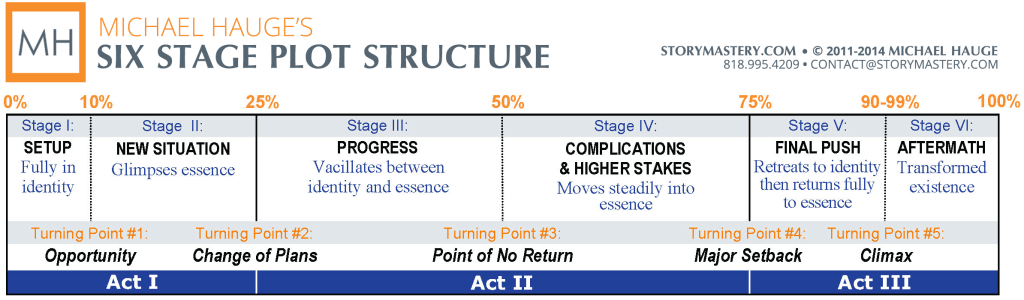
Stage 1 – Setup or “Everyday Life” (0%-10%)
Outer Journey
- Introduce your hero in their everyday world
- Create identification with 2 or more of the following:
- sympathy
- put them in jeopardy
- make them likable
- make the hero funny
- make them powerful
Inner Journey
- The hero exists completely in their identity.
- Their identity may be centered on what they do, their religion, or how they want others to see them.
- Their identity is what protects their core essence. (People pleaser vs “I am fine the way I am.”)
Turning Point 1 – Presented with an Opportunity (10% marker)
Outer Journey
- Creates in the hero a desire to move into a new situation, something new
- This is not the desire for the true endpoint.
Inner Journey
- Hero gets a glimpse of what it would be like to live in their essence
- They refuse the call to change
Stage 2 – New Situation (10% – 25%)
Outer Journey
- The adjustment
- What are the new rules?
- How can I get along?
- Usually, hero believes it will be easy.
Inner Journey
- Hero gets a glimpse of what it would be like to live in their essence.
- Reject living in their essence.
Turning Point 2 – Change of Plans (25% marker)
Outer Journey
- The visible end goal is established.
- The character realizes, “No, I have to do this.”
Inner Journey
- A foot in who their initial identity is and a foot in who they really are – their essence.
- They struggle back and forth with who they are and what they were.
Stage 3 – Progress (25% – 50%)
Outer Journey
- The plan seems to be working.
- There must be conflict, but the obstacles are avoided, overcome, delayed, or by-passed.
Inner Journey
- They are still straddling the fence of their essence and identity.
Turning Point 3 – The Point of No Return (50%)
Outer Journey
- When the hero is closer to the goal than the start,
 and they have become so committed they burn their bridges, making it impossible to turn back.
- The hero’s life as he knew it is over.
Inner Journey
- Their identity is stripped away.
- They realize their essence and begin pursuing it.
Stage 4 – Complications and Higher Stakes (50% – 75%)
Outer Journey
- It is more difficult to accomplish the goal, but also more important to accomplish.
- They have more to lose.
Inner Journey
- They continue pursuing who they really are.
Turning Point 4 – The Major Setback (75%)
Outer Journey
- The reader has the sense that all is lost.
- The plan they had is out the window but they can’t turn back.
- They must make one last push or die while trying.
Inner journey
- The hero has fully committed to living in their essence but now the outside world starts coming in and frightening them.
- The hero retreats back into their identity. They run away from who they are.
Stage 5 -The Last Push (75% to ?)
Outer Journey
- Do it or die while trying.
- Everything is put on the line.
Inner Journey
- They realize they don’t like who they were anymore. They have had a taste of who they truly are and they have to go after it.
- They have to find their destiny, even if it means risking everything to get what they want.
Turning Point 5 – Climax (% Depends)
Outer Journey
- All the problems are resolved.
- The hero can fail, succeed, or change their mind.
- The length of the climax depends on how many problems you have to resolve.
Inner Journey
- The moment they fully realize who they are.
Stage 6 – The Aftermath
Outer Journey
- Responding the climax emotionally.
- The wedding, reconciliation, etc.
Inner Journey
- The hero is going to live their new life as they truly are.
Interested in examples and learning more about either Mr. Hauge’s structure or the hero’s journey? I highly recommend buying the audible recording of his and Chris Vogular’s presentations. It is worth every penny. I have listened to it half a dozen times already and plan on listening again as I drive to Nashville for the ACFW Conference next week.
Michael Hauge’s website also does a great job showing examples.
Tell me what you think about this plotting format? Does it make sense to you? Are there any movies or books you can identify with this plot structure?
by Crystal Caudill | Aug 3, 2016 | Writing Craft
I am a woman. I think like a woman. I write like a woman. But what if I want to write like a man? If men are so straightforward and simple, shouldn’t it be easy to write in their point of view? Apparently not.
After my first failed attempt, I dove into researching how to write in the male POV. For the last couple weeks, I have shared what I learned about how men talk and how men think. Today we are wrapping up our study of writing in the male POV with a look at male behavior.
Without further ado…

Male Behavior
- Use strong verbs to describe their movement. Guys generally don’t wander and linger. They know where they’re going and they don’t mess around when they get there.
- When guys hang out together, there is usually an activity involved, whereas women can just get together and chat for the sake of chatting.
- The male ego can drive a guy to do things that are slightly crazy or a lot crazy.
“Almost all guys are defensive all the time. Lots of crossed arms, lots of small head-nods in agreement. Friendly guys will go for the back-slap or hair-ruffle (though ruffling is a bit demeaning, it’s the older-brother-little-brother gesture). With girls, it’s far more awkward. Maybe some casual, testing-the-water touches. Otherwise, guys are typically quite self-conscious around girls.”
– InkandQuills.com
Men…
- Are action-oriented. They do instead of think about it.
- Are rarely prepared to wait for any great length of time.
- Like being in charge (or at least like thinking they’re in charge!)
- Have better detection of light and have better depth perception.
- Are really great at faking being strong and tough. They present a confident front.
- Listen and give advice on how to solve a problem.
- Rarely admit being wrong.
- Rarely respond to direct commands unless it’s issued by a boss or other ranking figure.
- Rarely cry.
- Rarely have intimate friends. They tend to have a larger circle of ‘casual mates’
- Look for a physical way to end conflict–the quickest, most direct method you can imagine. Imagine physical contact or using anything blunt, heavy, or sharp
If the murderer were right there, then the Manly Guy will not stop to feel sad, he’ll go into Revenge Mode immediately, and nothing will stop him. But if the murderer is far away (the normal case) then the Manly Guy will go through the normal feelings of loss. Then he will map out a plan of action that will take him to the murderer and he will execute vengeance in a Manly Guy way, which will probably involve high explosives or machine guns or hot pokers placed in inconvenient places.
– AdvancedFictionWriting.com
Girl/Guy Interaction – According to a Man
Guys always notice girls. In the same way that guysalways notice every threatening-looking guy in a room, or the same way they notice if there’s a television.
The second look–the double-take–that’s the big one. The first look doesn’t count, that’s instinctual. The second look means we’re interested, or at least, willing to double-check.
As a guy, the general rule of thumb is, “Unless you knowotherwise, she’s taken.” To that extent, guys can look at girls, imagine what it might be like with her in a relationship, but then tell themselves a dozen reasons that wouldn’t work.
– InkandQuills.com
What do you think? Are there things that need to be removed? Need to be added? Comment below and let me know.
Previous posts about Male POV:
Writing Craft Wednesday: Writing in the Male POV – Part 1
Writing Craft Wednesday:Writing in the Male POV – Part 2
Interested in learning more? Check out my favorite articles from my time of research below.
Advanced Fiction Writing – Wrapping Up Those Manly Guy Characters
Advanced Fiction Writing – On Writing Convincing Male Characters
Keri Arthur – Male POV
Ink and Quills – How to Write from a Guys POV
Hopefully with the tools in hand that I have discovered, you will be reading about my believable swoon-worthy hero soon.
by Crystal Caudill | Jul 27, 2016 | Writing Craft
 Fitzwilliam Darcy
Thor
Two great swoon-worthy heroes, and who doesn’t love a swoon-worthy hero? As a writer, I strive to make my heroes the type that makes you swoon despite their flaws.
After learning the devastating truth, that my hero was a girly-man, I sought out to learn how to better craft the male POV in my writing. This sent me on a hunt through dozens of articles written by men, women, published authors, and editors to discover what makes a realistic male POV.
Last week I shared what I learned about male dialogue and conversations. Today I am wrapping up with bulleted lists on what I discovered about the male’s inner world.

The Inner Male
- Short snippets of inner monologue are best. One or two sentences is a good target.
- A man always thinks of himself in positive terms, even when he botches things terribly. He will phrase his defeat in terms that make it clear that he was put in an impossible situation or that he was off his game. (Of course, you can still have characters who struggle with self-image, but even then they can still have times of thinking like this.)
- A man would never describe himself as helpless. EVER. He may be down for a time while he waits for the next opportune moment, but he is not helpless.
- When a man sets his mind on a target, everything else vanishes from thought until the mission is accomplished.
- Men aren’t going to agonize over whether or not they should kiss the woman, they do it, then deal with the consequences afterward. Teenage guys might naturally agonize, though.
- Men are very visual. The way a woman dresses creates visual images a man’s brain that can linger for days, months, or even years.
- For every problem, there is a solution, but the consequences don’t matter as much as simply solving the issue to begin with. They may just try the direct, brute-force way first.
- Emotion, except for anger, is usually kept under wraps or repressed altogether.
- They think about responsibilities, deadlines, family, life, and sometimes there is literally nothing. (Is that seriously possible? I can’t even wrap my head around thinking nothing.)
- Most guys like to imagine they don’t have feelings. They use the ‘push it deep down’ approach 90% of the time and the remaining 10% of the time, it is bottled up until it eventually bursts.
- If you push a guy, he’ll get angry; if you break a guy, he’ll cry.
- Guys understand a woman’s emotions; they just don’t know what to do about it.
- Most guys only know eleven colors: red, blue, yellow, green, orange, purple, black, brown, gray, white, and pink.
- Guys do NOT always think about sex. If they do, they are not the type of guy you want being your hero. Real men can and do think about other things.
What do you think? Are there any things that could be added to this list? Any things which should be removed? Leave your comments below and come back next week for my final installment with Male Behavior.