by Crystal Caudill | Mar 19, 2024 | Author Interviews
If you’ve not had the pleasure of meeting Sara Brunsvold before, let me tell you, she is one of the sweetest, humblest women I’ve ever met. Her debut novel, The Extraordinary Deaths of Mrs. Kip, was one that rocked the Christian Fiction world in 2023. Her newest release, The Divine Proverb of Streusel, is sure to do the same, and I’m excited to talk about it with her today. In fact, you can get she streuselkuchen (German crumb cake) recipe from the book straight in your inbox when you subscribe to her monthly updates here. First, let me introduce you to Sara.
 Sara Brunsvold is a Christy Award-winning author who creates stories that speak hope and life. Influenced by humble women of God who find His fingerprints in the everyday, she does the same in her life and her storytelling. She lives with her family in the Kansas City, Mo., area.
You can connect with her through: Website | Facebook | Instagram | BookBub | GoodReads
Now for the fun stuff! I have to admit I am partial to my Fast Five. 🙂 So settle in as I hit Linda with rapid-fire.

CC: Pineapple pizza or candy corn?
SB: Pineapple (period)
CC: Test the waters or dive in the deep end?
SB: Test the waters.
CC: Guacamole or salsa?
SB: You ask impossible questions. I’ll go with guacamole.
CC: Silly hats or silly socks?
SB: Silly socks.
CC: Passwords or secret handshakes?
SB: Secret handshakes because I can’t remember one more password.
LOL. Oh man! I 100% get you on that last one. I use a program to manage all my passwords because it’s just ridiculous. Let’s start off with some get-to-know-you questions.
When did you first realize you wanted to be a writer?
SB: I first knew I wanted to be a novelist when I was in middle school, and the revelation was largely thanks to my language arts teacher.
CC: Teachers can be some of the best encouragers! I’m sure we’re all thankful for that teacher that set you on this path.
What does your writing process look like from beginning to end?
SB: I create just enough of an outline for a story in the beginning to have a general idea of where the story needs to go, and then I discover the rest along the way. My first drafts are sloppy and incomplete, but I don’t mind. I am a stronger editor than I am a first-drafter.
CC: I’m with you, except I tend to edit as I go along.
How have you seen God work through your writing journey?
SB: I have a testimony video on my website in which I share more about this. Basically, every “failure” I have had in my journey has proven to be a blessing. God wasn’t saying “No”; he was saying “Trust me.” This journey has taught and continues to teach me to be still and know that he is God. It has taught me obedience and faithful servanthood.
CC: Amen. I’m sharing the testimony video link here for those who want to hear her more detailed answer. (And can I say that I love that you have a testimony video?) Scroll toward the video and you can see her videos about her favorite verse and author journey. https://sarabrunsvold.com/about/
Now I’m excited to talk about your newest release, The Divine Proverb of Streusel.
 Cooking her way through her great-grandmother’s German recipes provides Nikki Werner an anchor in the storm of family crisis. But will it be enough to fill every hunger she has?
Shaken by her parents’ divorce and discouraged by the growing chasm between herself and her serious boyfriend, Nikki Werner seeks solace at her uncle’s farm in a small Missouri hamlet. She’ll spend the summer there, picking up the pieces of her shattered present so she can plan a better future. But what awaits her at the ancestral farm is a past she barely knows.
Among her late grandmother’s belongings, Nikki finds an old notebook filled with handwritten German recipes and wise sayings pulled from the book of Proverbs. With each recipe she makes, she invites locals to the family table to hear their stories about the town’s history, her ancestors–and her estranged father.
What started as a cathartic way to connect to her heritage soon becomes the means through which she learns how the women before her endured–with the help of their cooking prowess. Nikki realizes how delicious streusel with a healthy dollop of faith can serve as a guide to heal wounds of the past.
This contemporary Christian fiction story features unforgettable intergenerational characters, a touch of mid-life romance, small-town charm — and yes, unique recipes.
Purchase your copy at Amazon | Baker Book House | Barnes & Noble | Bookshop | Books-A-Million | Christianbook
CC: Where did you get the idea for this story?
SB: Two things inspired the premise of The Divine Proverb of Streusel. First was the movie Julie & Julia, about a young woman who cooks her way through Julia Child’s cookbook. After watching the movie, I wondered, “What if that concept was applied to a granddaughter cooking through her grandmother’s recipes?” The second inspiration came from a memoir I read. A grandson chronicled his German immigrant grandparents’ settling into Missouri. He mentioned the “common book” his grandmother wrote for her children. It was a dime store notebook she filled with practical life advice and wise sayings she had collected. Those two ideas — recipes and advice — collided, and the premise of The Divine Proverb of Streusel came into being.
CC: I love that concept! How perfectly wonderful!
Who was the most challenging character to create?
SB: The character of Uncle Wes represents the first time I have written from a male point of view. My husband was a gem in helping me understand Uncle Wes and how he might think and respond in a given situation.
CC: Husbands are a blessing in this for sure. I’m just learning how much of a gem my husband can be in the same way if I’m willing to be brave and talk to him about my story while still writing it.
Which character was the most fun to create?
SB: Hands-down the most fun was Aunt Emma. She was such a joy to write because she is witty and gregarious. All of her scenes came easily.
CC: She sounds like such fun character, and I can’t wait to get to know her better.
How did this story affect you as you wrote it? Did God teach you anything through the writing?
SB: The story is in many ways a tribute to what God had already taught me, specifically about forgiveness. I share in my author’s note at the end of the book that the story is loosely based on my own family’s story, specifically my relationship with my dad. Before my dad passed away, I sought his permission to write about our journey. I thank God that he understood why I asked and gave his permission. Because he did, what God first started in our real-life story can bear fruit in a fictional story as well.
CC: Hugs. I love that you have that personal connection and that your dad was willing to allow you to share that with us. There is a special beauty to writing stories that connect to use on such a meaningful level.
For my last question, I love to end with just a playful question.
You are in the back of a police car on your way to jail. What did you do and is anyone with you?
SB: I probably spray-painted grammatical corrections onto sign. My editing brain can’t overlook such abuse of language.
CC: LOL! I think there are many grammar police who would be sitting in the back seat with you!
Readers, I hope you’ll check out The Divine Proverb of Streusel and then leave a review on Amazon, Goodreads, and/or BookBub. You wouldn’t believe how important that is to an author.
Reader, if you were to sit down with someone over a meal or dessert and offer advice, what would the food be and what would the advice be?
by Crystal Caudill | Mar 12, 2024 | Book Reviews

A Lady’s Heart of Gold
by Sally Britton
Review:
This was the last book in the Hearts of Arizona series, and it was a wonderful wrap-up to the series with a depth that touched on historical hardships that many would like to forget or ignore. The author’s note in the back almost broke my heart when she said while she enjoyed writing the series, the hardships of the ethnically non-white people groups (Native Americans, Spanish, Blacks etc) were extremely hard on her to research, and so she was returning to her Regency romances to stay. Not that I don’t love her Regencies, but I felt the way she handled a lot of the injustices was beautifully done and brought new understanding and perspective to something I thought I was already very familiar with, considering my own family background in the Native American realm. The romance was sweet, the depth of characters greatly appreciated, and the view into previous books’ characters’ lives a joy.
I recommend this book to those who love ranch love stories, female reporters, historical details that are accurate and moving, well-developed characters, and romances that are solidly built without being gag-worthy. 🙂 If you know me, I am not a gag-me-with-a-spoon romance girl. 😉
Genre: Historical Romance, Western
Plot:
When a determined English newspaper woman arrives in the Arizona desert, she expects to find the lawless and the illiterate. Instead, she meets a well-spoken and handsome cowboy who’s ready to prove to her there’s more to the Territory than cattle and cacti.
English newspaper reporter Molly McKinney is determined to make a name for herself by writing about the wilds of the American West. After convincing her editor to take a chance on her idea, Molly travels to the United States looking for tales that will transport and inspire her readers. When she meets a quiet cowboy in the middle of Arizona Territory, she can sense that his story might be the most important of all—if only he’ll open up enough to tell it.
Eduardo “Ed” Byrd has worked at the KB Ranch for five years, making an honest living and trying to ignore his past. He’s one-quarter Cherokee, three-quarters Mexican-American, and entirely his own person. Light-hearted and hard-working, Ed keeps to himself and reserves his dreams for the privacy of his notebooks. When one meeting with the tenacious English woman rattles his mind and heart, Ed can’t help but wonder if he’s been playing things safe for too long.
A reporter’s natural curiosity spurs Molly to make her way to the ranch where Ed works, and she’s determined to find out what the cowboy is hiding beneath his gentle smiles. There’s more to Ed than he lets on, and when Molly starts to unravel his past, he realizes their story might only have a happy ending if he’s willing to risk more than just his heart.
Author Website: https://www.authorsallybritton.com/
Purchase Link: Amazon | Barnes & Noble
What is the most recent book you’ve read? What did you like about it? Who would you recommend it to?
by Crystal Caudill | Mar 5, 2024 | Author Interviews
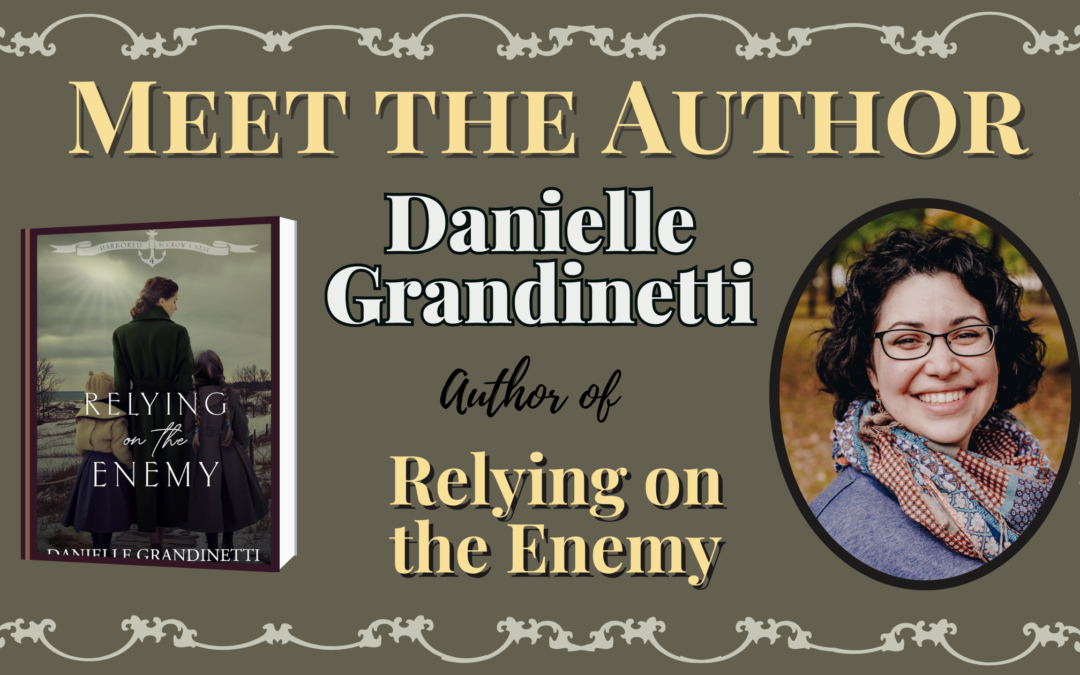
This week’s author interview is the wonderful Danielle Grandinetti. I’ve known Danielle for quite some time now, and it’s such a pleasure to know her. I love her unique time frame of the 1930s and her mix of history with romance and suspense. AND Danielle is generously doing a giveaway for a paperback copy of Refuge for the Archaeologist AND Relying on the Enemy (paperback, US only; ebook international). So make sure to go down to the bottom to participate.
 Danielle Grandinetti is an inspirational romance author fueled by tea and books, and the occasional nature walk. An award-winning author and FHLCW Reader’s Choice Finalist, her stories span from the Great Depression to present day. Originally from the Chicagoland area, she now lives along Lake Michigan’s Wisconsin shoreline with her husband and their two young sons. Find her online at daniellegrandinetti.com.
You can connect with her through: Website & Newsletter Signup | Website Store | Book Blog | Amazon | BookBub | GoodReads
Now for the fun stuff! I have to admit I am partial to my Fast Five. 🙂 So settle in as I hit Danielle with rapid-fire.
CC: Pineapple pizza or candy corn?
DG: Pineapple Pizza
CC: Test the waters or dive in the deep end?
DG: Test the waters
CC: Guacamole or salsa?
DG: Both!
CC: Silly hats or silly socks?
DG: Silly socks
CC: Passwords or secret handshakes?
DG: Passwords
I’m a huge silly socks fan. It’s the only socks I can almost guarantee my kids won’t steal. LOL So let’s dive in deep!
When did you first realize you wanted to be a writer?
DG: I’ve loved writing stories since I was in early grade school. I vividly remember writing my first short story in 3rd grade after hearing an author speak in Assembly. It has led me to believe that there’s nothing like the power of story to change lives, including my own.
CC: Amen. The power of stories never fails to amaze me.
What is your writing Kryptonite?
DG: Funny thing, description is my kryptonite. Though it’s one of my favorite writing skills to teach, I don’t write it naturally. Instead, I have to layer it in after I’ve set the scene. I suspect that’s because I’m a math nerd, albeit a romantic one, at heart.
CC: Ah. So you are one of the rare birds who is both a writer and a math nerd. 😉 I must admit, I like my spreadsheets. LOL
How have you seen God work on your writing journey?
DG: My characters’ spiritual struggles lead me to the Bible so I can offer them guidance in order to help them grow—whether through their own interaction with God or through the voice of another character. In turn, I am challenged as I write those scenes, and I hope those truths touch the hearts of my readers, too.
CC: I think that is one of my favorite parts of writing–seing how God uses my own story to grow me.
Now I’m excited to talk about your newest release, Relying on the Enemy.
 She’s protecting her children. He’s redeeming his past. But there’s nothing convenient about saving their patchwork family.
Wisconsin, 1931—All widowed mother Marian Ward wants is to provide for her girls. However, she faces the dead of winter with no income and dwindling resources. Then she overhears a nefarious conversation, putting her life and that of her children in immediate danger.
Aiming to make amends to the Wards, Gilbert steps in when the threat to Marian escalates. It costs him dearly. Either lose his career or marry her, and be tied to his past until death do them part.
He leaves the decision to Marian, who will do anything to protect her girls, even marry the son of the man who ruined her family. How will their fledgling trust prove strong enough to fulfill their vows as winter tightens its grip and desperation stalks at the door?
Welcome to Crow’s Nest, where danger and romance meet at the water’s edge.
Purchase your copy at Danielle’s Website and other retailers.
CC: What readers will most love Relying on the Enemy?
DG: If you love marriage of convivence tropes, then I hope you’ll love this story! And, doubly so if you also love Gilbert Blythe from Anne of Green Gables.
CC: You know, I’ve never read or seen Anne of Green Gables, but I’ve heard so much about Gilbert. He must be real swoon-worthy if this story has some connections to him.
What was some of your favorite research tidbits for this story?
DG: I love scouring old newspaper archives! And I found a gem of an article that provided a major scene in the story. On January 18, 1931, the first big snowfall of the year occurred. According to local newspapers at the time, it was a twenty-four-hour snowfall dropping six inches of blinding snow followed by cold weather.
CC: Oh my! That must have been something, and definitely a challenge for those who lived through it. (And I’m a huge fan of scouring old Newspaper archives too!)
Relying on the Enemy is book four in the Harbored in Crow’s Nest series. Can this story be read as a stand-alone?
DG: Yes, with a caveat.
All the books in the Harbored in Crow’s Nest series are stand-alone romances, meaning each book focuses on just one couple and their happily ever after. However, each book’s plot does build on the events in the previous one, though I do my best to avoid spoilers.
That said, this book is one that has a major spoiler. Gilbert is the son of the man who ruined Marian Ward’s family. Notice that I don’t use Gilbert’s last name. That’s because it’s a spoiler for events that happened to Marian’s brother-in-law in Refuge for the Archaeologist.
While you don’t have to read Refuge for the Archaeologist (book 2) before reading Relying on the Enemy, it is where you meet the Ward family, especially Marian’s two precocious little girls. And, it will help you understand why Gilbert could be seen as an enemy.
CC: Good to know! I have a few stories like that myself.
What do you hope readers will take away from this story?
DG: The verse I chose for the front of the book is “As for you, you meant evil against me, but God meant it for good.” Genesis 50:20a (KJV). That theme permeates this story. God can redeem. He can take awful circumstances and redeem them for His children. It might not always look the way we think it should, and we may not see the fruit of it as soon as we think, but I pray this story will offer hope.
CC: What a sweet and important nugget to walk away with. As always, I love to end off with a fun question.
What animal is most like you? Why?
DG: A golden retriever. Their personality seems so similar to the way other people describe me. 🙂
CC: LOL They are a man’s best friend, and you are a wonderful friend. So I definitely say that fits!
Readers, I hope you’ll check out Relying on the Enemy and then leave a review on Amazon, Goodreads, and/or BookBub. You wouldn’t believe how important that is to an author.
Giveaway – A copy of A Refuge for the Archaeologist and Relying on the Enemy (print US, ebook for International) Ends at 11:59 p.m. EST on 3/12/2024.
a Rafflecopter giveaway
Reader, what animal best describes you?
by Crystal Caudill | Feb 29, 2024 | Reading Challenge
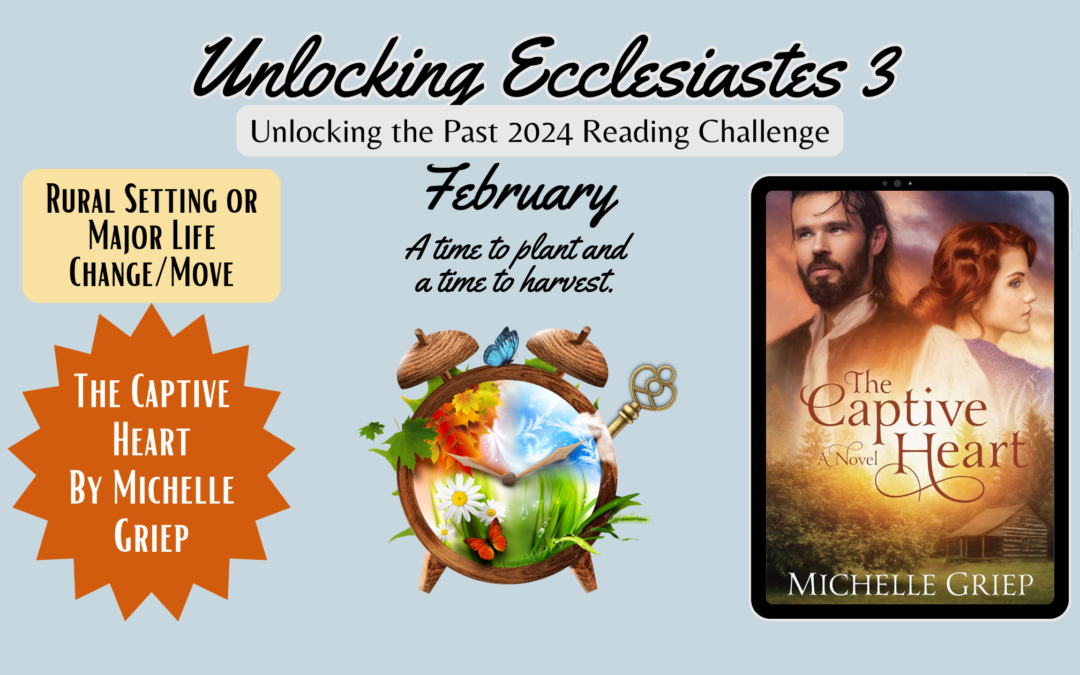
It’s another month our challenge: Unlocking Ecclesiastes 3. I’m so excited to join you again this year with guest reviews from our reading challenge participants. If you want to submit a review for upcoming months, feel free to email me using my contact form. If you are looking for suggestions as to what to read each month, may I recommend joining my Crystal Caudill’s Reading Friends Facebook group, or visiting Avid Readers of Christian Fiction or Inspirational Historical Fiction Index. I’ll also include a short list at the bottom of this post. Don’t forget to comment at the bottom of the post for your chance to win a book off my prize shelf. *The list of prizes available from my prize shelf can be found here.*
Unlocking the Past: Ecclesiastes 3
Just as Ecclesiastes has two opposites in each verse, most months will leave you with two options to choose from.
“For everything there is a season,
a time for every activity under heaven.”
February Verse: A time to plant and a time to harvest.
Challenge Theme: A book with a Rural Setting OR a Major Move/Life Change
March Verse: A time to kill and a time to heal.
Challenge Theme: A book with a serial killer or a character in the medical profession.

The Captive Heart
by Michelle Griep
Review by: Crystal Caudill, reposted from 2019 What I loved: Historical details are always a favorite of mine, and I really loved how the complexities of frontier life were displayed, especially for the heroine. To change from the pampered life of England to the comparably savage struggle of the frontier was fun to live through. I learned so much, and of course, I loved the romance. The struggle between the two to learn to love and trust each other was a slow simmer. Like a stew cooked to perfection takes hours and hours, Love is not rushed, and I really enjoyed that.
Favorite Character and Why: Samuel definitely won me over. He was a complex character, a puzzle to be figured out. He was both a man you loved and accepted as imperfect. He was real.
Who would like this? Anyone who loves frontier stories, romance, action, and danger. Also, if you love marriages of convenience, this is a fun story that breaks some of the molds.
Genre: Historical Romance, American Frontier, 1770 Plot Overview: The wild American wilderness is no place for an elegant English governess
On the run from a brute of an aristocratic employer, Eleanor Morgan escapes from England to America, the land of the free, for the opportunity to serve an upstanding Charles Town family. But freedom is hard to come by as an indentured servant, and downright impossible when she’s forced to agree to an even harsher contract—marriage to a man she’s never met.
Backwoodsman Samuel Heath doesn’t care what others think of him—but his young daughter’s upbringing matters very much. The life of a trapper in the Carolina backcountry is no life for a small girl, but neither is abandoning his child to another family. He decides it’s time to marry again, but that proves to be an impossible task. Who wants to wed a murderer? Both Samuel and Eleanor are survivors, facing down the threat of war, betrayal, and divided loyalties that could cost them everything, but this time they must face their biggest challenge ever . . .Love.
Purchase Links: Amazon | Barnes & Noble | Christianbook.com
Giveaway
For your chance to win a print copy, comment with what book YOU read for this month. Use the Rafflecopter below for extra entries and to mark that you left a comment. Entries end on the 7th of each month at midnight EST, and the winner will be drawn sometime that week and notified by email. The winner will be announced on the Rafflecopter widget. *Open to all residents of the contiguous USA, legally able to enter, and an e-book format or Amazon Gift Card will be awarded to those outside that range who are legally able to enter. a Rafflecopter giveaway
Recommendations for March:
- Kaely Quinn Profiler series by Nancy Mehl
- When Crickets Cry by Charles Martin
- Patrick Bowers Files by Steven James (Warning: Graphic)
- With Every Breath by Elizabeth Camden (doctor, TB, mystery)
- While Love Stirs by Lorna Seilstad (light/sweet romance, doctor)
- White City by Grace Hitchcock
- Wedded to War by Jocelyn Green
- A Memory Between Us by Sarah Sundin
- Wings of the Nightingale series by Sarah Sundin
- The Doctor’s Lady by Jody Hedlund
- Lost in Darkness by Michelle Griep
- Within My Heart by Tamera Alexander
- A Lady in Attendance by Rachel Fordham
- At Loves Command by Karen Witemeyer
What did you read for the challenge? What were your thoughts on it? Would you recommend it?
by Crystal Caudill | Feb 20, 2024 | Author Interviews
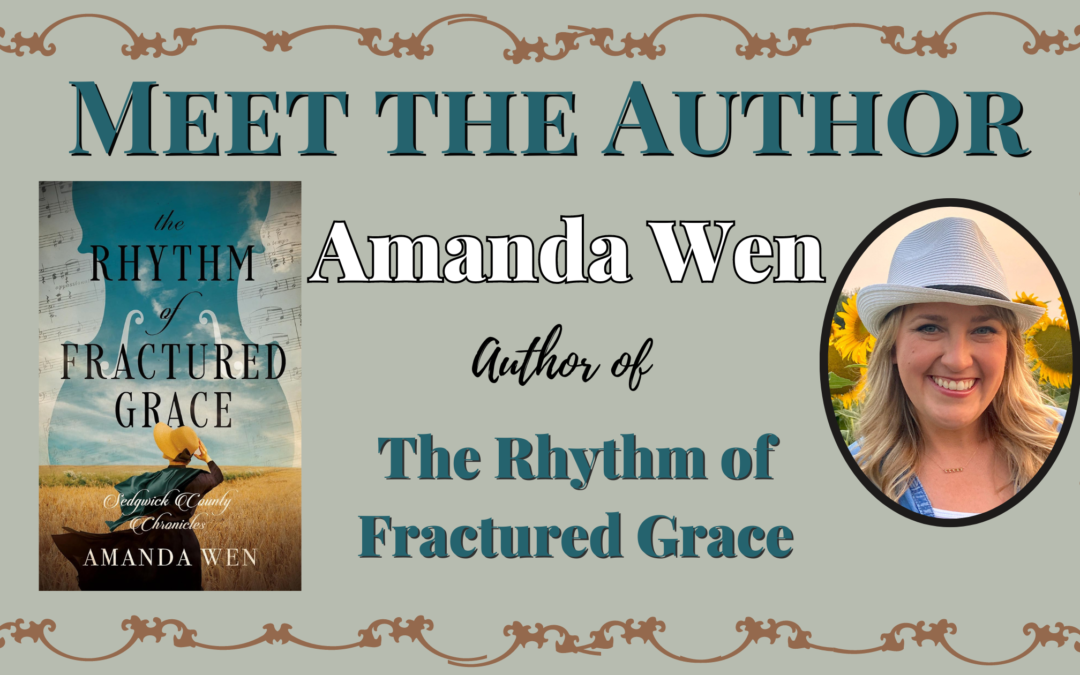
Amanda Wen is a fellow Kregel author, and it is my pleasure to introduce to you this Selah and Carol award-winning and Christy finalist author. She is an amazing woman that you don’t want to miss the opportunity to get to know. Even better, make sure to read all the way to the bottom where Amanda is generously giving away a signed paperback to one lucky U.S. resident.
 Amanda Wen’s novels have released to both reader and critical acclaim. Her second novel, The Songs That Could Have Been, won both the Selah and the Carol Awards, and her debut, Roots of Wood and Stone, was a finalist for the Christy Award. In addition to her writing, Amanda is an accomplished professional cellist and pianist who frequently performs with orchestras, chamber groups, and her church’s worship team, as well as serving as a choral accompanist. A lifelong denizen of the flatlands, Amanda currently lives in Kansas with her patient, loving, and hilarious husband, their three adorable Wenlets, and a snuggly Siamese cat.
You can connect with her through: Website | BookBub
Now for the fun stuff! I have to admit I am partial to my Fast Five. 🙂 So settle in as I hit Amanda with rapid-fire.
CC: Pineapple pizza or candy corn?
AW: Probably pineapple pizza because I can pretend it’s healthy.
CC: Test the waters or dive in the deep end?
AW: Test the waters. I’m generally a pretty cautious person.
CC: Guacamole or salsa?
AW: Guacamole, forever and always.
CC: Silly hats or silly socks?
AW: Socks. Despite my author photo, I’m not usually a hat person!
CC: Passwords or secret handshakes?
AW: Secret handshakes.
I am a huge guacamole fan, too, especially when it’s homemade and fresh. Oh, man. Now I’m craving some. I guess I’ll have to pick up an avocado, tomatoes, and onion. So lets dive a little deeper into getting to know you.
When did you first realize you wanted to be a writer?
AW: I’ve been writing stories since I was old enough to hold a pencil, and I have a vague memory of my dad paying me a penny a word in order to encourage me to write stories. (Decades later, I discovered editors don’t necessarily believe that more words = better, but hey, you gotta start somewhere!) My formal education was focused exclusively on music, resulting in two degrees in cello performance, but when I finished with school, fiction writing still called to me. I wrote a few stories for fun, but didn’t get serious about it until we moved back to my hometown in 2009 and I reconnected with my middle school BFF, who by then was a multi-published general market author. I finally got up the guts to show her my writing and she said I had promise! The rest, as they say, is history…
CC: How cool is that! I love that your dad paid you to write, and then your friend encouraged you too. (And can I admit I always wanted to play either the violin or cello but that was never offered at my school, so I got stuck with clarinet?)
What has been the biggest challenge for you on your writing journey?
AW: Making time for writing! The beginning of me getting serious about writing not-so-conveniently coincided with my beginning of Life As A Mom, so writing always came in snippets. I always wrote during my kids’ naptime, though, so most days I got 1-2 hours to focus on writing. Now that my kids are teens and tweens, my other job as a musician is what frequently gets in the way! I love love love my day job, and I can’t imagine not doing it, but balancing is sometimes incredibly challenging.
CC: I can only imagine. You frequently blow my mind with how much you perform, get to be an incredible mother, and yet still find time to write. You are a rock star.
Do you have any advice for those who want to write their own stories?
AW: Just do it! You’ll never know until you try. And hardly anyone is good at it when they first start–I know I wasn’t! Study the craft, dig into books you love and find out WHY you love them, then figure out how to incorporate those elements into your own stories. Finally, connect with the writing community. Those who are further along the path than you are will usually be eager to help you, and as you progress on your own journey you get to extend a hand to those further behind you. It is so rich and rewarding and one of the best parts of being a writer.
CC: I 100% agree. And I adore helping other writers. It truly is one of the best parts of being a writer.
Now I’m excited to talk about your newest release, The Rhythm of Fractured Grace.
 The Rhythm of Fractured Grace by Amanda Wen
When a new customer brings a badly damaged violin into Siobhan Walsh’s shop, it is exactly the sort of challenge she craves. The man who brought it in is not. He’s too close to the painful past that left her heart and her faith in shambles.
Matt Buchanan has had a rough start as the new worship pastor. A car accident on his way into town left him with a nearly totaled truck, and an heirloom violin in pieces. When he takes it to a repair shop, he’s fascinated with the restoration process–and with the edgy, closed-off woman doing the work.
As their friendship deepens and turns into more, they both discover secrets that force them to face past wounds. And the history of the violin reveals more about their current problems than they could have ever expected.
On the nineteenth-century frontier, a gruesome tomahawk attack wiped out most of Deborah Caldwell’s family. Her greatest solace after the tragedy is the music from her father’s prized violin. Given her horrendous scars, she’d resigned herself to a spinster’s life. But Levi Martinson’s gentle love starts to chip away at her hardened heart, until devastating details about the attack are revealed, putting their love–and Deborah’s shaky faith–to the ultimate test.
Full of forgiveness and the message that no one is too damaged for God’s healing touch, the final book in the split-time Sedgwick County Chronicles will thrill fans of Rachel Hauck, Lisa Wingate, and Kristy Cambron.
Purchase your copy at Amazon
CC: Where did you get the idea for The Rhythm of Fractured Grace?
AW: The historical story comes directly from my own family tree, which my mom has been researching for the last 50 years or so. In 1782, my 6x-great grandmother, Delilah Corbly, then 7 years old, survived a tomahawk attack that wiped out her mother and three of her siblings and left her and her sister, Elizabeth, maimed and scarred. Despite her injuries, Delilah lived to adulthood, got married, birthed and raised ten children, and died at the age of 64, which back then was quite the achievement for anyone, let alone someone who’d been scalped! The idea that someone could survive something so traumatic has always been an inspiration to me, so when I started writing novels, I knew I wanted to explore that issue in fiction.
CC: Wow! That is both incredibly horrifying and intriguing. I can see why you would write a story around that.
What readers do you think will enjoy this book?
AW: Readers who like deep fiction that deals with tough issues, split-time fiction, the friends-to-lovers trope, and pioneer-era stories. Also, to anyone who enjoyed Jack and Annabelle in the historical timeline of my debut, Roots of Wood and Stone…they just might show up in this book, too. 😉
CC: Oh! How fun! I love it when characters from other books show up!
How did this story affect you as you wrote it? Did God teach you anything through it?
AW: The contemporary storyline deals with toxic churches, and narcissistic abuse. What I didn’t realize when I wrote the book was that I was trapped in a web of manipulation and gaslighting courtesy of a narcissist in my own life. It wasn’t until I’d submitted the manuscript and was in the final stages of editing that I realized how closely some aspects of what my heroine, Siobhan, went through mirrored my own experience. And just as Siobhan was able–by God’s grace–to forgive her abuser, you guessed it, God called me to forgive mine. And– by His grace–I am thrilled to report that I have.
CC: Praise the Lord for your obedience in forgiveness, and oh my, how my heart hurts that you had to endure it.
What do you hope readers will take away from your story?
AW: The idea that no one is too far gone, too broken, or too damaged for God to redeem and restore.
CC: Amen. Such a powerful thing. To wrap this interview up, I always like to ask a fun question.
If you were stuck on an island, what three items would you have with you? Why?
AW: Sunscreen so I don’t burn, food so I don’t get hangry, and my cell phone (with battery pack) so I could get off the island and get back to Kansas where I belong. (There might not be a big hurry, though; we Kansans don’t get to see islands very often!)
CC: Wise decisions, and I laughed out loud about the cellphone. LOL That is a wise woman, if I do say so myself!
Readers, I hope you’ll check out The Rhythm of Fractured Grace and then leave a review on Amazon, Goodreads, and/or BookBub. You wouldn’t believe how important that is to an author.
GIVEAWAY – U.S. Residents only, ends 11:59 p.m. EST on 2/27/24.
a Rafflecopter giveaway
Reader, have you ever played an instrument? Or did you ever dream of playing one? Which one?