by Crystal Caudill | May 4, 2016 | Writing Craft
I took a couple weeks off doing only writing prompts while I figured out my new schedule for my blog. My new goal is to alternate between Writing Prompt Wednesday with Writing Craft Wednesday. So today marks the first Writing Craft Wednesday!
Today I am going to finish up our look at GMC: Goal, Motivation, and Conflict. Here is a list of the previous GMC posts:
Conflict: The Heat of the Story
So what is conflict? If goal is the “what” and motivation is the “why,” then conflict is the “why not.” Conflict is what your character must face in order to achieve their goal.
External conflict often comes in the form of a physical being, usually the villain. The villain causes problem after problem for the hero or heroine. All five senses are engaged when dealing with this maniacal menace. You can smell them, see them, feel them, hear them, and depending one what is going on… taste the blood they draw.
Internal conflict is more subtle. Whatever keeps the hero or heroine from learning their life lesson, that is your internal conflict. Just like anything else internal, it is emotional. Perhaps it is the self-conscious voice which keeps them from seeing their worth. Perhaps it is the guilt of not being there for a loved one when they were needed most. Whatever it is, it evades the five senses.
Why include conflict?
Readers like to see characters tested, run through the wringer, and facing their worst fears. Anticipating an explosion of conflict is what keeps the reader turning the pages.
Besides the excitement conflict brings to a story, it also brings depth and complexity to the characters. It is through conflict characters learn to dig withing themselves, grow and rise to the challenge. Through conflict they become a hero.
Think something is bad? Make it worse.
So how do you make the conflict engaging and page turning? Strife, tension, dissension, and opposition are key elements in creating conflict. Start with making a list of bad things which could stand in your character’s way.
Found one? Good. Now make it worse. Worse? YES! WORSE!
For one of my characters she is potentially losing her house. Initially, I started with the loan belonging to the bank, but then I applied the above principle. How did I make it worse? The loan belonged to a vicious loan shark who will get his money one way or another. Does that create more problems and stronger conflict? You betcha!
The stronger your conflict, the stronger your book.
Think your character has it bad?
Make it worse.
by Crystal Caudill | Apr 21, 2016 | Counterfeit Love, History Facts
Welcome to my first ever Throwback Thursday, where I share gems from my research for my novel.
The setting of my current Work In Progress (WIP) is a city with a wealth of history to pull from, Cincinnati, Ohio. Cincinnati is known as the Queen City and more important to today’s post, the City of Seven Hills.
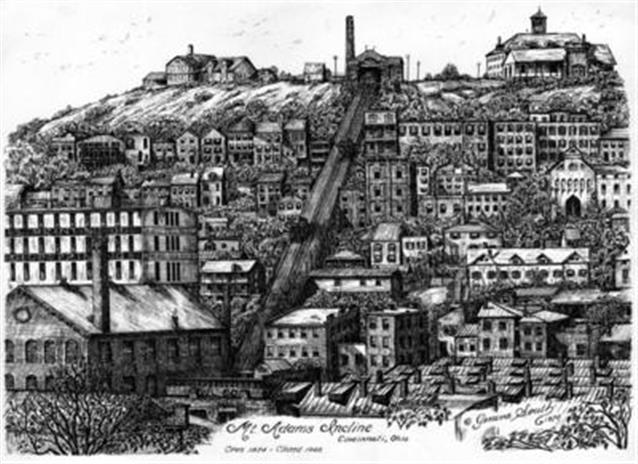
Drawing by Geneva South, 1972
The terrain for Cincinnati is very hilly as you can guess by the name, but not the gentle rolling hill kind where kids spend all summer rolling down until they become too dizzy to stand. Cincinnati’s hills are of the variety where trees and ravines impede your progress, where semis turn their hazard lights on because the climb to the top reduces them to a crawl.
Now step back to the Industrial Revolution, about one hundred-fifty years ago. Factories clogged the air with soot and smoke. Tuberculosis was rampant. The stench of the Erie Canal was far from pleasant. People looked to the hills for relief.
Omnibuses drawn by horses were the first transit system devised to struggle up the hills. However, drivers often had to hop out, block the wheels, and allow the horses to stop and rest before proceeding to the pristine air above. An alternative was desperately needed.
Responding to the need, business partners, Joseph Stacy Hill and George Smith, opened Cincinnati’s first incline plane on May 12, 1872. Hill top resorts, like the Lookout House and Highland House, opened and regularly drew in crowds of up to 10,000. (An upcoming post will describe the Highland House.)

Mt. Adams Incline
By the time my novel opens in 1883, Cincinnati had 4 operating inclines: The Mt. Auburn Incline (leading to the Lookout House), the Mt. Adams Incline (leading to the Highland House), the Price Hill Incline (the only double incline – one for freight and one for passengers), and the Bellevue Incline.
Interesting Tidbits and Stories
- In 1884, the price of a ride was 5¢.
- A one-way trip took 2 minutes and 20 seconds. This was repeated six times every hour, 19 hours a day.
- The Mt. Adams Incline made the trip in about 90 seconds.
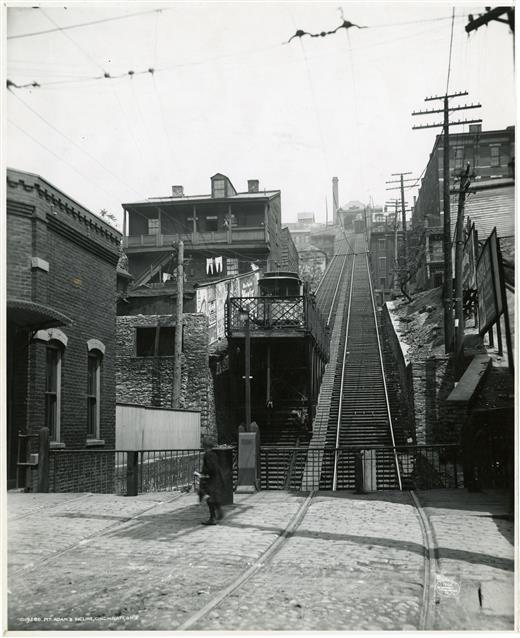
Mt. Adams Incline (1906): A car is lowering down the track and will eventually become flush with the ground.
- All full crew consisted of an operator, an engineer, a fireman, two gatemen, and two carpenters. The gateman’s job was to take the tickets from the passengers in the waiting room and then escort them onto the lift.
- A telegraphic system of signal bells between the operating engineer in the powerhouse at the top of the hill and the attendant at the bottom of the station. Two bells meant “ready,” one bell signaled the doors were closed and locked (“alarm”), and three bells rang for “start.”
- The Bellevue Incline passed by McMicken Hall, the first college of the University of Cincinnati. A medical school shared a freezer for cadavers with a brewery down the hill, and young students often got a thrill from waving body parts at passengers who passed by on the incline, in particular passengers of the female variety.

Bellevue Incline: You can see McMicken Hall in the background on the right.
Although the Cincinnati inclines are no longer around, the last one having closed its doors on July 25, 2008, they are still a fascinating part of history.
What was your favorite tidbit? Do you have any tidbits? How do you think inclines might play a part in my Work In Progress?
*All pictures were retrieved from: http://retro.cincinnati.com/Topics/Gallery/Cincinnati-Inclines#The Highland House. Visit there to see more pictures.
by Crystal Caudill | Apr 11, 2016 | Writing Craft
Last week we took an In-depth Look at Character Goals. This week we will examine the why of external and internal goals. At the end of the post you will find application questions to guide you on your way.
What is Motivation?
Goal and motivation co-exist. You cannot have one without the other. In fact, when defining our goal, motivation is taken into consideration. Motivation is the reason why they take action. It is what drives them.
The character wants his goal because of the motivation. It is the why.
Make It Compelling. Make It Urgent.
Motivation is important. It is a major element which helps us to empathize or connect with the character. My motto with motivation is “Make it worse.” This adds to the urgency of the goal.
The great thing about the fiction world is you can do what ever you want as long as the reader understands the why.
Your character has a loan they cannot repay? Make it worse. A bank will repossess your house and the items you own, but what a merciless loan shark would do can be far worse. Imagine how the plot would be different for each of those scenarios. Which story line will be more compelling to read?

Taking Motivation a Step Further
Motivation shouldn’t only drive your overarching goal, it should drive your character’s every decision and action.
- Why did honest Joe steal from the bank? Because his family was being held captive and would be killed if he didn’t.
- Why did the rich heiress choose the even richer rogue instead of the man she loved? Because her family was in financial ruin and her little sister would not be able to receive treatment without his infuse of money.
Give a reason which will make your characters willing to risk anything and everything to achieve their goal. Give them no other choice. A weak motivation leads to a weak story.
One Last Tip
Character motivation needs to match your actual character. Make it possible. Your story can be wildly crazy and believable as long as you have the right motivation.

Would a Union woman cut off her hair, pretend to be a mute boy in a Confederate prisoner camp, and secretly help Confederate men to escape? (If you are a history buff at all, you can imagine the risks that woman is taking. Doing so is completely against her best interest.)
If you give her the right motivation, it could be a completely believable story.
Application Questions:
- What is your character’s goal?
- What is their motivation?
- How can you make it worse?
- Is your motivation believable for the character? Would they really make that choice?
- Do your characters have a purpose that moves them toward their goal for the scene you have created?
Share some of your answers in the comments below. I would love to hear your thoughts. Are there any other guiding questions you would add?
May God bless your journey to follow “The Write Call”,

by Crystal Caudill | Apr 4, 2016 | Writing Craft
In a continuation of our look at GMC (Goal, Motivation, & Conflict), today I am focusing on an in-depth look at character goals. At the end, I will leave you with some guiding questions to help you develop your own character goals.
Last week we defined a goal as answering two questions. What does the character want? What is compelling them to take action?
Everyone has goals in life. Today my personal goal is to overcome this sinus infection, however, I do not believe you would want to read a story centered around that goal. Why not? For one, it is gross. Secondly, it is not a compelling story that grips at your heart and soul to keep you turning pages.
So what makes a compelling goal?
Think about the stories you love to watch and read. I can guarantee you the main character’s goal is one that is life altering. The consequence of not reaching their goal will negatively affect them in a serious manner. It is for this reason they take action.
For example, in Disney’s Beauty and the Beast, Belle’s goal is to save her father from dying in the Beast’s tower room. If she does not save him, her only remaining family member will be lost to her forever. She would be left to live alone and possibly accept Gaston’s proposal. Horror of horrors. These consequences compel her to action. Achieving her goal is worth any sacrifice.
A novel example would be from Jane Austen’s Pride and Prejudice. Elizabeth Bennet has the goal of marrying for nothing less than love. When the very rich and arrogant Mr. Darcy first proposes, she is compelled to refuse him. Why? Because money would not be worth the life of misery.

External Goals:
The previous examples were external goals. (An external goal is something tangible.) According to Debra Dixon, author of Goal, Motivation, & Conflict, you characters should not want something they already have or want more of it.
To develop a strong character, you must create a goal in which they desperately need what they do not have. Mrs. Dixon describes it best:
Dangle a carrot just out of their reach and make sure they haven’t had a bite in weeks.
– from Goal, Motivation, & Conflict by Debra Dixon
Not only should they desperately want it, they should also urgently need it. The more urgent, the better.
In the interest of achieving their goal in time, they will make choices they would not have previously considered. Urgency will push them to make choices that go against their own best interest.
Internal Goals:
Internal goals reach down into the emotional soul of the main character. It is what they feel. I find that usually the character arc, or what the character learns, goes hand in hand with the internal goals.
One of my characters will learn that real love is not based on what she does, but who she is. Therefore, I have made her internal goal to be feel worthy of love and attention. In the beginning she feels she must earn the love of her inattentive caregiver and subsequently the love of the man she hopes to marry.
This, combined with her external goal, forces her to make decisions  which she would never had made before. Some of the choices she makes will have dire consequences. You want to keep the reader wondering if they will ever learn their lesson and achieve their goal, all the way to the black moment a the end.
Application Questions:
- What is your main character’s goal?
- What is the consequence of not achieving their goal?
- How can you make them more dire?
- How can you make the goal more urgent?
- What choices would your character have to make that go against their best interest?
- What do you want your character to learn throughout the story?
- What could be their internal goal?
- What makes them desperate for this feeling?
- What will be the consequences if they do not achieve this internal goal?
Share some of your answers in the comments below. I would love to hear your thoughts. Are there any other guiding questions you would add?
by Crystal Caudill | Mar 28, 2016 | Writing Craft
The first step to developing a novel beyond the initial concept is to develop your GMC. If you are a newbie like me, you might not know what those three letters represent. Let me share what I have learned.
What is GMC?
GMC stands for Goal, Motivation, and Conflict. These three concepts are developed around your individual characters.
- Goal – What does your character want? What is the reason they take action?
- Motivation – What is driving them to achieve their goal?
- Conflict – Why can’t they have what they want? What is preventing them from learning their life lesson?
Each character you develop will have their own external and internal GMCs. Just in case those old Literature & Language classes are fuzzy in your memory, external means you can touch it or achieve it without emotion, while internal revolves around the emotional.
Here is an example of Little Red Riding Hood’s external and internal GMC:

Debra Dixon does a fantastic job of explaining each aspect in her book Goal, Motivation, & Conflict. In fact her book was so useful, I have included it and links to purchase it on The Write Resources page.
Over the next few weeks I will be using what I have learned from her book to explore more about GMC, but for now, why don’t you try your hand at GMC?
Today’s Challenge:
Take your favorite fairy tale character or even your own made up character and share their GMC. You can copy and paste the following into the comments if need be:
Character:
- External Goal –
- External Motivation –
- External Conflict –
- Internal Goal –
- Internal Motivation –
- Internal Conflict –