by Crystal Caudill | Jun 23, 2026 | Bonus Content, Counterfeit Faith, Counterfeit Hope, Counterfeit Love, History Facts
A Brief History of the Secret Service
“The detection of crime, when entered upon with an honest purpose to discover the haunts of criminals and protect society from their depredations by bringing them to justice, is held to be an honorable calling and worthy of commendation of all good men.”
– Hiram C. Whitley, Chief of the Secret Service, May 1869 – September 1874
Welcome to my series of blog posts revisiting my research on the Secret Service for my Hidden Hearts of the Gilded Age series. For the next few months, I’ll be posting about their history. At the end of each post, I’ll include my resources and links to the other posts. As each post goes live, the links will be updated.
Part 2: The Making of an Operative
Operatives tended to have military, police, or detective experience and come from a law-abiding middle-class background. These men were successful in life prior to being appointed and often had a job history that indicated an ambition to do more.
Unlike their predecessors, they adapted their behavior to bureaucratic routines, followed orders, and obeyed rules. They were talented detectives, highly tolerant of paperwork, and committed to organizational goals.
They were a tough, capable, and honorable breed, with high standards of personal integrity, who felt it their duty to interact with criminals for the greater good of society.

THE DO’S AND DON’TS OF BEING AN OPERATIVE IN THE 1880S
“Employees will be judged by the character they sustain, by the results they accomplish, and by the manner in which they accomplish them.” – Elmer Washburn, Chief of the Secret Service 1874-1876
- Avoid “any appearance of impropriety or disgraceful behavior.”
- Criminals are not personal acquaintances; they are enemies of the social order.
- Submit weekly reports to the director. They must include accounts of your actions and expenses every hour of every day.
- Do not accept gifts or gratuities to perform or forgo official duties.
- Do not deliver or give permission to use counterfeit money to any unauthorized person.
- All arrests must be in strict conformity to civil law and with the cooperation of the local policing institution.
- All financial transactions must be reported, even those involving criminals.
- Report all criminal transactions: what was paid for counterfeit money, from whom it was purchased, where the deal was made, the kind of bogus money purchased, and how much counterfeit was obtained.
- Record “all charges for information and assistance,” including names and residences of each person receiving these sums.
- Purchasing counterfeit money must be done for the smallest, practical amount.
- “Authority must be had from this Office before any bargain is made for information or assistance, unless the operative can clearly make it appear that the interest of the service would have suffered materially by the delay necessary, in order to obtain such authority.”
- “Operatives will neither promise, either by word or implication, immunity from punishment, nor anything in mitigation of sentence, to any person for any offense he may have committed.”
- Suspects must be warned about their rights – everything they say will be documented and used against them in court. Suspects needn’t answer any questions until a lawyer is obtained. (This was long before the Miranda Rights became required in 1966.)
Check out the Hidden Hearts of the Gilded Age Series
Can these four Secret Service Operatives catch the counterfeiters … without losing their hearts?
A Gilded Age Secret Service historical romance series, with mystery and suspense
Resources
While I’m not going to list all the resources I used in research for this story, I will leave you with a few of my favorites in case you want to research further.
Books
Illegal Tender by David R Johnson* (My personal favorite. It gives you a look at counterfeiters AND the Secret Service.)
True Detective Stories by Andrew L. Drummond (Digital)
Digital Resources
ABOUT CRYSTAL CAUDILL
Crystal Caudill is the author of “dangerously good historical romance.” Her debut novel, Counterfeit Love, was a 2023 Carol Award finalist, and her novella, “Star of Wonder,” won the 2024 Christy Award for short form. She loves history, hot tea, all things bookish, and the Teenage Mutant Ninja Turtles. She is a stay-at-home mom, caregiver, and chaos organizer. When she isn’t writing, Crystal can be found hanging with her family and playing board games at her home outside Cincinnati, Ohio. Find out more at crystalcaudill.com.
Connect with the author:
Website | Newsletter | Facebook | Facebook Group | Instagram | Pinterest | Amazon | BookBub | GoodReads
A Question for You:
What was your favorite fact shared today?
by Crystal Caudill | Jun 14, 2026 | Bonus Content, Counterfeit Faith, Counterfeit Hope, Counterfeit Love, History Facts
A Brief History of the Secret Service
“The detection of crime, when entered upon with an honest purpose to discover the haunts of criminals and protect society from their depredations by bringing them to justice, is held to be an honorable calling and worthy of commendation of all good men.”
– Hiram C. Whitley, Chief of the Secret Service, May 1869 – September 1874
Welcome to my series of blog posts revisiting my research on the Secret Service for my Hidden Hearts of the Gilded Age series. For the next few months, I’ll be posting about their history. At the end of each post, I’ll include my resources and links to the other posts. As each post goes live, the links will be updated.
Part 1: The Early Days
While many people today think of the Secret Service as primarily protecting the President, that duty did not actually become a part of their repertoire until 1894. Until 1902* it was conducted only informally and part-time, and even then, only two operatives were assigned full-time to the White House. So what did they do from their creation in 1865 until 1902, and beyond?
*Taken from the Secret Service’s website, as there are conflicting dates.
Counterfeiters Beware
It is estimated that one-third of the circulating U.S. currency was counterfeit during the Civil War. Until 1863, there was no national currency. Each state and bank had its own banknote design, making it an easy world for counterfeiters to thrive. Public confidence in a nation’s currency is critical to the health of the country’s economy, and the United States was in serious trouble. Even after the installation of a national currency in 1863, counterfeiters thrived. Only local police and occasional investigations by the War Department hampered counterfeiters.
On April 14th, 1865, Secretary of the Treasury Hugh McCullough brought attention to the growing trouble of counterfeiting and insisted that a permanent, continuous, aggressive, organized effort was needed to thwart this menace to the economy. Abraham Lincoln agreed and authorized him to move forward. That same night, Abraham Lincoln was shot by John Wilkes Booth. Despite the turmoil in the government that followed, on July 5, 1865, William P. Wood was sworn in as the first Chief of the U.S. Secret Service.
About 30 men made up this first group of Secret Service operatives. Headquarters were set up in Washington, and 11 field offices were established in cities throughout the country. A guide list of six “general orders” was issued*:
- Each man must recognize that his service belongs to the government through 24 hours of every day.
- All must agree to assignment to the locations chosen by the Chief and respond to whatever mobility of movement the work might require.
- All must exercise such careful saving of money spent for travel, subsistence, and payments for information as can be self-evidently justified.
- Continuing employment in the Service will depend upon demonstrated fitness, ability as investigators, and honesty and fidelity in all transactions.
- The title of regular employees will be Operative, Secret Service. Temporary employees will be Assistant Operatives or Informants.
- All employment will be at a daily pay rate; accounts submitted monthly. Each operative will be expected to keep on hand enough personal reserve funds to carry on Service business between paydays.
*Taken from The United States Secret Service by Warren S. Bowen and Harry Edward Neal.
Credentials were handwritten letters of appointment until an incident in 1871 forced them to reconsider an alternative. Ira W. Raymond waltzed into a field office posing as an operative and demanded all contraband be turned over to him. The operative on duty felt it odd that he wasn’t notified, and he telegrammed headquarters. Raymond was arrested, but this prompted Chief Whitley (the second Chief) to design and issue distinctive badges and printed credentials to all members of the Secret Service.
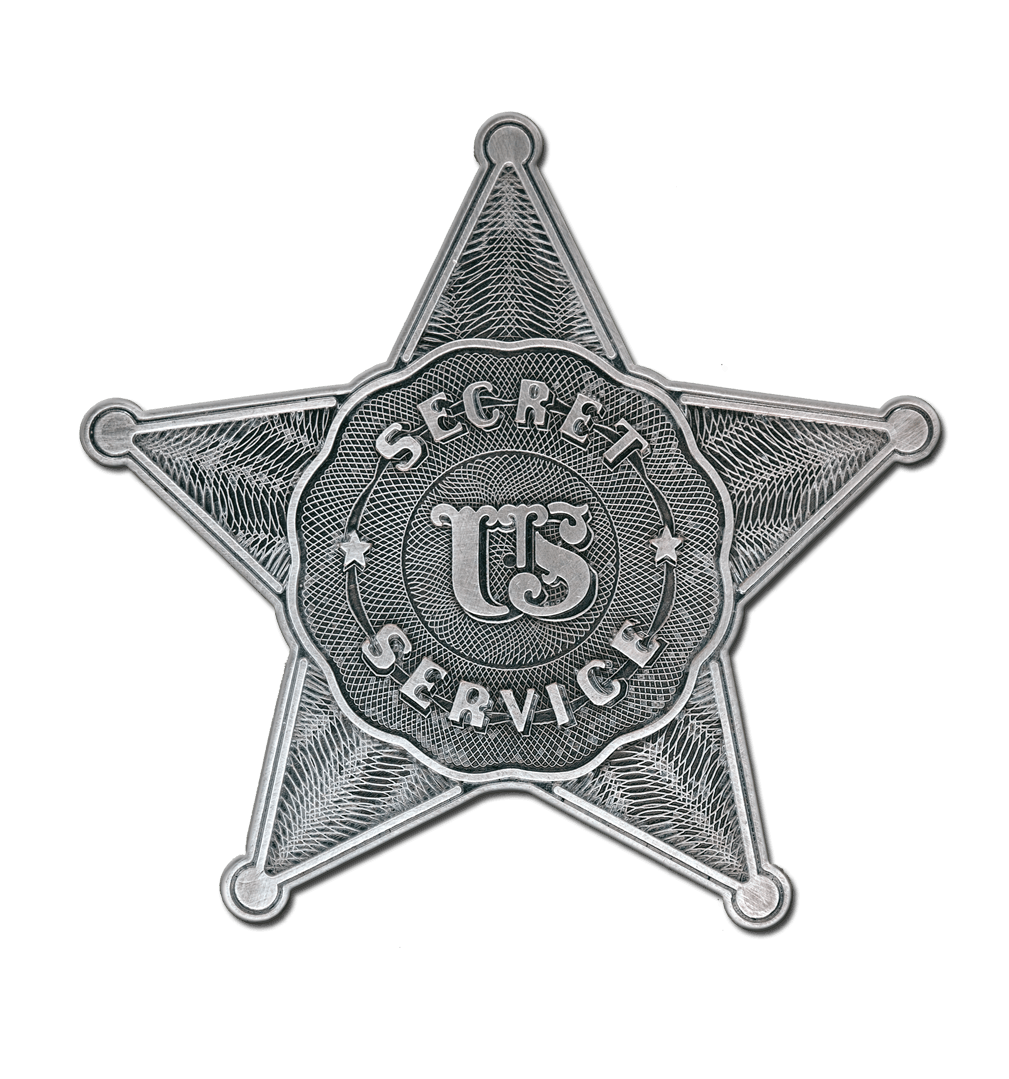
These badges were five-pointed, silver stars with lacework engraved into each point. “U.S. Secret Service” was stamped into the center of each. Operatives had $25 deducted from their paycheck for the badges, with the promise that it would be returned upon retirement when they turned in their badge. Each operative carried engraved and printed credentials called commissions from that point forward.
Unfortunately, the first two administrations of the Secret Service were fraught with scandal. As a result, a cloud hung over the division’s public image. Chief Washburn made some repairs to their reputation, but it was Chief James J. Brooks who really turned things around.
One of Chief Brooks’s first acts was to compile and issue the first formal manual of instructions for operatives. These were called “General Orders No. 4.” Under his reformation, the Secret Service was officially recognized as a division of the Treasury Department with its own budget, as limited as it was. Chief Brooks was a hard man and did not believe in vacations for his men. Any leave of absence was given without pay. But through his leadership, public opinion began to shift in a positive direction toward the Secret Service.
Check out the Hidden Hearts of the Gilded Age Series
Can these four Secret Service Operatives catch the counterfeiters … without losing their hearts?
A Gilded Age Secret Service historical romance series, with mystery and suspense
Resources
While I’m not going to list all the resources I used in research for this story, I will leave you with a few of my favorites in case you want to research further.
Books
Illegal Tender by David R Johnson* (My personal favorite. It gives you a look at counterfeiters AND the Secret Service.)
True Detective Stories by Andrew L. Drummond (Digital)
Digital Resources

ABOUT CRYSTAL CAUDILL
Crystal Caudill is the author of “dangerously good historical romance.” Her debut novel, Counterfeit Love, was a 2023 Carol Award finalist, and her novella, “Star of Wonder,” won the 2024 Christy Award for short form. She loves history, hot tea, all things bookish, and the Teenage Mutant Ninja Turtles. She is a stay-at-home mom, caregiver, and chaos organizer. When she isn’t writing, Crystal can be found hanging with her family and playing board games at her home outside Cincinnati, Ohio. Find out more at crystalcaudill.com.
Connect with the author:
Website | Newsletter | Facebook | Facebook Group | Instagram | Pinterest | Amazon | BookBub | GoodReads
A Question for You:
What was your favorite fact shared today?
by Crystal Caudill | Mar 11, 2022 | Counterfeit Love, History Facts
It’s release month for Counterfeit Love and I thought it might be fun to share some of my behind-the-scenes research of the Hidden Hearts of the Gilded Age series. I’ll also be running a giveaway all month long with each Counterfeit Love / Secret Service post for your chance to win one of three prizes. Read through this post to the bottom to discover the details.
What is the Gilded Age?
When most people think of the Gilded Age, they generally think of the lavishly rich, fancy ball gowns and dinners, and New York. However the Gilded Age is so much more complex than that, and that’s why I love to write during this era.
The Gilde Age is actually a term coined by the ever sarcastic and famous satirical writer, Mark Twain, in a book he
collaborated with Charles Dudley Warner on called The Gilded Age. The term Gilded Age was meant as a jab at the gross materialism and political corruption of his time. While everything was glittering, beautiful, and elegant on the surface, the moment one scratched at it, they’d discover gross corruption at the core. On a caricature level, the late 19th century was a period of massive immigration, socio-economic turmoil, rapacious Robber Barons, unscrupulous speculators, corporate buccaneers, shady business practices, scandal-plagued politics, and vulgar displays of materialism and wealth. This is one of the reasons why I love this era. It is so complex and intricate that I just never want to leave studying it.
While most people expect stories of the wealthy and elite when seeing “Gilded Age,” I love to take a look at it from the experiences of the varied classes and their experiences. There was a dark underbelly to the Gilded Age, and I love to explore it. However, I do like to see it from the perspective of the rich as well. It is like examing two very different worlds, and I find it incredibly fascinating.
A Period of Transition
During the 1870s, society as a whole was transitioning from largely agrarian to industrial–in part due to the repercussions of the Civil War and Reconstruction Era, and in part due to the massive innovations brought on by the Industrial Revolution. Many farmers and immigrants shifted to big cities to work in the factories that provided steady work and steady pay. The way businesses operated transformed and cooperations emerged with a focus on gaining the most profit possible at the cost of others. Labor unrest was a constant issue during the Gilded Age as corporations were treated as people rather than businesses, an especially terrible slap in the face to now freed slaves who were people but had only been considered property.
This was a period where Robber Barons emerged–people who because rich through often ruthless and unscrupulous business practices. Of course, not everyone who became rich met that definition, but this was largely the view of society outside the ranks of the upper-class society. These corporations had huge influences on politics, and often politicians were portrayed as merely being the puppets of those corporations. The period from 1870 to 1900 was marked by increased poverty, rising inequality, and bubbling discontent beneath the gilded filigree of society.
Big Picture Events and Issues
While the “Wild West” will live on in infamy, it was during this period that the western frontier actually began to close. The open ranges were closed in by barbed wire fences. Millions of acres of land were snatched up and populated. Native Americans were confined to reservations and then pushed farther west onto new reservations. Treaties were made to the disadvantage of the people and another Trial of Tears occurred. In fact, part of my family’s heritage cannot be traced back any further than this time because of how much was lost in this tragedy.
Technology and communication exploded during the Gilded Age. Telephones, electricity, machines, even the mass-circulation of newspapers and magazines, redefined aspects of the United States in unprecedented ways. With technology came more leisure time for new sports and entertainment to be developed. Transporation grew exponentially, opening up the country to easy travel and new migration patterns. Over these years, horse-led transportation diminished as trains, automobiles, electric trolleys, and others were developed.
Mass immigration poured millions of people into country giving rise to anti-immigrant reactions. Limitations on immigration from certain places started to appear, and the grouping of immigrants arriving shifted to larger numbers of Hungarian, Italian, Polish, and Russian peoples. Often these unskilled workers sought out cities where they could work at factories, often for horrifically low pay.
I talked a little bit about big business already, but this period is when the modern American economy emerged. Our economy became more globalized, dependent on products from around the world to supply the materials needed. Small businesses were consolidated and bought out. It was a dynamic time of wealth and poverty.
Politics too played a significant role during this time. The 1880s and 1890s especially were years of turbulence. Political conflicts were constant with corporations having an influencing hand in many areas. Farmers and laborers fought for fair representation and support against those corporations who they felt took advantage of them. You also have the beginnings of suffragist and civil rights movements.
Why I Write Gilded Age
As you can see, there is just SOOOO much conflict and depth that can be mined from this time period. I love looking at all the different perspectives and challenges that were faced by the people. So while you might think of all that glitters when you see the words Gilded Age, know that it is so much more than that, and I hope to bring some of those aspects and struggles to life in my stories.
A Second Gilded Age
Something I found interesting in my research is that the term Gilded Age has been applied to our current era by many different sources. There are parallels, but not completely. I just thought it fascinating, and if you’d like to read a succinct article on some of that, you can visit the History Channel’s article about it here.
Your chance to comment: What sort of things do you think of when you hear “Gilded Age” in relation to a fiction story?
Enter the Rafflecopter below to be entered to win one of three prizes: (Grand prize) – A signed copy of Counterfeit Love with a book sleeve made by my Momma, a toe bag with story-related prizes inside, (2nd prize) – A signed copy of Counterfeit Love with a book sleeve made by my Momma, socks, and a bookmark, (3rd prize) A signed copy of Counterfeit Love with a book sleeve made by my Momma and a bookish zipper bag. Entries run from March 1st to March 31st, 11:59pm EST. *Open to those legally able to enter, U.S. residents only for the physical prizes, international winners will be given a prize of equal value to whichever level they win.*

a Rafflecopter giveaway
by Crystal Caudill | Apr 1, 2020 | Counterfeit Love, Writer's Life
Welcome to the end of a crazy month (so crazy, I’m a day late on this post) with the prospect of one more left to go. It’s wild how much our world can change within a matter of weeks. I pray you are staying home, staying healthy, and if you are one of those essential workers getting out every day to serve the rest of us, THANK YOU SO MUCH. My prayers are with you no matter where you may be working.
I am back at editing my Secret Service story, so to shake things up a bit, I thought I’d share the inspiration for each of my Secret Service heroes.
Meet the Heroes of Counterfeit Love
Broderick Cosgrove
Broderick works as an undercover Secret Service operative during the early 1880s. He is focused, loves puzzles, and sees his service to country as primary in his life. He pursues justice and truth with care so that no innocent person comes to harm and all who are guilty face a punishment befitting their crime.
His goal in Counterfeit Love: Ferret out the leaders of an elusive counterfeiting gang before they can get the new counterfeit twenties into circulation and damage an already fragile economy.
The Challenge: His former fiancée has somehow become entangled with the gang. She is innocent, but how can he prove it and protect her while doing his job?
The real inspiration behind the character:
Andrew L. Drummond, Chief of the Secret Service between February 1891 and January 1894 – The initial inspiration for this story came from his book True Detective Stories. One of my favorite stories is where he was “arrested” and escaped jail with a counterfeiter in order to build the trust of an elusive gang. Where did his escapades lead him, but Cincinnati? The location of my story.
Andrew Darlington
While Andrew Darlington may not seem the hero type, he is a man trying to overcome a secret past which could cost him his job as a Secret Service operative. Therefore, he strikes every case with a vengeance. Collateral damage don’t matter so long as the criminal is brought to justice and put behind bars.
His Goal in Counterfeit Love: Prove Theresa Plane is the real mastermind behind the elusive counterfeiting ring. No one knows better than him how corrupted and devilish a woman’s soul can be.
The Challenge: Broderick Cosgrove has been swindled by the woman and now he must work around a fellow operative to bring the truth to light.
The real inspiration behind the character:
William P. Wood, Chief of the Secret Service from January 1863 to May 1869
Chief Wood earned a reputation for rash aggressiveness. In the book Illegal Tender, David R. Johnson described Chief Wood as “prowl[ing] the boundaries between legitimate and deviant society” and “lacking scruples and good judgment.” This was the basis for my backstory for Darlington. He is a complex character which you only scratch the surface of in Counterfeit Love.
Josiah Isaacs
Poor Josiah Isaacs is an accidental play boy. He can’t help it that women take his friendliness to be flirtation, and bless his soul, he’s incapable of purposely breaking a woman’s heart. He’s been cornered into a proposal multiple times, and uses cases which take him away from home to convince the women he’s not a good for them so they break it off. He’s smart, caring, and understands Broderick’s position, but duty to their job must have the final say in the case.
His goal in Counterfeit Love: Allow Broderick–his partner and friend–the support and space he needs to prove whether or not Theresa Plane is guilty, but stand firm in revealing the truth should evidence prove otherwise.
The Challenge: Withholding information from their superiors could cost their job, and when the evidence continues to point toward Theresa Plane’s guilt, his friendship with Broderick becomes strained.
The real inspiration for the character:
There isn’t one particular Secret Service operative who stuck out to me to inspire Isaacs. He is sort of a meshing of many operative stories and characters. For me, I wanted a character who would play off the others and be fun to develop, and what more fun can I have than with a man who doesn’t mean to flirt and keeps getting engaged even when he never wants to marry? The story I have planned for him will be so much fun!
by Crystal Caudill | Jun 16, 2016 | Counterfeit Love, History Facts

What is better than a wedding in a cemetery? How about a night in a cemetery jail?
A jail in a cemetery? Absolutely!
Last week, I described a chapel in the cemetery so beautiful, people are dying to get married there. (Terrible pun, I know, but I couldn’t resist!) This week dare to journey with me to a dark corner in this beautiful place.
In the basement of Norman Chapel is a jail cell. During the late 1800s, persons caught driving too fast through the cemetery were arrested and kept there overnight.
Yes, overnight.
I have found no stories of anyone’s experiences to share, but I can easily imagine how the night would go.
Can you imagine it?
The night watchman pushes you into a dark little room, maybe with a cot or maybe just a stone floor. Keys jingle against the iron bars as the lock clangs into place.
The one-eyed guard splits his scraggly beard with a black grin.
“Sleep tight. Don’t let the ghosts bite.”
His hearty laugh echoes off the walls as he leaves you to huddle alone in a corner.
Hours pass. The sun sets.
An eerie fog sinks through the barred window.
Howling wind prowls past the headstones. The screech of a night owl pierces your soul. The striking of midnight announces the witching hour.
Ghosts are not real. Mere superstition and bluff.

Then you hear it. Chains dragging, rattling. The strangled whispers of the undead clawing in their caskets, “Help me! I am still alive!” (For the Victorians were very afraid of this really happening.)
Terror claims you and you shrink into the darkest corner, hoping… no praying the ghosts will move on and not inhabit your body. (We are talking the age of superstition here…)
Whispers and moans. Death bells ringing frantically.
Bone chilling dampness creeping over you like the spiders seeking refuge on your coat.
The night marches on slowly. Eventually, the sounds ebb away.
Gritty eyes blur your vision when at last the night watchman comes, keys jangling. Slowly it turns and the barred door swings open on screaming hinges.
“Are ye possessed?” He walks toward you lifting a crucifix. When you do not cower from it, he grins that wretched smile. “Good, now be gone with ye, and dunna rush. A second night ye might not be so lucky…”
As you force yourself to walk a hasty retreat from your haunted prison he cackles, skittering shivers up your spine. Casting one glance back, he is gone, but the key remains in the barred door as it swings shut.

I do not know about you, but a night in a cemetery prison might make for some interesting stories. Unfortunately, they will have to remain in your head. If you speed through Spring Grove Cemetery now, other consequences await. That spooky jail is now just a storage room. What a pity.
by Crystal Caudill | Jun 9, 2016 | Counterfeit Love, History Facts

Image from SpringGrove.org
Have you ever been to a wedding in a cemetery? Well, that is a fairly normal occurrence at the Spring Grove Cemetery. Why? Because the Norman Chapel is a magnificent piece of architecture set in the picturesque beauty of a cemetery meant to look like a park.
Last Throwback Thursday I talked about the Spring Grove Cemetery where my main character’s grandfather is interned. This week I want to explore the gorgeous Norman Chapel.
The History & Design
The magnificent Romanesque-style chapel was designed by famous Cincinnatian architect, Samuel Hannaford, in 1879. The chapel itself was constructed in 1880 and the first service, a funeral, was held on February 7, 1881.
The Exterior
The exterior is made of rough-hewn limestone and has areas of intricately carved stonework. Beautiful archways and a covered drive are something to be admired. If you do a search of “Wedding Photos at Norman Chapel”, you will find several pictures where the arches are clearly seen. As of this moment, I have not made it back to the Spring Grove Cemetery for pictures, and I do not have permission to share the ones I have saved for research purposes.
The Interior
The interior of Norman Chapel is breath-taking.

Pictures and Collage created by SpringGrove.org.
The arches of the exterior are mirrored on the interior. Carved wooden beams support the chapel’s ceiling and marble graces the floor. The focal point is a magnificent stained glass window at the front of the sanctuary that depicts the Ascension of Christ, although at the time of my story the stained glass had not yet arrived from Europe.
Black Belgium marble floor paves the chapel floor and Bedford limestone is prominent in the vestibule. There are bronze doors on each side of the altar with bas-relief panels of Biblical scenes of the resurrection of Lazarus and of Jesus Christ, the Ascension, the revival of the widow’s son and Jabirus’ daughter, and the healing of the paralytic man.
The stained glass window shows not only the Ascension of Christ but also Jesus healing the paralytic man. The window is inscribed with Luke 51:24, “And it came to pass while He blessed them, He was parted from them and carried up into heaven.”
The chapel is in use today, although more for weddings than funerals now. Its beauty is lost to the dead, and often to the grieving as well. Norman Chapel is definitely one better suited for the rose colored lens of new love, eager to soak in every detail of the day.
So if you are looking for a unique venue you may want to consider the Norman Chapel. Just be aware, your guest list may be well over several thousand… but no worries, most of them are permanent residents.