by Crystal Caudill | Dec 12, 2023 | Reading Challenge
As we close out another year of the Unlocking the Past Reading Challenge, I’m looking forward to a new year with new challenges. After taking suggestions from my Facebook Group, I’ve settled on the theme:
Unlocking the Past: Ecclesiastes 3
Just as Ecclesiastes has two opposites in each verse, most months will leave you with two options to choose from.
“For everything there is a season,
a time for every activity under heaven.”
January Verse: A time to be born and a time to die.
Challenge Theme: A book with a Baby or End of Life character
February Verse: A time to plant and a time to harvest.
Challenge Theme: A book with a Rural Setting OR a Major Move/Life Change
March Verse: A time to kill and a time to heal.
Challenge Theme: A book with a serial killer or a character in the medical profession.
April Verse: A time to tear down and a time to build up.
Challenge Theme: A book with characters or plots related to construction, remodeling, demolition, or architecture.
May Verse: A time to cry and a time to laugh.
Challenge Theme: A RomCom or a book that makes you cry
June Verse: A time to grieve and a time to dance.
Challenge Theme: A book with a funeral or with a character who is a dancer.
July Verse: A time to embrace and a time to turn away.
Challenge Theme: Second Chance Romance or Family/Friend Reconciliation
August Verse: A time to search and a time to quit searching.
Challenge Theme: A mystery or a theme of someone searching for family
September Verse: A time to tear and a time to mend.
Challenge Theme: A Tailor/Seamstress character
October Verse: A time to be quiet and a time to speak.
Challenge Theme: A mute/deaf character or a character who advocates for others
November Verse: A time to love and a time to hate.
Challenge Theme: An enemies-to-lovers book
December Verse: A time for war and a time for peace.
Challenge Theme: A book set at the end of a war
Just as this year there was a monthly prize, there will continue to be a monthly prize with this reading challenge. You don’t have to participate every month to qualify. Participate in what months you can and skip the months where life gets in the way.
Now I need YOUR help. I want to create a page, as well as posts, with recommended reads for each month. So help me out and tell me what books you’d recommend. (Be sure to say which month 1, 2, 3, etc your recommendation goes with.)
Everyone who comments will be entered for a chance to win either a signed copy of one of my books (your choice) are a book off my prize shelf. (The winner will be randomly selected on December 19 and emailed.)

by Crystal Caudill | Sep 26, 2023 | Bonus Content, We Three Kings
In part 2 of my We Three Kings release blog posts, we will look at some of the German traditions that take place in our novellas–and I’ve linked to how you can do one of your own traditional German Christmas crafts.
German Christmas Traditions
Cara wanted to connect her story to her WWII novels, so it only made sense that the family line would be of German heritage. Not only did that give us some fun historical scenarios to work with, but it also gave us a rich and deep well of Christmas traditions to incorporate into our stories. Each of the below traditions can be found in some form in our novellas.
 Nikolaustag
All over the world, December 6 is known as St. Nikolaus Day and is a celebration of Saint Nikolaus, the Bishop of Myra and the patron saint of seafarers and children. Children leave shoes outside their door in order for Saint Nikolaus to deposit a sweet treat for their year of good behavior. However, in Germany, Saint Nikolaus is accompanied by a more sinister figure who carries a sack and switch. Children who were bad could be given a switch or taken away in the sack. This assistant has various names based on the region, the two most familiar being Krampus and Knecht Ruprecht. I chose to use Knecht Ruprecht, as he first appeared in a seventeenth-century Nuremberg Christmas procession, and Krampus appears to be used more often in the Alpine Region.
Weihnachtsmarkt—German Christmas Markets
These open-air markets are a German Christmas tradition that signal the beginning of the Advent season and date back to the Middle Ages. Traditionally, the stalls are made from timber, and everything sold must be locally produced and handmade. Twinkling lights, music, and the scent of traditional German foods mixed with the scent of a hot mulled wine called Glühwein set the atmosphere for this unique experience. If you ever get the chance to go, be sure to check out the hand-carved ornaments, Advent calendar wreaths, and my favorite, Quetschemännchen—the little figurines made from dried fruit and walnuts.
Epiphany
January 6 is the religious feast day known as Epiphany or das Dreikönigsfest (“three kings festival”) in Germany and some other locations. Epiphany commemorates the journey of the wise men who traveled to seek the Christ child. Often, the letters CMB can be found written in chalk on the doors to welcome and commemorate these men. According to German-way.com, “Traditionally, the three letters in the inscription stand for the names of the three Wise Men (Magi): Caspar, Melchior and Balthasar (German spelling). Another possible explanation is that “C+M+B” stands for the Latin phrase: Christus mansionem benedicat, which translates into “Christ bless this house.” The inscription is usually made with chalk that has been blessed by a local Catholic priest.” While there are variations in how it is done, in Cara’s story, three men travel from door to door, offering blessings to those at home. Often, the children would also dress up, and sometimes, a leader of the procession would carry a star. Small gifts are given to the children, just as the wise men gave their gifts to the Christ child.
 Martinstag
Martinstag, or St. Martin’s Day, is celebrated on November 11 with a lantern parade. Tradition says St. Martin was a soldier who had given away his last cent when he spied a man shivering in the cold. Out of compassion he took off his cloak and cut it in half with his sword to share. The whole town heard of his generosity and wanted to praise him. Embarrassed by the attention, St. Martin hid in a goose house, so the townsfolk had to use lanterns to search for him. Today, that search for him is mimicked through a lantern parade complete with song and, depending on where you are, candy.
Make Your Own German Paper Star

There is a reason why Celestia struggled to make her star . . . There are a LOT of steps. Depending on whether you are a video tutorial person or a printed instructions person, I’ve given you the link to two great options below:
About We Three Kings

Purchase Links
IN THIS CHRISTMAS COLLECTION, WEISE MEN STILL SEEK JESUS–AND LOVE
Best-selling romance authors Caudill, Putman, and Strong follow three generations of the Weise family in this third collection of Christmas novellas from Kregel that will prove just as popular as the previous award-winning volumes.
“Star of Wonder” by Crystal Caudill
The Christmas-themed maiden voyage of his family’s grand steamer ship was supposed to be Aldrich Weise’s chance both to instill investor confidence and to romance Celestia Isaacs. Instead, he must foil a criminal and leave his lady love behind forever.
“Beauty Bright” by Cara Putman
Lieutenant Charles Weise served as a Monuments Man after World War II and now works to restore stolen art to rightful owners. Captain Lillian Thorsen pairs up with him not only to return treasures but also to fix the war-torn lives around them.
“Perfect Light” by Angela Ruth Strong
Essential oils mogul Brendon Wise is drawn to Lacey Foster, the event planner for his huge Christmas lights festival. But when he inadvertently makes a spectacle of her on television, Lacey wants nothing to do with him. Will a chance to give gifts to those in need at Christmas be the key to discovering common ground–and maybe love?

by Crystal Caudill | Jun 6, 2023 | Counterfeit Faith, History Facts
Back to Bonus Content Back to Books
Initially, in my research for Counterfeit Faith, I began my studies looking at the history of orphanages intending for my story to be set there. However, during my research, I stumbled upon the concept of a House of Refuge. Having worked a summer during college at a camp for at-risk youth, my heart was immediately drawn to this setting and the stories of the children who were deemed juvenile delinquents. I had to know more, and you can read the results of that study in the story. However, like any historical novel, I couldn’t include everything I learned. So this is blog post is an attempt to give a brief overview of Houses of Refuge.
“To accomplish the work of reformation, it is essential that depraved children should be removed from the contaminating contact with wicked associates, both adult and juvenile, and transplanted to a purer and more health-inspiring moral atmosphere. Many of them have been roughly treated by the world, and should be looked upon ‘with a countenance more in sorrow than in anger.’ The light which guided them was not that of virtue, but the lurid glare springing from the polluted and deathly quagmires or society. If any man proud of his integrity and high social position should be tempted to look sternly on erring youth, he should reflect on what he might have been, if penury and ignorance had been the only endowments of his childhood.”
Thomas Budd upon the opening of the new White Female Department Building, January 20th, 1872
Why They Were Created
Prior to the early 1800s, convicted youths were confined to jails and penitentiaries with hardened criminals, regardless of the crimes or noncriminal behavior that placed them there. A child who had been picked up off the street for vagrancy may have been in the same cell as a man who had brutally murdered someone. Not only were they housed with adults, but the institutions were also overcrowded, many of them decrepit. It was a terrible situation that came under the notice of a social welfare movement.
Thomas Eddy and John Griscom organized the Society for the Prevention of Pauperism, establishing the first House of Refuge in 1825. It was located in Manhattan, New York, and remained open until 1935. Many other institutions throughout the country followed suit, creating their our state or privately ran Houses of Refuge. These institutes were designed to house poor, destitute, and vagrant youth who were deemed by authorities to be on the path toward delinquency. In other words, Houses of Refuge were the predecessors to today’s juvenile justice system.
How Did a House of Refuge Work?
There were some varying differences from institution to institution, but in general, youths under the age of 21 who had been abandoned, convicted of a crime, or homeless could be referred to the institution through a judge or mayor for at least one year. Many of those children actually spent an indefinite amount of time in these institutions before being placed into indenture agreements, where the inmates would work and train under the supervision of their employer until they reached the age of 21. If a child could not be indentured in cases of mental physical infirmity or otherwise, they could be returned to friends (as they believed the parents were generally a bad influence on the children), sent to the almshouse (poorhouse), or otherwise “placed out.” Girls were trained in housewifery, sewing, washing, and cooking. Anything that went along with managing a house or serving in a house that could afford paid help. Boys were apprenticed sed to apprentice as farmers, printers, tanners, carpenters, blacksmiths, and shoemakers.

Indentured Locations May 1834
However, before children could reach this position of indentured service, they had to earn the right of relative freedom granted through such an agreement. When children were brought into the institutions, they were divided up by sex and then advanced through the following classes. (*This was the class system of the Philadelphia House of Refuge, but each institution had its own variant.)

About Division of Inmates
“The children shall be divided into eleven classes, class No. 10 being the lowest–advancing to No. 1–and the eleventh being the Class of Honor. When admitted, they shall be placed in Class No. 10, and be promoted (when deserving) monthly, until they have gone through the first ten classes, when they shall be placed in the Class of Honor. After they have been two months in that class, they shall be placed in charge of the Indenturing Committee: Provided, that nothing in this rule shall prevent the Board of Managers from discharging a child when it is obviously to the advantage of the child that he or she should not be longer retained.” – By-laws, Rules, & Regulations of the Board of Managers of the House of Refuge: Adopted 1876 (Philadelphia, PA)
An Inmate’s Day
The children’s days were highly regimented with a focus on moral, intellectual, and physical improvement. Days began at 5 am and went until an 8 pm bedtime. The children would labor for six to seven hours, have schooling for three hours, have 30 minutes for each meal, 30 minutes of devotional time, and three hours of recreational time–all of which was strictly supervised. The concept was that idle hands are the devil’s workshop. The children’s labor supported the operating expenses for the reformatory. You can see the items produced in 1834 by the Philadelphia House of Refuge below, as well as a sample schedule.
-

-
Example Schedule from the By-Laws
-

-
Items Produced by Boys
-

-
Items Produced by Girls
What Could Possibly Go Wrong?
The goal of a House of Refuge was to reform, educate, and provide a Christian moral foundation for inmates so that they could become productive and desired members of society. Unfortunately, like many institutions, Houses of Refuges had the best intentions but suffered from the same issues that plagued the adult facilities. Houses of Refuge quickly outgrew their capacity and became overcrowded, suffered from deteriorating conditions, and staff abuse. In 1876, the Philadelphia House of Refuge underwent a nine-day investigation into abuse. Members of the Pennsylvania House of Representatives “found that the board punished children by banning play, sending them to bed without supper, placing them in solitary confinement, and even imposing lashings. The board forced children to labor in institutional workshops six days a week without pay and, to make matters worse, thousands of dollars in profits from the goods produced went directly to the board. Despite the prevalence of punishments, the House committee deemed that the board’s actions were not abusive.” (The Encylopedia of Greater Philadelphia, “House of Refuge” by James Kopaczewski.)
By WWII, most, if not all, Houses of Refuge had either closed or restructured and changed their names or taken on the new concept of juvenile jails. You can still find private and state-ran boarding school situations for at-risk youth all over the country. While they hold many similarities to the Houses of Refuge of old, it is my hope they do not suffer from the same issues that plagued their predecessor.
So what are your thoughts on Houses of Refuge, reader? What questions do you have?
RESOURCES: (A Small sampling)
Budd, T. A. (n.d.). An address delivered at the opening of the new building of the White Female Department of the House of Refuge, January 20th, 1872. HathiTrust. https://hdl.handle.net/2027/hvd.rslvjr (Address given on January 20th, 1872.)
Henry, A., & Barclay, J. J. (1835, May 1). Annual report of the House of Refuge of Philadelphia. 7th. HathiTrust. https://hdl.handle.net/2027/umn.31951002246474k
Juvenile Justice History. Center on Juvenile and Criminal Justice. (n.d.). https://www.cjcj.org/history-education/juvenile-justice-history
Kopaczewski, J. (2022, March 28). House of Refuge. Encyclopedia of Greater Philadelphia. https://philadelphiaencyclopedia.org/essays/house-of-refuge/
New York State Archives. (1989). The Greatest Reform School in the world: A guide to the records of the New York House of Refuge. The Greatest Reform School in the World. https://www.archives.nysed.gov/sites/archives/files/res_topics_ed_reform.pdf
Pickett, R. S. (1969).
House of Refuge: Origins of Juvenile Reform in New York State, 1815-1857. Syracuse University Press.
https://doi.org/10.2307/j.ctv64h7hd
Teerters, N. K. (n.d.). The Early Days of the Philadelphia House of Refuge. https://journals.psu.edu/phj/article/view/22729/22498
by Crystal Caudill | May 23, 2023 | Counterfeit Faith, History Facts
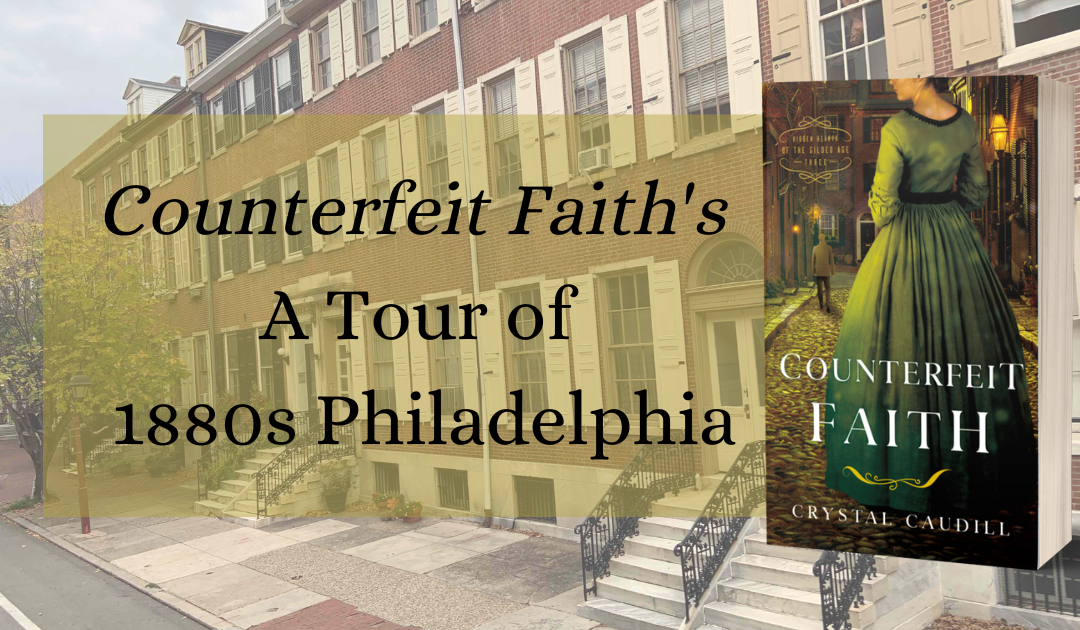
Counterfeit Truth and Counterfeit Faith take place in Philadelphia, and while so much of the city has stayed the same, much of it has changed. In this tour, I’m sharing pictures of settings from Counterfeit Faith during my whirlwind two-day tour of Philadelphia. First off, did you know that Philadelphia is only two miles from river to river? I couldn’t believe how much they had cram-packed into that little space, but WOW. So, in reality, the majority of my story took place within two square miles. That really just blows my mind. So let’s take off.

Of course, Carpenters Hall was under construction when I went.

The Philadelphia Library, where Josiah first laid eyes on Gwendolyn as he came down those stairs.
Carpenters Hall is where we must start our tour because, of course, that is where Gwendolyn first starts out waiting for Mr. Farwell. You might have caught on to my intentional pun with his name if you’ve read the book. Poor Mr. Farwell must say farewell during the story, and I just couldn’t help myself. Nothing about Independence Park is the same as when Counterfeit Faith took place. In 1885, Carpenter Hall sat in the center of a city block surrounded by other businesses and buildings. There were a couple of alleys to access it, but there was no direct view. If you notice the cobblestone part of the walkway, that was approximately the size of the entrance between buildings to access Carpenters Hall.
It was while leaving this building that Josiah first laid eyes on Gwendolyn. It’s a good thing he did too, and more importantly, he noticed Quincy’s knife blade. It was at this location that everything was set into motion for two people to come together to rescue at-risk children, find love, and face more than their share of danger. For a woman who is used to being ignored or having to rescue herself, Josiah’s heroic intervention sets her heart aflutter and stirs dreams of romance that she’d long thought dead. Personally, I was a little giddy getting to stand on these steps and imagine the heroic rescue as it occurred. Of course, some of the buildings have been moved, and things don’t look 100% the way they did, but it was close enough to really enjoy the experience.

Houses that look like Josiah’s would have.
While the gorgeous houses on Arch Street described in the book no longer exist, I did see some houses that are similar in style. They’re larger than some of the other homes I found, and they had those stoops, shutters, and arched doorways that I was looking for. It was the best match I could find, and my mind relished imagining Josiah and Gwendolyn conversing on those steps.
Josiah worked for the Secret Service, which had offices in the unfinished City Hall building. When Josiah was there, the tower would not have been finished yet, nor would the giant William Penn statue have been on display. He worked in the judicial wing, and his office was hidden behind numbers without signage. He would have taken one of the sets of floating stairs to get to his floor of the building. These were such an architectural phenomenon that Wanamakers, the department store across the street, sold pamphlets and tours to show off those stairs. As you can see below, no supports are beneath it, just solid pieces of granite worked into the wall. Originally I had Josiah nervous to walk on them, but after having walked them myself, I knew Josiah wouldn’t have had a problem. They are so beautiful and fascinating I had to include pictures of all three views of the stairs.
-

-
A small portion of the massive City Hall.
-

-
Office door similar to what Josiah’s would have been.
-

-
View straight on.
-

-
View from top down.
-

-
View from the bottom up.
 Going back to Wanamaker. I don’t know if you caught it in the story, but Wanamaker’s was the department store where Gwendolyn’s mother and aunt worked. It was one of the first of its kind, offering set prices, return policies, various departments, artwork as fine as you would find in a gallery, and service for all levels of customers. Wanamaker was a brilliant man who helped to change the way people shopped. No more dickering and haggling over prices. Everyone paid the same price for the same item. Wanamaker’s no longer exists, but the store is now a Macy’s. Believe it or not, Wanamaker made the bold move of buying a former train station to turn it into his department store. I’m not sure if this location was the original train station location, but it’s definitely taller than it would have been in 1885. Those other floors were added later.

 I’ll end my tour with a nod to Felicity from Counterfeit Truth. One of my big goals of this trip was to eat a Philadelphia pretzel . . . but apparently, they aren’t as big now as they were during Felicity’s time. The ONE pretzel I found was a sore disappointment that had to be rectified by going to my favorite pretzel place when I got home. However, the Reading Market (I think?) DID have some chocolate ice cream for me to sample from Bassetts that I must heartily agree is amazing. The whole time I ate that giant cone, I thought of Felicity eating ice cream with Mr. Cochran. If you haven’t read that book yet, you can download a free copy by joining my newsletter or purchasing it on Amazon.

by Crystal Caudill | Apr 11, 2023 | We Three Kings
I’m excited to reveal to you today the cover of We Three Kings: A Romance Christmas Novella Collection. You’ll find the blurb and fun cover process below, but I wanted to let you know that Baker Book House has it (and all my books) for 20% off right now, so it’s a great time to order/preorder books.
Creating a Cover
The process of creating a cover rarely involves me beyond the initial form I fill out to my publisher of critical information about the story that might work its way onto the cover. Generally, other than seeing the final product and saying I like it, that’s about as involved with the process as I get. However, with the We Three Kings Romance Christmas Collection, the experience was very different.
The Draft
Cara Putman and Angela Ruth Strong are my co-authors in this collection, and all three of us were sent the cover asking for input on how it might be tweaked. Really the only element from our story on the cover other than the snow indicating winter/Christmas was the ornament of the three kings. The ornament is one that my characters buy at the end of the story, and it reappears in various forms in the other two stories. You can see the original cover they sent us below:

It wasn’t a bad cover, we just were afraid it wasn’t compelling enough for readers to pick up. Especially when compared with the previous novella collections in the series: Joy to the World and O’ Little Town.


These covers were stunning, in my opinion, and I felt like our cover didn’t match the “feel” of these other two. After tossing some ideas around with Cara and Angela, I decided I wanted to play in Canva, an image creation program. I’m a pretty tactile person, and this was how I process anything that requires a visual image. After talking with a friend who is a cover designer, one of the things I realized that was missing was that “aisle” or framing feeling. The columns in Joy to the World draw your eyes to the house and up to the title. In O Little Town, you have the lamp posts creating that same sort of effect.
Playing Around
Using Cara and Angela’s suggestions, I brought in more trees to create the framing feeling. But in our conversation, we also brought up the fact that each of our stories has to do with some form of light. My story is “Star of Wonder,” Cara’s is “Beauty Bright,” and Angela’s is “Perfect Light.” And considering our stories connect to the three Weise (wise) men, the cover would probably benefit from having a star. I’m getting pretty savvy at using Canva with layering, and so after lots of playing with removing backgrounds and editing various features, this is the mock-up I came up with:

Making the layers match in coloring is something I’m still learning, and since this was just me playing around, I didn’t bother with even trying. I sent the mock-up to Angela and Cara but did not intend to send it to Kregel. I responded with some verbal tweaking ideas that we’d discussed, but I didn’t mention I’d created a mock-up or anything. Design is not something I have a lot of confidence in, and besides, it was more or less just playing for my own sake so I could communicate some suggestions without overstepping.
However, Angela added my mock-up to her email when she sent in her recommendations. I am so thankful for her boldness in doing that. It gave a much-needed encouragement boost, and Kregel’s response was equally encouraging. And I think you might understand why when you look at the two options they sent to us afterward:
Option 1:
While that was better than the first one, we unanimously agreed that the second option was the favorite. And now, I get to reveal the FINAL cover of We Three Kings: A Romance Christmas Collection.
Cover Reveal – the FINAL Cover
Didn’t they do a phenomenal job? AND LOOK!!! They took my playing-around mock-up and turned it into something beautiful!!!! I’ve always loved my covers from Kregel, but this one will always have a special place in my heart (and on my Christmas tree). God is so good to bless me with that sort of encouragement, and I am so grateful that He used Angela to place it into Kregel’s hands. Now we just have to wait for it to release in September. Want to know more about each of our stories? Here is the blurb and preorder links!
We Three Kings: A Romance Christmas Collection
In this Christmas collection, Weise men still seek Jesus–and love
Best-selling romance authors Caudill, Putman, and Strong follow three generations of the Weise family in this third collection of Christmas novellas from Kregel that will prove just as popular as the previous award-winning volumes.
“Star of Wonder” by Crystal Caudill
The Christmas-themed maiden voyage of his family’s grand steamer ship was supposed to be Aldrich Weise’s chance both to instill investor confidence and to romance Celestia Isaacs. Instead, he must foil a criminal and leave his lady love behind forever.
“Beauty Bright” by Cara Putman
Lieutenant Charles Weise served as a Monuments Man after World War II and now works to restore stolen art to rightful owners. Captain Lillian Thorsen pairs up with him not only to return treasures but also to fix the war-torn lives around them.
“Perfect Light” by Angela Ruth Strong
Essential oils mogul Brendon Wise is drawn to Lacey Foster, the event planner for his huge Christmas lights festival. But when he inadvertently makes a spectacle of her on television, Lacey wants nothing to do with him. Will a chance to give gifts to those in need at Christmas be the key to discovering common ground–and maybe love?
Preorder Links: Amazon | Baker Book House | Barnes and Noble | Books-A-Million
What do you think of the cover and the process?