by Crystal Caudill | Jan 18, 2017 | Writing Craft
*This is an expanded edition of my guest blog post to Southern Writer’s Magazine on December 14, 2016.
Crafting the Perfect Chapter – It’s Elementary, My Dears

Before becoming a stay-at-home-mom, I taught fifth-grade students to analyze writing. I hadn’t given much thought to applying what I taught to my own writing until I substitute taught a fifth-grade reading class. That day, I discovered a crucial concept for every fiction writer.
Students all over the country are forced summarize every chapter they read by looking for these key things: Somebody… wants… but… so… then…
We, as writers, need to zero in on every chapter we write to make sure we can answer: Somebody… wants…. but…. so… then…
How do we do this? It’s elementary, my dears.

To illustrate this concept, I will use chapter eight of George Washington’s Socks. I will assume most my readers have not had the enjoyment of reading this children’s novel, so I will just give a very brief introduction to the story.
George Washington’s Socks
A mysterious rowboat transports five adventurous kids back in time to the eve of the Battle at Trenton where they experience the American Revolution. Through encounters with Hessian soldiers, revolutionaries, and even George Washington himself, Matthew, Quentin, Hooter, Tony, and Katie watch history unfold before their eyes as they see first-hand, the grim realities of war and the cost of freedom.
– Amazon.com Blurb
Somebody… wants… but… so… then…
Let’s break it down:

Somebody…
Who is the central focus of this chapter? This can be one or two characters if you are splitting your story between points of view, but even if there are multiple points of view, a chapter is generally about one person. Who would students identify as the main character for your chapter?
In George Washington’s Socks there are five focus characters, however, chapter eight focuses solely on the perspective of Matt.
Wants…
This is the goal of the main character for this chapter only. What is it that the character wants to accomplish in this small timeframe? More often than not it is a small goal that builds into something bigger.
For Matt, his initial goal in the chapter was to return General Washington’s cape.
But…
No story is engaging without conflict, and neither is a chapter. What obstacle does the character face? It can be internal or external in nature, but it needs to be plausible and, if at all possible, unforeseen.
Matt’s challenge comes in the form of a captain who believes Matt is a rebel soldier.

So…
This is the reaction to the conflict. What does the character do? What does he/she think? Do they change their goal? What about the supporting characters? How do they respond to the conflict, and how does their response affect the main character?
Matt changes his goal. He goes from wanting to return General Washington’s cape to retreating to the safety of the boat.

Then…
This is where a consequence occurs or an additional problem is added to the plot. There could be a hint to the subplot, or a difficult obstacle the character must face, or it could leave the reader with a cliffhanger. Whichever course you choose, the “then” is used as a hook for the next chapter.
Matt’s chapter doesn’t end with him being forced into battle. His “then” is the fatal injury of the only man who can get Matt home.
Combine all the elements and you get:
Matt wanted to return General Washington’s cape but a Captain thought he was a rebel soldier trying to desert, so Matt tries to return to the boat. Then, as Matt is being forced into battle, the only man who can get Matt and his friends home suffers a fatal injury.

Somebody… wants… but… so… then… is a quick, easy summary that drives to the heart of a chapter. Do each of your chapters contain these elements? Could you summarize them in this way?
Even scarier…. could a fifth-grader?
I challenge you to share one of your chapters in this way, and just so I am being fair, here’s my example from chapter one.
Kessara wants to pay off her grandfather’s debt, but she doesn’t want him to find out she had to save the family name again, so she goes to the cemetery at midnight to retrieve her secret stash of money. Then as she is returning to the carriage she stumbles upon a clandestine meeting between two criminals who spot her.
What do you think? How would you break down one of your chapters?
by Crystal Caudill | Nov 2, 2016 | Book Reviews, Writing Craft
Have you struggled with flat characters? Difficult to plot stories? A lack of knowledge on how to correct these issues?
Oh my! I must admit I fall very solidly in this category. After the ACFW Conference, I realized just how much of a beginner I am. It feels like I have scrapped my story for the umpteenth time, but this time I have a solid plan.
One of the many benefits of attending the conference was connecting with Susan May Warren, a wonderful author and teacher. She has created this wonderful online community that is lesson based. It does require a membership, but the investment has been definitely worth the cost so far.
Due to the fact I do pay a membership, I have been hesitant to share what I have learned. I would not wish to break any copyright laws nor infringe on what Susie has spent so much time creating.
But lucky for you, one of the most helpful sets of lessons has recently been transcribed into a book that, even with access to the courses, I have added to my library of resources.

The Story Equation: How to Plot & Write a Brilliant Story From One Powerful Question by Susan May Warren
Susie’s wonderful method is based on developing your POV characters from the inside out. I will not steal her thunder, for the information is not mine to share, but I will say this has become my new favorite method to work my story.
It is organic and naturally encourages great depth. The plot, theme, and premise developed around my characters with surprising results. My story already feels stronger with the use of the Story Equation (SEQ).
I will not lie. As a beginner, I have spent many hours doing the courses, redoing them, and reading the book over and over again, working my characters as I did so. My characters are finally (mostly) solid and I am working on developing my major plot points.
The Kindle Edition of the book costs only $6.99. Let me tell you, this is an AMAZING price for an invaluable book. It is a quick and easy read, and easy to apply. If you can afford a monthly membership to her community, The Novel Academy, I would HIGHLY recommend that as well.
Below is the book blurb from Amazon. If you have any questions or experiences with the SEQ or Novel Academy, please comment below. I am so excited to share this resource with you!
“Discover The Story Equation!
One question can unlock your entire story! Are you struggling to build a riveting plot? Layered characters? How about fortify that saggy middle? Create that powerful ending?
You can build an entire book by asking one powerful question, and then plugging it into an “equation” that makes your plot and characters come to life. You’ll learn how to build the external and internal journey of your characters, create a theme, build story and scene tension, create the character change journey and even pitch and market your story. All with one amazing question.
Learn:
- The amazing trick to creating unforgettable, compelling characters that epic movies use!
- How to create riveting tension to keep the story driving from chapter to chapter
- The easy solution to plotting the middle of your novel
- The one element every story needs to keep a reader up all night
- How to craft an ending that makes your reader say to their friends, “Oh, you have to read this book!”
Using the powerful technique that has created over fifty RITA, Christy and Carol award-winning, best-selling novels, Susan May Warren will show novelists how to utilize The Story Equation to create the best story they’ve ever written.”
– Blurb from Amazon
by Crystal Caudill | Aug 17, 2016 | Writing Craft
In my search for the perfect story structure and plotting, I have read many books and continue to do so. However, so far, Michael Hauge’s 6 Stage Story Structure has been my favorite. I love his linear, clear-cut structure.
Mr. Hauge’s structure is centered around script writing and is very formulaic. Although the percentages are more a reference to script writing, they can be loosely used for novel writing.
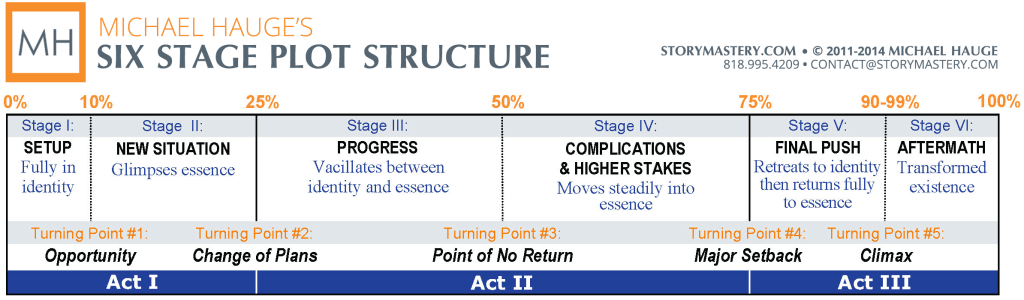
Stage 1 – Setup or “Everyday Life” (0%-10%)
Outer Journey
- Introduce your hero in their everyday world
- Create identification with 2 or more of the following:
- sympathy
- put them in jeopardy
- make them likable
- make the hero funny
- make them powerful
Inner Journey
- The hero exists completely in their identity.
- Their identity may be centered on what they do, their religion, or how they want others to see them.
- Their identity is what protects their core essence. (People pleaser vs “I am fine the way I am.”)
Turning Point 1 – Presented with an Opportunity (10% marker)
Outer Journey
- Creates in the hero a desire to move into a new situation, something new
- This is not the desire for the true endpoint.
Inner Journey
- Hero gets a glimpse of what it would be like to live in their essence
- They refuse the call to change
Stage 2 – New Situation (10% – 25%)
Outer Journey
- The adjustment
- What are the new rules?
- How can I get along?
- Usually, hero believes it will be easy.
Inner Journey
- Hero gets a glimpse of what it would be like to live in their essence.
- Reject living in their essence.
Turning Point 2 – Change of Plans (25% marker)
Outer Journey
- The visible end goal is established.
- The character realizes, “No, I have to do this.”
Inner Journey
- A foot in who their initial identity is and a foot in who they really are – their essence.
- They struggle back and forth with who they are and what they were.
Stage 3 – Progress (25% – 50%)
Outer Journey
- The plan seems to be working.
- There must be conflict, but the obstacles are avoided, overcome, delayed, or by-passed.
Inner Journey
- They are still straddling the fence of their essence and identity.
Turning Point 3 – The Point of No Return (50%)
Outer Journey
- When the hero is closer to the goal than the start,
 and they have become so committed they burn their bridges, making it impossible to turn back.
- The hero’s life as he knew it is over.
Inner Journey
- Their identity is stripped away.
- They realize their essence and begin pursuing it.
Stage 4 – Complications and Higher Stakes (50% – 75%)
Outer Journey
- It is more difficult to accomplish the goal, but also more important to accomplish.
- They have more to lose.
Inner Journey
- They continue pursuing who they really are.
Turning Point 4 – The Major Setback (75%)
Outer Journey
- The reader has the sense that all is lost.
- The plan they had is out the window but they can’t turn back.
- They must make one last push or die while trying.
Inner journey
- The hero has fully committed to living in their essence but now the outside world starts coming in and frightening them.
- The hero retreats back into their identity. They run away from who they are.
Stage 5 -The Last Push (75% to ?)
Outer Journey
- Do it or die while trying.
- Everything is put on the line.
Inner Journey
- They realize they don’t like who they were anymore. They have had a taste of who they truly are and they have to go after it.
- They have to find their destiny, even if it means risking everything to get what they want.
Turning Point 5 – Climax (% Depends)
Outer Journey
- All the problems are resolved.
- The hero can fail, succeed, or change their mind.
- The length of the climax depends on how many problems you have to resolve.
Inner Journey
- The moment they fully realize who they are.
Stage 6 – The Aftermath
Outer Journey
- Responding the climax emotionally.
- The wedding, reconciliation, etc.
Inner Journey
- The hero is going to live their new life as they truly are.
Interested in examples and learning more about either Mr. Hauge’s structure or the hero’s journey? I highly recommend buying the audible recording of his and Chris Vogular’s presentations. It is worth every penny. I have listened to it half a dozen times already and plan on listening again as I drive to Nashville for the ACFW Conference next week.
Michael Hauge’s website also does a great job showing examples.
Tell me what you think about this plotting format? Does it make sense to you? Are there any movies or books you can identify with this plot structure?
by Crystal Caudill | Aug 3, 2016 | Writing Craft
I am a woman. I think like a woman. I write like a woman. But what if I want to write like a man? If men are so straightforward and simple, shouldn’t it be easy to write in their point of view? Apparently not.
After my first failed attempt, I dove into researching how to write in the male POV. For the last couple weeks, I have shared what I learned about how men talk and how men think. Today we are wrapping up our study of writing in the male POV with a look at male behavior.
Without further ado…

Male Behavior
- Use strong verbs to describe their movement. Guys generally don’t wander and linger. They know where they’re going and they don’t mess around when they get there.
- When guys hang out together, there is usually an activity involved, whereas women can just get together and chat for the sake of chatting.
- The male ego can drive a guy to do things that are slightly crazy or a lot crazy.
“Almost all guys are defensive all the time. Lots of crossed arms, lots of small head-nods in agreement. Friendly guys will go for the back-slap or hair-ruffle (though ruffling is a bit demeaning, it’s the older-brother-little-brother gesture). With girls, it’s far more awkward. Maybe some casual, testing-the-water touches. Otherwise, guys are typically quite self-conscious around girls.”
– InkandQuills.com
Men…
- Are action-oriented. They do instead of think about it.
- Are rarely prepared to wait for any great length of time.
- Like being in charge (or at least like thinking they’re in charge!)
- Have better detection of light and have better depth perception.
- Are really great at faking being strong and tough. They present a confident front.
- Listen and give advice on how to solve a problem.
- Rarely admit being wrong.
- Rarely respond to direct commands unless it’s issued by a boss or other ranking figure.
- Rarely cry.
- Rarely have intimate friends. They tend to have a larger circle of ‘casual mates’
- Look for a physical way to end conflict–the quickest, most direct method you can imagine. Imagine physical contact or using anything blunt, heavy, or sharp
If the murderer were right there, then the Manly Guy will not stop to feel sad, he’ll go into Revenge Mode immediately, and nothing will stop him. But if the murderer is far away (the normal case) then the Manly Guy will go through the normal feelings of loss. Then he will map out a plan of action that will take him to the murderer and he will execute vengeance in a Manly Guy way, which will probably involve high explosives or machine guns or hot pokers placed in inconvenient places.
– AdvancedFictionWriting.com
Girl/Guy Interaction – According to a Man
Guys always notice girls. In the same way that guysalways notice every threatening-looking guy in a room, or the same way they notice if there’s a television.
The second look–the double-take–that’s the big one. The first look doesn’t count, that’s instinctual. The second look means we’re interested, or at least, willing to double-check.
As a guy, the general rule of thumb is, “Unless you knowotherwise, she’s taken.” To that extent, guys can look at girls, imagine what it might be like with her in a relationship, but then tell themselves a dozen reasons that wouldn’t work.
– InkandQuills.com
What do you think? Are there things that need to be removed? Need to be added? Comment below and let me know.
Previous posts about Male POV:
Writing Craft Wednesday: Writing in the Male POV – Part 1
Writing Craft Wednesday:Writing in the Male POV – Part 2
Interested in learning more? Check out my favorite articles from my time of research below.
Advanced Fiction Writing – Wrapping Up Those Manly Guy Characters
Advanced Fiction Writing – On Writing Convincing Male Characters
Keri Arthur – Male POV
Ink and Quills – How to Write from a Guys POV
Hopefully with the tools in hand that I have discovered, you will be reading about my believable swoon-worthy hero soon.
by Crystal Caudill | Jul 27, 2016 | Writing Craft
 Fitzwilliam Darcy
Thor
Two great swoon-worthy heroes, and who doesn’t love a swoon-worthy hero? As a writer, I strive to make my heroes the type that makes you swoon despite their flaws.
After learning the devastating truth, that my hero was a girly-man, I sought out to learn how to better craft the male POV in my writing. This sent me on a hunt through dozens of articles written by men, women, published authors, and editors to discover what makes a realistic male POV.
Last week I shared what I learned about male dialogue and conversations. Today I am wrapping up with bulleted lists on what I discovered about the male’s inner world.

The Inner Male
- Short snippets of inner monologue are best. One or two sentences is a good target.
- A man always thinks of himself in positive terms, even when he botches things terribly. He will phrase his defeat in terms that make it clear that he was put in an impossible situation or that he was off his game. (Of course, you can still have characters who struggle with self-image, but even then they can still have times of thinking like this.)
- A man would never describe himself as helpless. EVER. He may be down for a time while he waits for the next opportune moment, but he is not helpless.
- When a man sets his mind on a target, everything else vanishes from thought until the mission is accomplished.
- Men aren’t going to agonize over whether or not they should kiss the woman, they do it, then deal with the consequences afterward. Teenage guys might naturally agonize, though.
- Men are very visual. The way a woman dresses creates visual images a man’s brain that can linger for days, months, or even years.
- For every problem, there is a solution, but the consequences don’t matter as much as simply solving the issue to begin with. They may just try the direct, brute-force way first.
- Emotion, except for anger, is usually kept under wraps or repressed altogether.
- They think about responsibilities, deadlines, family, life, and sometimes there is literally nothing. (Is that seriously possible? I can’t even wrap my head around thinking nothing.)
- Most guys like to imagine they don’t have feelings. They use the ‘push it deep down’ approach 90% of the time and the remaining 10% of the time, it is bottled up until it eventually bursts.
- If you push a guy, he’ll get angry; if you break a guy, he’ll cry.
- Guys understand a woman’s emotions; they just don’t know what to do about it.
- Most guys only know eleven colors: red, blue, yellow, green, orange, purple, black, brown, gray, white, and pink.
- Guys do NOT always think about sex. If they do, they are not the type of guy you want being your hero. Real men can and do think about other things.
What do you think? Are there any things that could be added to this list? Any things which should be removed? Leave your comments below and come back next week for my final installment with Male Behavior.
by Crystal Caudill | Jul 20, 2016 | Writing Craft

“So God created man in His own image;
He created him in the image of God;
He created them male and female.”
– Genesis 1:27
And boy did he create the differently. Ever heard of the boo k Men are from Mars, Women are from Venus? I personally have never read the book, but I can relate to the feeling that men seem to be from a different planet. (And I am sure there are probably at least a few men who feel the same about women.)
One of my favorite things about reading and writing romantic fiction is the perspective of the story from both sexes. Reading it is easy. Writing it? Not so much.
In fact, in my first draft of my work in progress, my critique partners gently revealed to me that my hero was a whiny, wimpy, girly-man (my words, not theirs). I may be married to a man, but I certainly couldn’t write or think like a man. Boy, was I thankful to discover that early into my writing!
So I set my manuscript aside and decided to dive into the world of male point of view. I looked at suggested articles and sought more out on my own. What I discovered, from both the male and female writers of these articles, was a pattern.

Men are pretty straightforward creatures with specific tendencies in their speech, inner thoughts, and behavior.
Over the next couple weeks, I will give a bulleted list of what I have learned. Keep in mind that these bullets are just patterns that I found. There are always exceptions.
Male Dialogue
- They rarely end sentences with questions or say things like “I’m not sure.”
- They do not use expressive adjectives (wonderful, gorgeous, etc. unless being sarcastic). Usually, “it’s okay” or “it looks good” are about what you get.
- They are rarely heard saying “May I? Could I? Should I?”
- They rarely use words like darling, honey, or sweetheart except during times of intimacy or moment of extreme stress.
- Make dialogue to the point.
Male Conversation
- Conversations are a means to relay information not build relationships.
- Conversations are typically on a non-important topic until everything dies away
- Guy conversations generally involve the least amount of words possible.
- Generally, guys only have two or three things in common with other – sports, work, music, games, food. Gossip is off the table.
- If two guys disagree on something, expect some flaring tensions and arguments.
- Talking with girls varies. Some are very shy, some of full of confidence and swagger. Some try to be amicable and get a laugh out of you whether you’re guy or a girl.
- If men are embarrassed they usually try to laugh it off.
- If men are hurt they get quiet and try not to get mad.
Men…
- Prefer direct action to talk.
- Are problem solvers. They rarely listen without giving advice.
- Rarely ask for advice.
- Rarely admit to being wrong and their apologies tend to be gruff and unpolished.
- Rarely respond to a direct command unless they are outranked.
- Say what they think. They don’t use euphemisms.
- Use very black-and-white talk – it is what it is; a spade is a spade.
- Don’t do small talk.
- Rarely punctuate speakers with agreeing noises.
- Mostly repress emotions except anger.
- Are a lot less likely to share their feelings. Feelings are private, which are none of your business.
What do you think? Is anything off base? Is there anything you would add? Share it in the comments below and then come back next week when I tackle male thought patterns and behaviors.